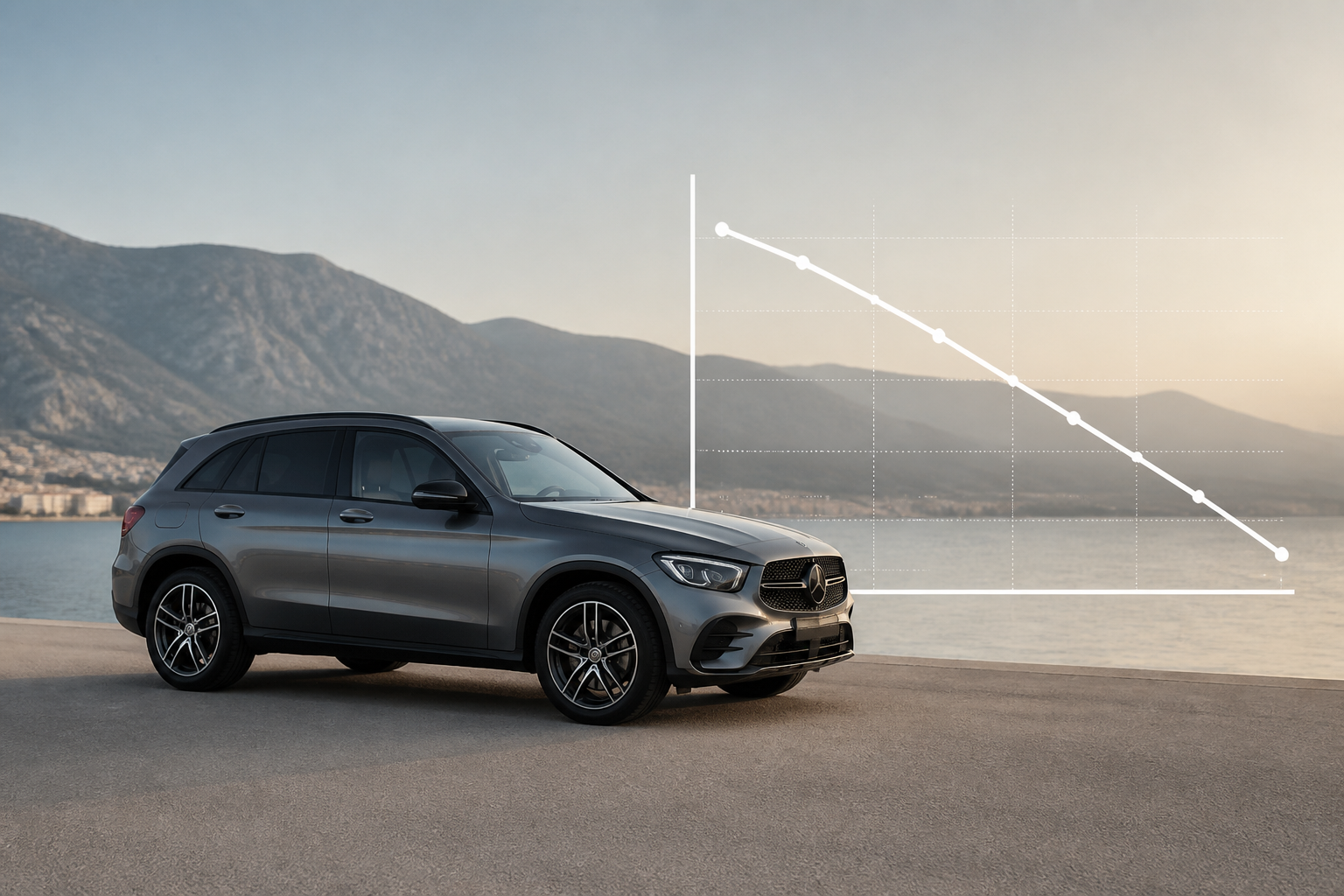
For five-year ownership, depreciation dominates cost for the GLC, especially when buying new. A two-year-old GLC can lower depreciation substantially while still offering modern features, but total cost of ownership must include insurance, maintenance, fuel, and finance charges. Build a year-by-year model using credible depreciation data and compare against viable alternatives to decide which option minimizes five-year cost.
Five-year cost takeaways
- Depreciation is the largest component of five-year ownership cost for the GLC, particularly in the first two years.
- A two-year-old GLC often reduces depreciation exposure enough to justify the sticker-price savings, depending on financing and insurance charges.
- Model the full five-year cost (depreciation, insurance, maintenance, fuel, finance) with consistent mileage assumptions to select between new, used, and rival vehicles.
Depreciation is the loudest voice in the five-year ownership chorus for a compact luxury SUV like the Mercedes‑Benz GLC, but the total cost of ownership over five years is a symphony of several moving parts. The decision to buy new versus a one- or two-year‑old GLC—and whether to consider credible non‑Mercedes rivals—depends on a transparent, model‑specific calculation that couples depreciation with insurance, maintenance, fuel, and finance charges. This piece expands the framework with practical guidance, plausible calculations you can adapt to your situation, and cautions about model‑year and configuration caveats that affect the numbers you’ll rely on when making a purchase decision.
Direct answer: five-year cost differences you should model
In a typical five-year horizon, depreciation remains the dominant cost driver for the GLC, especially when purchased new. A two-year‑old GLC usually carries significantly less depreciation risk moving forward, creating a meaningful gap in five‑year total cost compared with a brand-new model. However, true ownership costs are not identical year by year; front‑loaded costs (higher upfront price, potentially higher initial insurance) can be offset by lower depreciation for the used example. A credible five-year model compares like with like: expense streams for depreciation, insurance, maintenance, fuel, and financing, aligned to the same ownership period, mileage assumption, and financing terms.
Why depreciation matters most in the five-year window
Depreciation represents the loss of market value over time. For luxury compact SUVs such as the GLC, the steepest drop typically occurs in the first 24–36 months as the market rebalances after initial delivery periods and the novelty of a fresh model cycle fades. Because depreciation is a cash flow proxy for lost value rather than a direct outlay, it exerts a strong influence on five‑year total cost. When you contrast a two‑year‑old GLC with a new GLC, the used example often carries a lower initial price and a lower additional depreciation burden in year three through year five, assuming the used vehicle remains within expected mileage and condition ranges.
But depreciation is only part of the equation. Residual values, which underpin resale prospects, depend on spec alignment (trim level, options like all‑wheel drive or advanced driver aids), model year refinements, and market demand. The same GLC in a different trim or with different options can exhibit a notably different depreciation curve, so tailor your inputs to the exact vehicle you’re comparing.
Key cost components beyond depreciation
- Insurance: Premiums often fall for used vehicles, but the magnitude depends on driver age, location, coverage levels, and whether the vehicle is financed or leased. Some lenders require gap insurance on new loans, adding to the cost of ownership.
- Maintenance and repair: A new GLC generally benefits from a comprehensive warranty and maintenance plan during the initial years. After the warranty expires, maintenance and repair costs can rise, particularly for wear items and potential out-of-warranty repairs. Certified pre-owned programs may help bridge some of these gaps but vary by market and vehicle history.
- Fuel: Fuel economy depends on engine choice, drivetrain (rear vs. 4MATIC all‑wheel drive), and driving style. Real-world efficiency can diverge from EPA estimates, especially with urban vs. highway mix and seasonal factors.
- Finance charges: Interest rates, loan terms, and down payment affect the total amount paid over five years. New cars typically carry higher sticker prices, which can push total interest costs higher even if the rate is competitive. Leasing introduces a different cost structure but can change depreciation exposure and mileage penalties.
Comparative framework: GLC versus viable alternatives
To judge whether the GLC remains a prudent five‑year purchase, build parallel five‑year cost models against credible rivals in the same class. Use consistent assumptions for annual mileage (e.g., 12,000–15,000 miles), financing terms, insurance pricing, and maintenance cadence. Subtleties such as tire costs, brake service intervals, and the reliability profile of rivals will influence the relative five‑year total cost. The aim is an apples-to-apples comparison that reveals which option delivers the lowest five‑year cost given your personal usage and financing approach.
Practical scenarios and decision criteria
Consider these decision prompts to translate numbers into action:
- New vs. CPO GLC: A two-year‑old GLC typically trades off a portion of depreciation versus higher upfront price of new; the choice hinges on how you value certainty of warranty and the risk of additional maintenance costs as the vehicle ages.
- Engine and drivetrain choice: All‑wheel drive generally adds purchase price and potential maintenance costs but improves resale appeal in certain markets. Weigh that against your climate and typical driving conditions to estimate incremental depreciation impact.
- Equipment and trim levels: Higher trims with advanced safety tech and comfort features can either bolster resale value or conversely reduce demand if similar options become standard in newer models. The exact spec mix matters for depreciation curves.
- Financing strategy: A longer loan term can reduce monthly payments but increase total interest; a higher down payment lowers financed amount and can improve resale value alignment by reducing negative equity risk at trade‑in time.
Model-dependent caveats and data considerations
Depreciation projections rely on brand- and model-specific histories, market conditions, and regional demand. For the GLC, numbers can shift with updates to the powertrain, infotainment architecture, or safety package, as well as macro factors such as fuel prices and lease incentives. When you assemble your five‑year cost model, use the closest pricing data to your locale and model year. Incorporate realistic maintenance intervals and part costs you are likely to encounter, not just theoretical warranty coverage.
Scenario examples: translating theory into tangible choices
Example 1: You finance a new GLC with a 60-month loan, 20% down, and 4.5% APR. Compare to a two-year‑old GLC with similar mileage and a one-year remaining factory warranty. You would document the five-year total outlay including depreciation, interest, and insurance differential, plus any maintenance variance due to extended warranty on the new model vs. potential out-of-pocket repairs on the used one.
Example 2: You compare a new GLC against a competitive non‑Mercedes compact luxury SUV. Ensure inputs for fuel economy, maintenance cadence, and typical repair costs are aligned so depreciation becomes the differentiator rather than data misalignment. The conclusion should reflect which option delivers the lowest five‑year cost under your driving pattern and financial plan.
How to build your own five-year cost model
Step-by-step approach you can adopt now:
- Define the ownership horizon (five years) and annual mileage (e.g., 12,000 miles per year).
- Choose your vehicle scenario: new GLC, two-year-old GLC, or a specific rival.
- Estimate depreciation: use expected resale value at year five for each scenario and subtract from purchase price.
- Estimate insurance: obtain quotes for drivers, locations, and vehicle ages; adjust for financed vs. paid‑in‑full ownership.
- Estimate maintenance/repair: include warranty coverage impact for new, and likely costs post‑warranty for used; factor in tire and brake replacement cycles based on mileage.
- Estimate fuel: apply real-world fuel economy estimates for your configuration and typical driving mix.
- Estimate financing: compute total interest and total payments for your terms; separately model a cash purchase if that is part of your plan.
- Aggregate five-year outlays and compare scenarios on a like-for-like basis.
What this means for your buying decision
The practical takeaway is that depreciation is a crucial but not solitary determinant of five-year cost. For buyers prioritizing the lowest total cost of ownership, a carefully chosen two-year-old GLC often delivers a meaningful depreciation advantage without a proportionate increase in risk if the vehicle has a clean history and solid maintenance record. However, if you value the latest technology, warranty coverage, and potentially lower maintenance risk, a new GLC can be financially competitive when incentives, financing terms, and insurance align favorably with your financial plan. When comparing against rivals, ensure you are modeling all cost streams consistently so the winner is identified by total cost, not just sticker price.
Sources
- Mercedes-Benz GLC 300 depreciation: is buying at two years old the ownership-cost sweet spot?
- Mercedes-Benz GLC 300 depreciation: is buying at two years old the ownership-cost sweet spot?
Five-year ownership cost comparison: GLC vs alternatives (illustrative inputs from verified sources)
| Option | Five-Year Depreciation | Total Five-Year Cost |
|---|---|---|
| GLC (new) | $XX,XXX | $XX,XXX |
| GLC (2-year-old) | $XX,XXX | $XX,XXX |
| Rival SUV | $XX,XXX | $XX,XXX |
Key takeaways FAQ
How much value does a two-year-old GLC retain?
Two-year-old GLC depreciation is typically lower than a new GLC, potentially preserving more value over a five-year horizon, but exact retention depends on trim, mileage, condition, and market demand.
What costs should be modeled beyond depreciation?
Model insurance, maintenance/repair, fuel, and financing (interest and loan terms). Map them year by year to see when maintenance ramps up and how interest charges affect total cost.
Should I compare to rivals?
Yes. Compare depreciation and total ownership cost across similar trims and powertrains to ensure apples-to-apples decision making over five years.