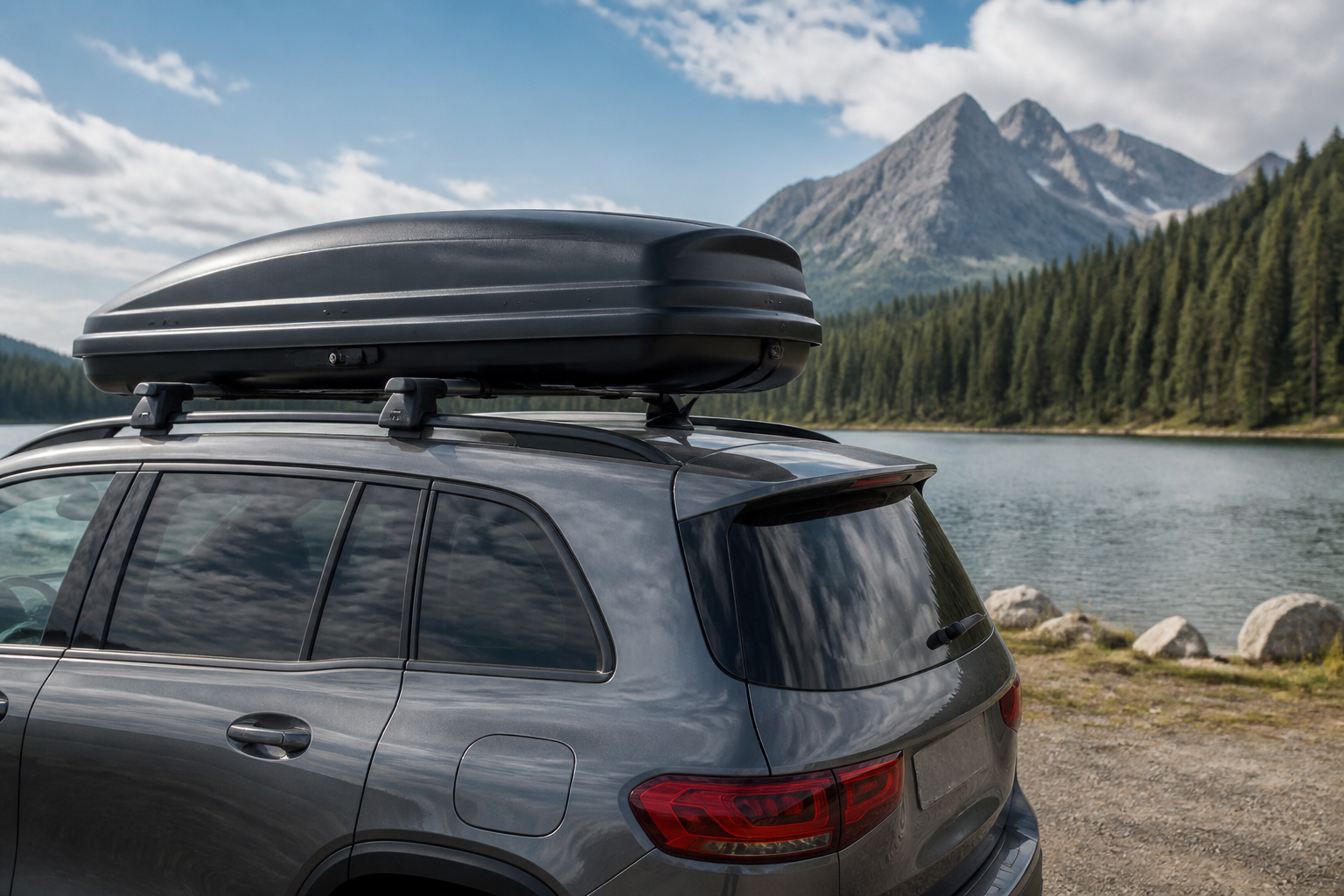
To choose a roof box for a Mercedes-Benz, prioritize compatibility with your crossbars, ensure hatch clearance, and respect the vehicle’s total roof-load limit. Consider hatch clearance and drag, and compare with a hitch-mounted carrier if available, noting potential differences in rear clearance and fuel economy.
Key takeaways
- Match box to your crossbar system and model-specific racks.
- Measure hatch clearance before buying; ensure liftgate and sensors aren’t obstructed.
- Calculate total roof load (box + cargo + rails) and stay within the Mercedes-rated limit.
- Consider a hitch carrier if your Mercedes has an available hitch, for easier loading and potentially better fuel economy.
- Budget for a possible fuel-economy impact when using roof boxes, and remove the box when not needed.
Choosing the right roof box for a Mercedes-Benz isn’t just about capacity. It’s about matching the box to your rack system, ensuring hatch clearance, and staying within the vehicle’s roof-load limits. This guide distills practical criteria from trusted sources to help Mercedes owners decide between cargo boxes and alternative solutions while keeping cargo secure and fuel economy reasonable.
Key factors: rack compatibility, hatch clearance, and roof-load balance
Start with the basics: verify the roof rack and crossbars on your Mercedes model are compatible with the roof box you’re considering. Different roof rails and crossbar shapes require specific box fittings or adapters. After confirming compatibility, measure hatch clearance to prevent interference with the liftgate, especially on SUVs and wagons with top-hinged rear doors. Finally, account for the vehicle’s total roof load—this includes crossbars, the box, and the cargo inside. The combined weight must not exceed the manufacturer’s stated limit. Heavier cargo tends to perform best when placed low or inside the cabin if possible to keep center of gravity and handling benign.
Crucially, the roof-load limit published in your owner’s manual is the ceiling, not a target. It represents the maximum distributed weight the roof structure and mounting system can safely bear under typical driving conditions. Subtract the weight of rails and crossbars from that figure, then allocate the remaining allowance to the box and its contents. If you’re unsure, consult your dealer or the MB guidelines for your specific model year, as some AMG or high-load variants use reinforced rails with different limits.
Practical scenarios for Mercedes owners
Family road trips with a full cargo box
A roof box adds cargo space without sacrificing interior passenger room, but it does introduce drag and a small fuel economy hit. Car and Driver’s analysis highlights that hitch cargo carriers can offer easier loading and often lower fuel penalties when a hitch is available, yet may block rear sensors or tailgate access. If your Mercedes SUV has a compatible hitch, compare the loading convenience and any impact on rear visibility against a roof box. When choosing a roof box, verify that its dimensions do not protrude beyond the liftgate arc or overhang, which could snag on trees or garage doors during entry and exit. For families, a box with a sensible internal configuration (tie-down points, accessible interior straps) can ease packing and reduce shifting during transit.
Source context: Car and Driver notes the general practicality of hitch carriers in terms of loading ease and fuel economy, while trade-offs such as rear-camera visibility and tailgate reach remain vehicle-dependent considerations. Source: Car and Driver.
Compact models with tight hatch clearance
On models with compact hatch openings, the risk of obstructing the liftgate or sensors increases. GearJunkie emphasizes measuring hatch clearance before purchase and choosing a box with dimensions that fit the available clearance. Always subtract the rack and box weight from the vehicle’s roof-load limit before calculating usable load capacity. Consider a box with a shorter profile or a model designed for low-profile rack systems to minimize rear clearance issues when opening the hatch in tight spaces. If your Mercedes uses a panoramic roof or roof rails with integrated mounting points, ensure the box doesn’t conflict with any sun/moonroof equipment or roof-mounted accessories you already use.
Source context: GearJunkie highlights the importance of hatch clearance, crossbar compatibility, and cautious load budgeting. Source: GearJunkie.
Heavy or bulky gear and fuel economy considerations
Loads placed on the roof add aerodynamic drag, which can affect fuel economy. Consumer Reports notes that roof racks can reduce fuel economy, so plan for lighter, evenly distributed loads and consider removing the box when not needed. If you routinely carry heavy equipment (bikes, skis, or camping gear) on long highway trips, evaluate whether a roof box with a high sectional efficiency is worth the added drag versus a rear-mounted carrier or even interior packing rearrangements. Heavier items should be kept low and near the vehicle centerline to preserve predictable handling and minimize rollover risk in sudden maneuvers or crosswinds.
Source context: Consumer Reports discusses load capacity implications and fuel economy penalties of roof racks. Source: Consumer Reports.
How to measure roof load and ensure safe installation
Check the owner’s manual for the maximum allowed roof load in pounds or kilograms, and verify the combined weight of the crossbars, box, and cargo. Use a precise scale or the manufacturer’s specifications to avoid exceeding limits. When installing, evenly distribute weight, secure loose items, and ensure the box is locked and keyed. Periodically re-check fasteners during long trips or after rough road segments. If you’re adding heavy items (tools, machinery) frequently, consider distributing those items between roof and cabin when possible, or using a cargo bag for lighter, flexible loads that conform better to irregular shapes.
Comparison: roof box vs. hitch carrier considerations for Mercedes
Although this article focuses on roof boxes, it’s worth noting practical trade-offs when your Mercedes has a compatible hitch. In many cases, a hitch-mounted carrier offers easier loading and a smaller fuel-economy penalty than a roof box, but you may sacrifice tailgate access and rear-camera visibility. If you don’t need frequent access to the rear cargo area or sensors, a hitch carrier can be a convenient alternative. For more on the trade-offs, see Car and Driver’s analysis and GearJunkie’s rooftop box guidance. When evaluating, consider the vehicle’s trailer hitch class, tongue weight, and any impact on warranty or warranty service advisories related to towing equipment.
In any scenario, the decision should be driven by total payload needs, how often you’ll deploy the roof system, and how the roof setup affects daily usability (parking, garage clearance, and sensor operation).
Practical step-by-step decision checklist
- Confirm roof rack type and crossbars on your Mercedes model and check box compatibility with adapters if needed.
- Measure hatch clearance with the box attached to ensure full opening and sensor clearance.
- Calculate total roof load: crossbars + box + cargo, ensuring it stays within the manufacturer’s limit.
- Assess weight distribution—prefer lower, closer-to-center cargo if possible; avoid unloading the cabin with rooftop gear unless necessary.
- Compare with a hitch carrier if available: loading ease, potential fuel-economy difference, and rear clearance implications.
Useful sources for assessing compatibility and load considerations include GearJunkie and Car and Driver, which discuss rack compatibility, hatch clearance, and fuel economy implications. GearJunkie rooftop boxes guide and Car and Driver: roof box vs hitch carrier.
Bottom line: choose a roof box that fits your Mercedes crossbars, clears the hatch, and stays within roof-load limits. When in doubt, compare to a hitch carrier if your vehicle supports it and loading convenience is a priority. Always verify compatibility with your specific model year, as Mercedes trims and roof systems evolve, and consult the latest owner’s manual guidance before buying or mounting.
FAQ
How do I measure roof load accurately for my Mercedes?
Check the owner’s manual for the maximum roof load and compare it with the combined weight of crossbars, the roof box, and cargo. Use a scale if needed and verify that the weight is distributed evenly.
Can a roof box affect Mercedes rear sensors or backup camera?
Yes. A roof box may affect rear visibility and sensor performance, especially on SUVs with sensitive parking aids. If sensor interference is a concern, compare with hitch-mounted options or choose a box with a lower profile.
Should I remove the roof box when not in use?
Removing the box when not needed can restore fuel economy and reduce aerodynamic drag. Car and Driver and GearJunkie guidance suggest weighing the trade-offs of keeping the box on long trips versus removing it for daily driving.
Related Mercedes-Benz guides
- Charging ecosystems and home installation for Mercedes BEVs
- Mercedes-Benz telematics and diagnostics overview for owners
- Mercedes GLC versus GLE family ownership comparison
- 2026 Mercedes-Benz New Models: GLA, S-Class, GLC EQ and AMG GT Guide
- Mercedes-Benz MB.OS explained: features, updates, and daily usability