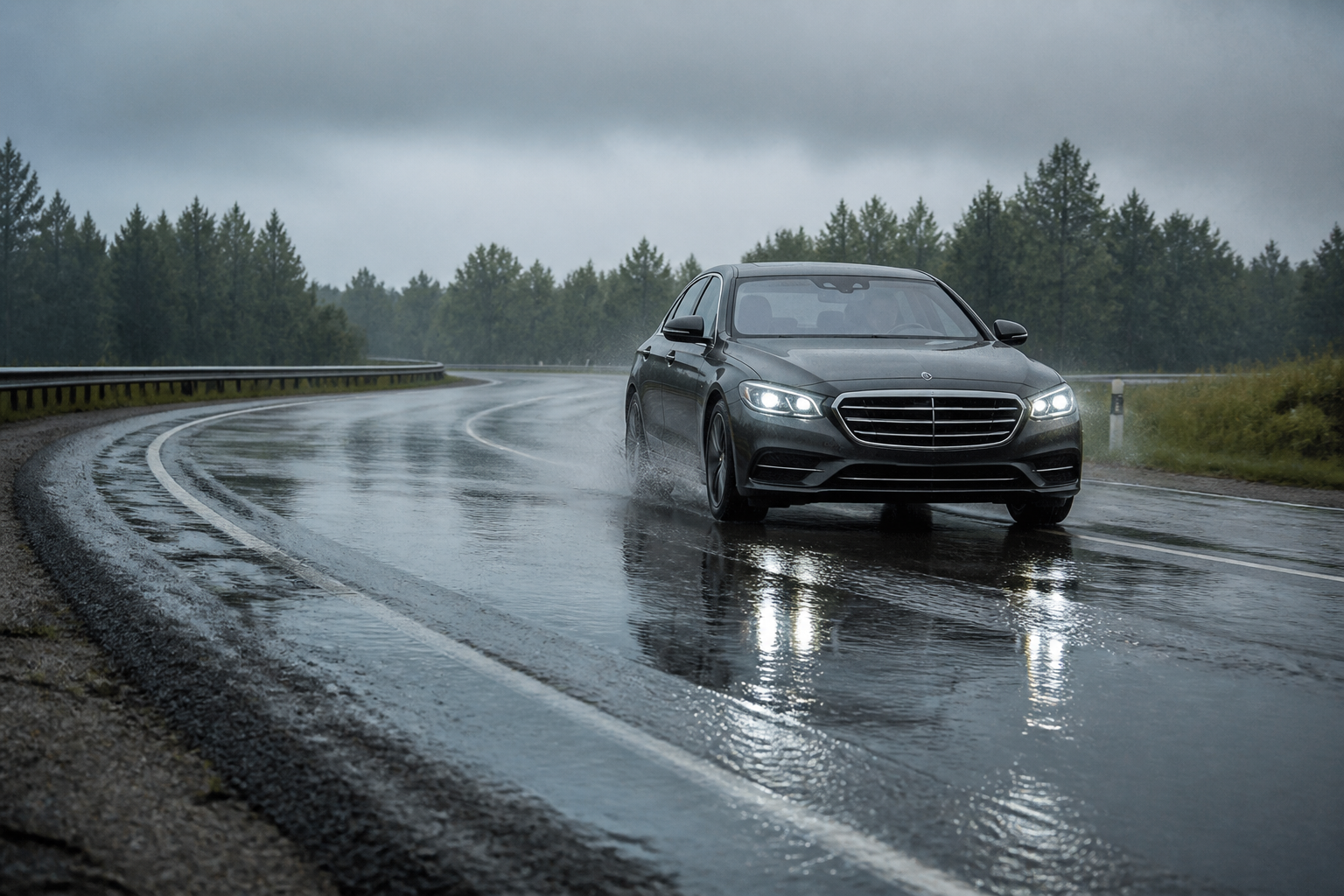
Reduce speed, avoid grooves in the road, and brake cautiously when hydroplaning is possible in a Mercedes-Benz. If grip is lost, steer toward your intended direction with smooth inputs; do not slam the brakes. This guidance mirrors MBUSA’s manual instructions and independent safety sources.
Key takeaways
- Hydroplaning can occur even at low speeds and with new tires.
- In heavy rain, slow down and avoid track grooves.
- Brake cautiously and avoid harsh steering or abrupt inputs to maintain control.
Hydroplaning can occur when the road is wet enough that a thin layer of water builds between the tire and the pavement, reducing grip. In Mercedes-Benz vehicles, the practical response is best expressed as a simple, repeatable checklist that you can apply in real time. This article translates the owner-manual guidance into actionable steps, explains why each step matters, and adds model- and condition-specific caveats to help you apply the guidance across a range of vehicles and weather scenarios. It also clarifies how driver-assistance technologies interact with your actions during reduced-traction events.
From the owner’s manual to an actionable in-vehicle routine
The MBUSA MY12 SL Operator’s Manual states that hydroplaning can occur even at low speeds and with fresh tires. The recommended response is a triangle of actions: slow the vehicle, avoid grooves that can trap a thin water film, and brake cautiously. Think of these as guardrails to help preserve directional control while the tires regain contact with the road surface. This framing remains valid across most Mercedes-Benz models, though exact steering feel and braking balance will vary with tires, suspension tuning, and drivetrain configuration.
Why these three elements matter in practice includes the following:
- Reduce speed promptly: Lowering speed reduces kinetic energy and the risk that a water film causes lift-off. It also buys you more time and margin to respond to any tendency to drift or hydroplane. The target is to settle into a speed you can maintain without having to make abrupt corrections.
- Avoid road grooves and tracks: Grooves, lane dividers, and ruts can alter how water is evacuated from under the tire, creating dynamic changes in grip. Steering or throttle changes while the tire is atop a slick film are harder to predict when the road surface features interact with the water layer.
- Brake cautiously: Abrupt braking can destabilize the vehicle if tires have reduced adhesion. Progressive, gentle braking helps keep wheel lock risk low and maintains some steering feel as tires reconnect with the road.
Realistic interpretation for different Mercedes-Benz models
While the core principle is universal, there are practical caveats you should consider based on your vehicle’s tires, suspension, and drivetrain:
- Tire condition and type: Worn tread or incorrect tire pressures reduce the contact patch and water evacuation capability. Performance or summer tires may respond with quicker steering feedback and stiffer responses; the same braking-and-steering sequence remains valid, but the margin for error can be smaller.
- Suspension and steering feel: Some models offer more responsive steering or variable-ratio systems. In a hydroplaning scenario, smooth, modest inputs are more effective than quick corrections, which can be unsettling as grip changes.
- All-season vs. rain-tuned tires: Tire design affects water evacuation and grip. The basic strategy—slow early, avoid grooves, brake gently—still applies, but remember that tire-specific behavior will influence how quickly grip returns after a water phase passes.
Practical, step-by-step checklist you can use today
- Notice signs early: Look for reduced feel through the steering wheel, spray from other vehicles, or a faint change in how the car tracks. Begin easing off the accelerator and plan a smoother line before grip is visibly lost.
- Reduce speed steadily: Lower speed in a controlled manner to a level you can maintain without heavy braking. This helps maintain steering control as you approach potential hazards in wet conditions.
- Steer with intent, not correction: Keep hands on the wheel with light to moderate inputs. Avoid abrupt lane changes or sharp steering movements, which can unsettle the vehicle when traction is limited.
- Brake with gradual input: If braking is necessary, apply smoothly and progressively. Avoid slamming the pedal, which can trigger wheel lock or destabilize the car when grip is marginal.
- Stay in or follow tire tracks when possible: If you can, follow the path of the vehicle ahead where the surface may be clearer, but do not risk following too closely into deeper water or flooded patches.
- Look toward your intended direction: Keep your gaze and steering toward where you want the car to go. This supports predictability as grip returns and helps you converge back to a stable path more quickly.
- Reset after conditions improve: As tire grip returns on drier patches, gradually return to your normal driving speed and resume lane position while continuing to scan for standing water and road texture.
Driver responsibility and the role of vehicle aids
Modern Mercedes-Benz models may include stability control, traction control, and driver-assistance systems designed to aid in reduced-traction conditions. These systems are support tools, not substitutes for driver input. They respond within the safety envelope you set with your inputs. In hydroplaning, deliberate, calm actions—gentle throttle, steady steering toward your intended path, and cautious braking—work in concert with, rather than against, electronic aids.
Contrast with general public-safety guidance
Public-safety guidance consistently emphasizes slow, smooth inputs and avoidance of abrupt maneuvers when traction is compromised. The Mercedes guidance aligns with this core principle, but grounding in the owner’s manual provides vehicle-specific context—how water film behavior interacts with tire contact patches, grooves, and suspension dynamics. Independent safety sources reiterate the same core ideas: do not slam the brakes, keep looking at your target path, and steer toward the direction you want to go as grip returns.
What to do in a hurry if hydroplaning seems imminent
In time-sensitive scenarios, the emphasis remains the same, but you can practice quick mental rehearsals so that your actions become reflexive. If hydroplaning is suspected, prioritize: smoothly ease off the accelerator, apply gentle steering corrections toward your intended lane, and brake only if you are confident you can do so without lockup. If you do lose control, look where you want to go and steer toward that exit path rather than against the slide.
Summary tailored for Mercedes-Benz owners
The essential message, supported by MBUSA’s manual and corroborated by independent guidance, is that hydroplaning can occur under less-than-extreme conditions. The most reliable response is a calm, measured sequence of inputs: reduce speed early, avoid road features that complicate traction, and brake gently. This approach aligns with public-safety and independent-safety perspectives and reinforces the shared aim: maintain control with disciplined, predictable actions rather than sudden, reactive maneuvers.
For reference, core sources used to shape this guidance include the Mercedes-Benz SL (MY12) Operator’s Manual PDF and independent safety resources such as AAA Wet Weather Driving Tips and NHTSA guidance on driver assistance technologies. These materials inform the practical steps and safety context described here: https://www.mbusa.com/content/dam/mb-nafta/us/owners/manuals/2012/operators/MY12_SL_Operator.pdf, https://exchange.aaa.com/safety/driving-advice/wet-weather-driving-tips/, https://www.nhtsa.gov/vehicle-safety/driver-assistance-technologies
Sources