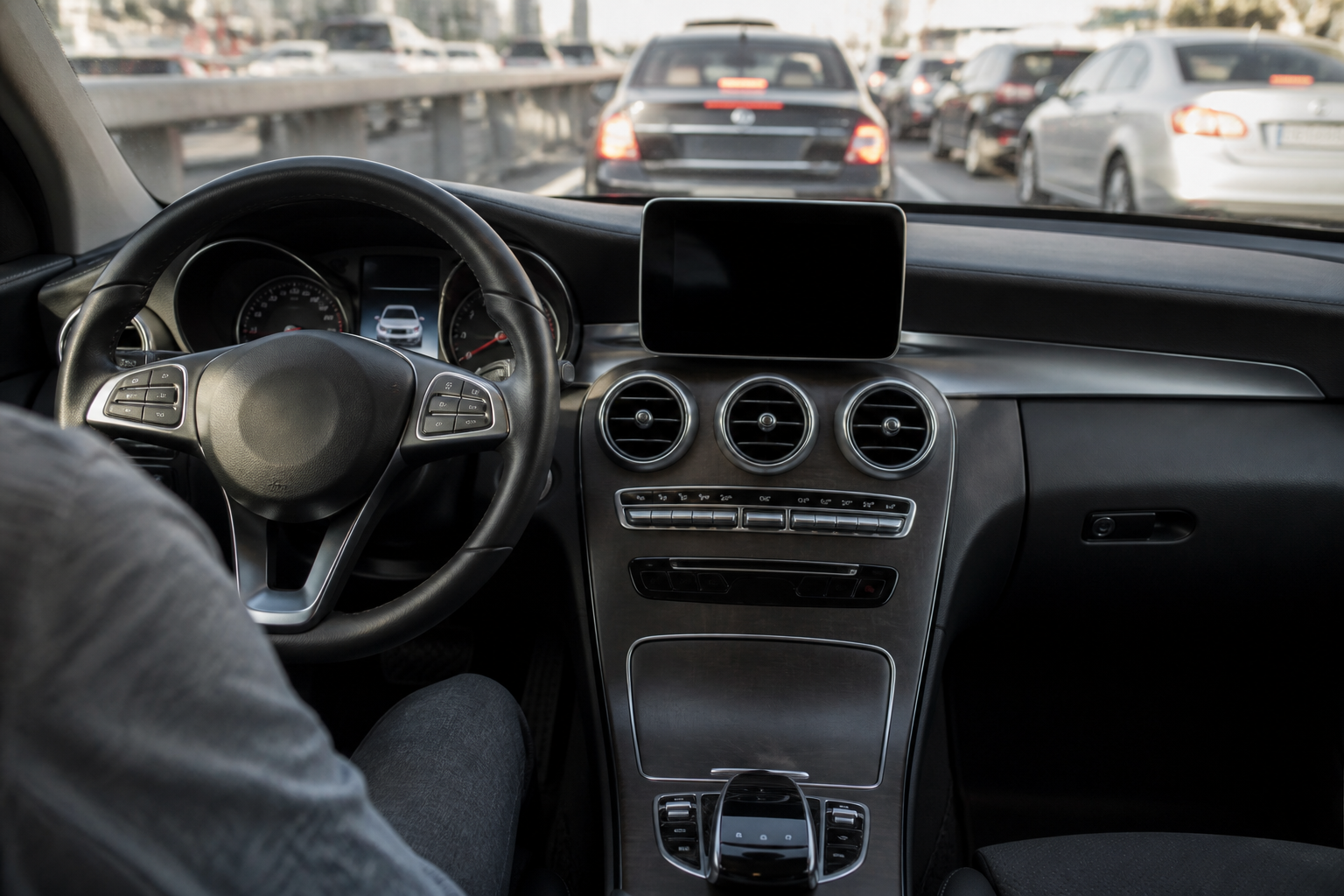
Use the Mercedes-Benz HOLD function to keep the vehicle stationary without continuous brake pedal force in stop-and-go traffic. Activation involves a brake-pedal sequence that triggers the HOLD indicator to appear. The system deactivates when you depress the accelerator to pull away or press the brake until the HOLD indicator disappears; it also deactivates under other conditions when safety systems or driver actions require it. Always remember HOLD is an aid, not a substitute for securing the vehicle or maintaining awareness.
Key takeaways
- HOLD helps hold a stopped vehicle without keeping the brake pedal pressed.
- Activation is shown by the HOLD indicator after a brake-pedal sequence; consult model-specific manuals for exact steps.
- HOLD deactivates when you accelerate to pull away or brake to cancel; safety warnings emphasize not leaving the vehicle unattended while HOLD is active.
- Always use HOLD in conjunction with normal driving vigilance and consider DISTRONIC and other systems as part of overall vehicle control.
- Refer to your model’s Owner’s Manual for precise activation steps and deactivation conditions.
HOLD function: core purpose and practical use
The Mercedes-Benz HOLD function is designed to keep the vehicle stationary without the driver maintaining pressure on the brake pedal. In stop-and-go traffic, at a red light, or while waiting in a lane of traffic, HOLD allows the car to remain at a standstill with the driver’s foot off the brake—reducing pedal effort and fatigue. It is important to treat HOLD as an assistive feature, not a substitute for vigilance or for securing the vehicle when leaving the interior cabin. Because HOLD is interconnected with braking systems and with driver-assistance features, its behavior depends on vehicle speed, accumulated stop duration, and the status of systems such as Active Distance Assist DISTRONIC. Understanding these conditions helps you use the feature smoothly and safely across common driving scenarios.
Activation: when and how HOLD appears
Activation generally occurs during a deliberate stop sequence. In most MBUSA manuals, you engage the hold state by bringing the vehicle to a stop using the brake pedal, and then continuing to observe the instrument cluster for the HOLD indicator to appear. The exact pedal choreography and timing can vary by model year and model, but the principle remains: depress the brake pedal, maintain a complete stop, and observe the HOLD cue. Once the HOLD display or indicator is visible, you can release the brake and the system will hold the car in place without brake pressure.
Model-year specific notes include references to how the HOLD indicator appears during the stopping process and the moment it becomes active. Some models specify an activation sequence that advances to HOLD readiness after a confirmed stop, with the indicator confirming that HOLD is engaged. If your vehicle uses a slightly different process, the underlying concept remains consistent: a verifiable halt with the HOLD cue active before you release the brake pedal to rely on HOLD.
Deactivation: how HOLD ends and how to pull away
HOLD ends when you intend to move again. The two most common and straightforward deactivation methods are:
- Depressing the accelerator pedal to begin moving and pull away; in many models, this action clears the HOLD indicator and releases the hold state.
- Depressing the brake pedal until the HOLD display disappears, which ends the hold state and returns control to you for a standard stop-and-go start sequence.
In addition to these primary methods, manuals list several conditions under which HOLD can be deactivated automatically or when other systems intervene. Notably, if Active Distance Assist DISTRONIC or other driver-assistance features are active or require attention, the vehicle may exit HOLD or require manual confirmation to continue holding. Always verify the exact deactivation rules in your vehicle’s owner’s manual for your specific model and year.
Safety cautions: how to use HOLD responsibly
HOLD is intended to reduce continuous braking effort during stationary waits, but it does not eliminate the driver’s responsibility for safety. While HOLD is active, you should:
- Maintain awareness of your surroundings—check mirrors and look out the windows for pedestrians, other vehicles, and potential hazards before releasing the brake.
- Avoid leaving the driver’s seat while HOLD is engaged, especially if the vehicle is in a lane or near traffic. Some manuals warn of the risk of movement if the driver exits with HOLD active.
- Be mindful of how other features interact with HOLD. If DISTRONIC or other assisted features adjust speed or distance, you may need to re-engage HOLD or intervene manually to maintain a safe stop.
Engineers designed HOLD as an assistance function, not a substitute for vehicle securing. If you need to attend to the interior or leave the vehicle briefly, apply the appropriate parking brake or engage a fully stationary state using standard securing procedures. Consider that environmental conditions such as hills, slippery surfaces, or uneven pavement may affect how quickly HOLD can re-engage or release when the vehicle posture changes.
Model-specific caveats and how to check your manual
Because activation, deactivation, and safety cautions for HOLD can differ by model and year, it’s essential to consult the owner’s manual for your exact vehicle. Notable references from Mercedes-Benz documentation include:
- The C-Class Sedan Owner’s Manual describing how HOLD is activated and deactivated, and listing conditions under which it may disengage (for example, when certain driver-assistance features are active).
- MY24 EQB Owner’s Manual with updated instructions reflecting SAE-level features and deactivation triggers related to newer driver-assistance integration.
- EQV MPV operator’s manual excerpts that frame HOLD as a standstill aid and warn about the risks if the driver exits while HOLD is active, along with inputs that can deactivate it (accelerator/brake actions).
For practical reference, model-specific steps and cautions are found across the MBUSA manuals linked to the C-Class Sedan, EQB, and EQV MPV. Always verify the exact sequence and warnings in the latest materials for your model-year:
Practical takeaways for everyday driving
To maximize comfort and safety when using HOLD in everyday driving, consider these practical habits:
- Come to a complete stop with your foot on the brake, then watch for the HOLD indicator. Do not assume HOLD is active until you see the indicator.
- Maintain awareness of your surroundings while HOLD is engaged. Be prepared to take manual control if traffic shifts or an obstacle appears.
- When the traffic flow is ready, either gently apply the accelerator to move forward or fully depress the brake to release HOLD, depending on your model’s response.
- If a driver-assistance feature intervenes, be ready to intervene manually to re-establish the desired behavior after the vehicle stops or starts moving again.
Remember, HOLD is an aid intended to reduce fatigue during extended waits, but it does not replace prudent driving, nor does it eliminate the need to securely immobilize the vehicle when parked. If you anticipate leaving the cabin or a long stop, apply the parking brake or engage the vehicle’s standard stationary procedures.