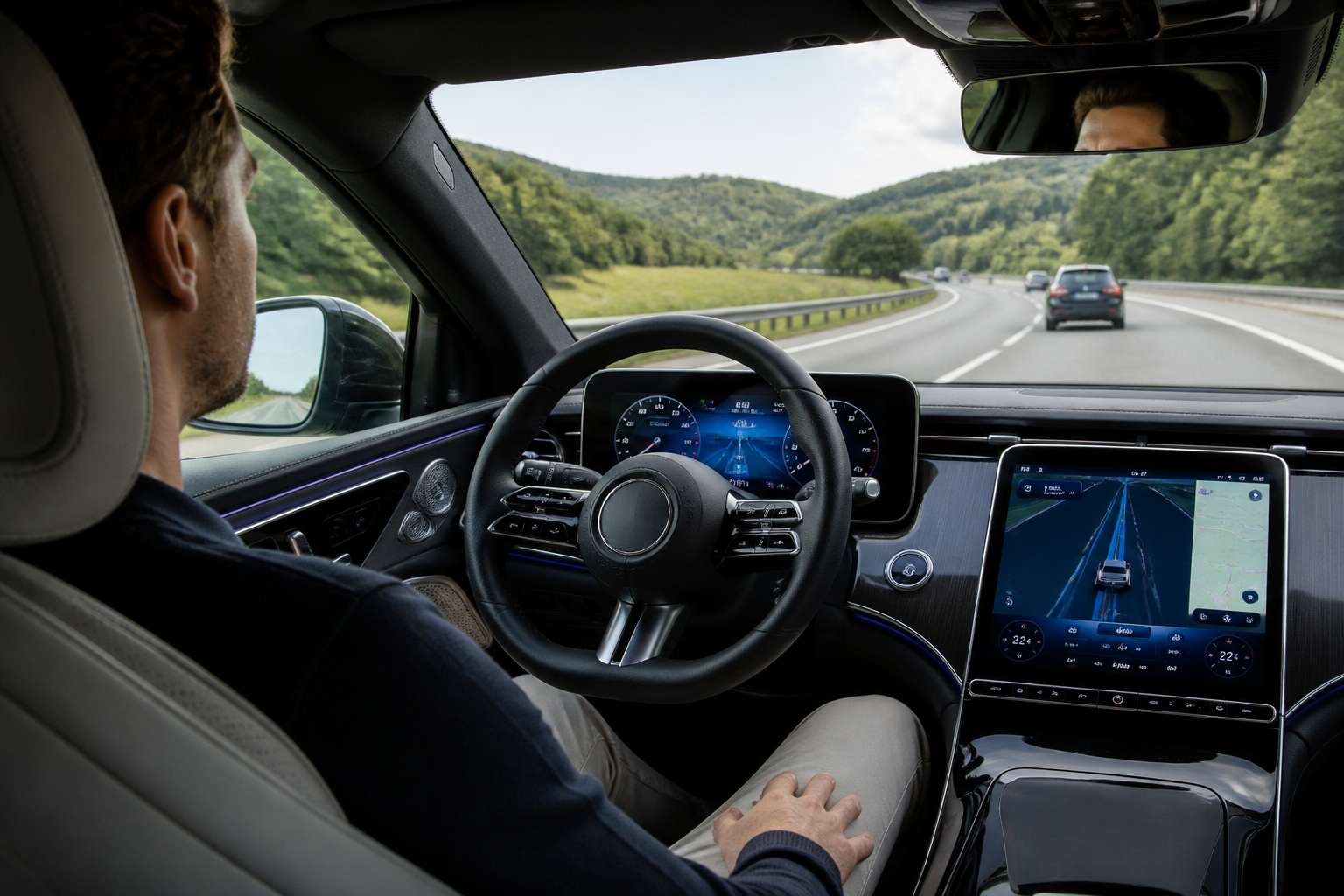
Active Steering Assist is a lane-centering aid that works when DISTRONIC and ESP are active. The system can keep the vehicle centered in the lane on supported roads, but the driver must remain attentive and ready to take over. A handover to passive mode occurs if the system cannot safely maintain lane centering or if the driver does not maintain steering. Limitations include poor visibility, unclear lane markings, tight bends, and other conditions where lane-centering support may be unavailable.
Top takeaways
- Active Steering Assist provides lane-centering support but requires the driver to stay responsible for steering.
- System relies on DISTRONIC activation and clear lane markings; it is not autonomous steering.
- Handover to passive mode occurs when the system detects it cannot safely assist or when prompts indicate the driver must take control.
- Be aware of weather, visibility, and road conditions that can limit the feature’s effectiveness.
- Always follow the owner’s manual guidance and Mercedes-Benz’s official notes regarding engagement and limitations.
In-Depth Guide: How Mercedes-Benz Active Steering Assist Works and How to Use It Safely
Active Steering Assist is designed to help keep the vehicle centered in its lane by coordinating with other driver-assistance systems. It is not autonomous steering; drivers remain the primary operators and must monitor conditions, be ready to intervene, and comply with all safety warnings. This guide translates the feature’s official descriptions into a practical, hands-on checklist you can apply in real traffic, including engagement prerequisites, how to recognize when to take over, and the explicit limitations that can cause the system to drop out.
What the system does and how it fits into the driver’s task
Mercedes-Benz positions Active Steering Assist as continuous lane-centering support that operates with DISTRONIC (Adaptive Cruise Control) and ESP (Electronic Stability Program). The system analyzes lane markings, vehicle position, relative speed to other traffic, and road geometry to provide steering torque that helps maintain the car near the center of the lane. Importantly, the feature is always subject to driver oversight and can disengage or hand back control when conditions exceed its capabilities.
Key caveats to keep in mind include:
- The system requires DISTRONIC and ESP to be active; it does not replace the driver’s steering input.
- Driver attention is ongoing: the system can prompt the driver to steer and, in some scenarios, may require handover to manual control.
- Capabilities are conditional on road markings, weather, lighting, wheel torque, and vehicle speed within certain ranges.
Source references: Mercedes-Benz’s Driver Assistance Features overview and the owner’s manuals emphasize that Active Steering Assist is an aid and that the driver remains responsible for lane position, speed, distance, and braking.
Engagement prerequisites: getting the system ready to assist
- Activate the prerequisite systems: Ensure ESP (ESC) and Active Distance Assist DISTRONIC are turned on. Active Steering Assist works to center the vehicle when these are active, but it does not steer the car on its own without driver input.
- Check status indicators: Look for status messages on the instrument cluster or head-up display indicating that Active Steering Assist is engaged and ready to assist along with DISTRONIC.
- Adjust position and readiness: Sit with hands on the wheel and maintain a light grip; be prepared to take over at any moment. Do not rely on permanent, hands-off operation.
Practical note: In some models, the system may only provide lane-centering support when lane markings are clearly detectable and the vehicle is traveling within a specific speed window. Always verify your own vehicle’s user interface cues for readiness.
How Active Steering Assist behaves in real traffic
- What it does when active: It helps keep the vehicle centered by applying slight steering torque in the direction needed to stay within the lane, especially in straight-line travel or gentle curves, provided lane markings are visible and traffic conditions permit.
- When it contributes most: On highways or well-marked lanes with moderate traffic, where steering corrections are predictable and small, the system can reduce the driver’s steering workload.
- What happens during a handover to passive mode: If the system detects that steering assistance is no longer reliable or the driver is not actively steering when prompted, it will disengage and request the driver to take over. Look for on-board prompts and a visual/audio warning indicating that you should resume steering.
- Driver prompts and warnings: A prolonged absence of steering input, a lack of hands-on-wheel contact, or detection of conditions beyond the system’s safe operating envelope will trigger a handover to manual control and a warning signal or message.
- What the driver should do: When handed back to manual control, resume steering with deliberate, continuous input and respond to any new prompts. Do not attempt to “game” or ignore the warning to continue using the system in unsafe conditions.
Note: The Mercedes-Benz YouTube instructional content reiterates that the system does not steer the car autonomously and that the driver must remain engaged, especially when visibility is reduced or lane markings are ambiguous.
Limitations and critical warnings you must observe
The official owner’s manuals and the driver-assistance overview highlight several scenarios where Active Steering Assist may be unavailable or limited:
- Low or ambiguous lane-marking detection: If lane lines are not clearly detectable, steering assistance may be reduced or not available.
- Complex driving maneuvers: Tight bends, merges, or rapid directional changes can exceed what the system can reliably support.
- Poor visibility: Snow, heavy rain, fog, glare, or spray can degrade lane detection and the system’s ability to steer.
- Slippery surfaces and adverse weather: Ice, standing water, or slush can limit steering torque and system responsiveness.
- System limits on steering torque: The device may only provide limited steering assistance within its capability envelope; it cannot compensate for all misalignments or unpredictable events.
- Driver must retain hands-on control and be prepared to intervene at any time, even when the system is active.
Real-world implication: Even when the system is active, you should maintain a ready-to-take-over posture and stay vigilant for changing road conditions, construction zones, or sudden maneuvers by other road users. The feature is a tool to reduce steering fatigue and assist with lane maintenance, not a substitute for attentive driving.
Practical guidelines for owners: safe usage, routine checks, and best practices
- Before starting a trip, verify that DISTRONIC and ESP are active and that the Active Steering Assist status indicates readiness where applicable.
- Keep your hands on the wheel with a light grip and be prepared to steer. Do not rely on the system to handle all driving tasks, especially in complex environments.
- Dimensional cues such as lane width, curve radius, and road marking quality influence the system’s effectiveness. In uncertain conditions, switch to manual mode and resume full control.
- Monitor the vehicle’s prompts closely: if a handover is requested, take immediate control and adjust speed and following distance manually as needed.
- Limit use to appropriate road types and conditions. Avoid relying on lane-centering in construction zones, city streets with irregular markings, or poor weather where system performance is degraded.
For deeper details, refer to the Mercedes-Benz Driver Assistance Features page and the 2020 A-Class Operator’s Manual sections specifically addressing Active Steering Assist. They consistently emphasize that the driver’s responsibility is ongoing and that the assistance is conditional on system health and road conditions.
Model-dependent caveats and considerations
Different Mercedes-Benz models may implement Active Steering Assist with varying thresholds, indicators, and required preconditions. Always consult your vehicle’s user manual for model-specific guidance on:
- Exact engagement procedure and status indicators for your trim level.
- Minimum/maximum speeds and lane-marking requirements that govern when the feature can provide assistance.
- Specific prompts, warning tones, or on-screen messages used to signal when you should take over.
- Conditions under which the system may escalate warnings or disengage entirely.
In all cases, treat Active Steering Assist as an optional aid that complements competent, defensive driving. Its goal is to support the driver under favorable conditions, not to replace the driver’s responsibility to maintain lane position, speed, and safe following distances.
Sources: Mercedes-Benz USA — Driver Assistance Features overview; Mercedes-Benz USA — 2020 A-Class Operator’s Manual (Active Steering Assist) ; Mercedes-Benz USA YouTube instructional content on Active Steering Assist.
Sources
- Mercedes-Benz Driver Assistance Features (Active Steering Assist overview)
- 2020 A-Class Operator’s Manual (Active Steering Assist: hands-on + system limitations)
- 2024-2025 EQB How-To: Active Steering Assist (Hands-on rules + passive handover behavior)
Related Mercedes-Benz guides