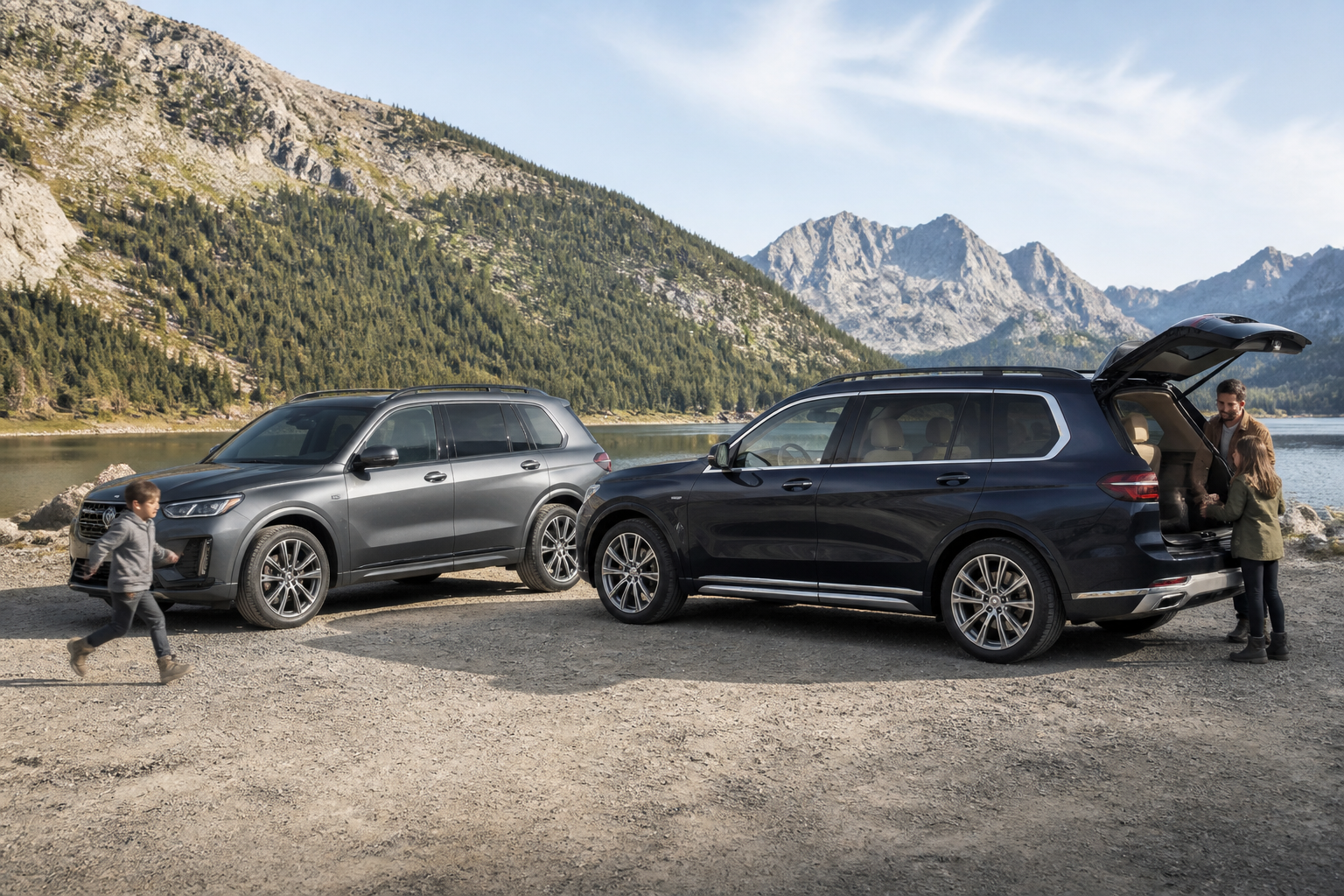
For daily family use, the Mercedes GLE generally offers better two-row practicality, cargo flexibility, and fuel economy, with easier parking and lower running costs. The GLS provides guaranteed seven-seat occupancy and more interior space for passengers, at the expense of length, maneuverability, and higher operating costs. Your choice should hinge on how often you need a third row and how much you value two-row cargo space and daily efficiency versus passenger capacity.
Key takeaways
- GLE excels for two-row daily use with practical cargo space behind the second row.
- GLS adds a usable third row and more passenger space, better for larger families on longer trips.
- Expect higher purchase price, longer footprint, and potentially higher running costs with the GLS.
- Fuel economy favors the GLE in typical use; consider total cost of ownership for your scenario.
- Use case matters: two-row dominance favors GLE; frequent seven-seat travel favors GLS.
The Mercedes-Benz GLE and GLS sit at opposite ends of the brand’s SUV spectrum, yet many families face a clear decision: does the extra space, presence, and premium feel of the GLS justify its larger footprint, higher price, and possibly higher operating costs? This practical guide pulls live-source data and real-world usage patterns to compare two-row daily usefulness, kid-carrier logistics, and the occasional seven-seat need, without marketing spin.
Space, versatility, and how that translates to daily life
At the core of the choice is how you use space. The GLE is a two-row, five-seat SUV with about 33.3 cubic feet of cargo space behind the rear seats, which expands to roughly 74.9 cubic feet with the rear seats folded. The GLS, in contrast, commonly seats seven as standard, but behind its third row there is about 17.4 cubic feet of cargo space, expanding to 42.7 cubic feet with the third row folded. When all rear rows are folded, the GLE still offers more total cargo volume than the GLS, reflecting its two-row, cargo-focused layout rather than a strict carry-all philosophy. These figures matter in everyday routines: groceries, sports equipment, stroller and diaper-bag setups, and weekend projects all benefit from usable rear-space depth and accessible loading thresholds.
Size matters in parking and maneuverability. The GLS stretches to about 205.0 inches in length, versus roughly 194.3 inches for the GLE. The extra length translates into more interior room for passengers and cargo behind the second row, and a longer wheelbase that can smooth out road imperfections on longer drives. It also means tighter parking clearance to manage in crowded garages and narrower urban lanes. In practice, the GLE’s shorter footprint typically yields easier curbside loading and simpler parallel parking, while the GLS requires a more deliberate approach to spatial awareness when navigating tight spots.
Fuel economy—an everyday budget factor—tends to tilt in favor of the GLE in mixed-driving scenarios. Live data from contemporary comparisons show the GLE delivering higher combined mpg than the GLS, reflecting its lighter weight and two-row configuration. For families watching fuel bills, this difference can accumulate meaningfully over yearly mileage, especially for long commutes or frequent highway drives.
Seating flexibility, passenger flow, and real-world family scenarios
The GLE’s two-row arrangement is straightforward for most families that don’t regularly rely on a third row. The 33.3 cubic feet behind the rear seats is practical for daily routines—strollers, diaper bags, groceries, sports gear—while folding the rear seats expands cargo capacity to about 74.9 cubic feet, making the GLE adaptable for larger purchases or weekend excursions. The GLS’s seven-seat configuration prioritizes passenger capacity. Its third row is usable for short trips or smaller occupants, and when that row is deployed, cargo space drops sharply (to about 17.4 cubic feet behind the third row), which is typical for three-row full-size SUVs. If seven-seat flexibility is a frequent requirement, the GLS delivers that option in a single, cohesive package.
In typical daily tasks—grocery runs, school runs, and carpooling—the GLE’s smaller footprint and generous second-row cargo space can reduce loading stress and vehicle gymnastics at the curb. The GLS’s broader cabin offers more seating permutations and a more plush experience for longer trips or a full cabin, but its longer length can complicate parking, and when fully utilized, its cargo footprint behind the third row is notably smaller than the GLE’s two-row space.
Powertrains, towing, and ownership costs in practical terms
Mercedes-Benz offers mature powertrain families across both models. For families who tow trailers or larger gear, the GLS typically provides greater rear-axle payload and a higher maximum tow rating due to its larger chassis and tuned suspension, though exact numbers differ by engine and trim. On the road, the GLS tends to favor ride comfort with its more sophisticated suspension tuning, beneficial for long commutes with a full cabin. The GLE balances performance and efficiency, delivering solid everyday driving dynamics with typically better fuel economy thanks to its lighter weight and two-row setup.
Ownership costs extend beyond sticker price. The GLS generally carries a higher starting price and can incur higher ongoing costs for insurance and maintenance due to its greater scale and premium content. Both models share Mercedes-Benz’s dealership and service network, which helps mitigate maintenance friction and supports warranty coverage. However, the cost delta is a meaningful factor for families budgeting for monthly payments, fuel, insurance, and potential depreciation over the ownership horizon.
Which fits two-row daily use with occasional seven-seat capability?
If your daily routine is centered on two-row use with the occasional need for extra seating, the GLE offers an appealing balance: more cargo space behind the second row for everyday items, easier urban maneuverability, and typically stronger fuel economy. If your week regularly includes transporting additional passengers or bulky cargo behind a fully deployed third row, the GLS’s standard seven-seat layout and larger interior can be compelling—despite the longer footprint and potentially higher operating costs.
Practical decision criteria to guide a purchase
- Daily cargo needs: choose the GLE if you routinely haul larger items behind the second row; choose the GLS if you frequently rely on a third row for passengers.
- Parking and urban driving: the shorter GLE is easier to maneuver and park in tight spaces; the GLS requires more space and careful parking planning.
- Occasional vs. regular seven-seat use: pick the GLS if seven-seat capability is a regular requirement; pick the GLE if you primarily need two rows with flexibility for occasional passengers.
- Operating costs: expect better fuel economy from the two-row GLE on average; anticipate higher maintenance and running costs with the GLS due to its size and equipment level.
- Long-term ownership: total cost of ownership considerations—maintenance, insurance, resale value—can tilt more favorably toward well-equipped GLE configurations in many markets, though highly optioned GLSs may hold value differently depending on region and demand.
Bottom line for family ownership decisions
In real-world family usage, the GLE’s two-row practicality often provides the most stress-free day-to-day experience: generous cargo space behind the second row, easier parking, and typically better fuel efficiency. The GLS adds a genuine third-row option and more passenger comfort for longer trips or larger families, but its larger footprint and higher running costs come with a trade-off in cargo versatility when all rows are in use. The best choice maps to your routine: two-row daily needs with occasional seven-seat use point to the GLE; regular seven-seat trips and maximum passenger capacity lean toward the GLS.
Sources: Edmunds: 2025 Mercedes-Benz GLE-Class vs GLS-Class comparison, Car and Driver: 2026 GLS-Class review
Related Mercedes-Benz guides