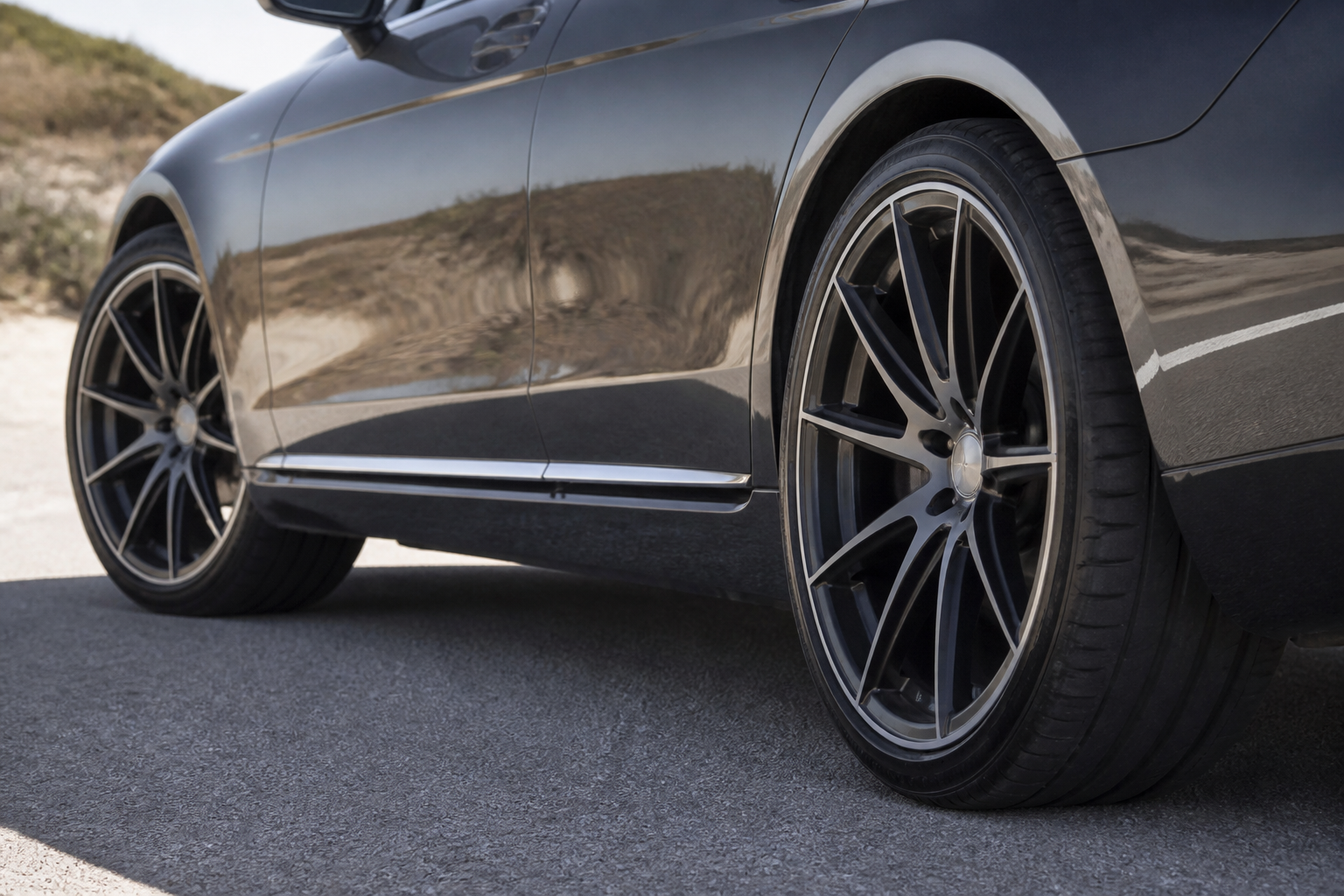
Staggered tire fitments on Mercedes-Benz usually complicate rotation. A standard front-to-rear rotation is often not possible when sizes differ or tires are directional. Verify exact sizes on the door placard and sidewall, consult the owner manual for the recommended rotation method, and ask your service provider whether side-to-side rotation is allowed or if tires must be dismounted/remounted. If your MB uses non-directional tires with different front/rear sizes, some rotation options may exist, but always follow the manufacturer guidance. In many cases, you’ll rotate only within the allowed pattern or avoid rotating altogether to preserve safety and performance.
Key takeaways
- Staggered fits often limit rotation options; always check MB owner manual and tire sidewall markings.
- Directional tires generally require staying on their original sides, restricting rotation.
- Many scenarios require tire dismount/remount or replacement to rotate safely and maintain performance.
- If rotation is permitted, follow a manufacturer-approved pattern rather than a generic template.
- Plan maintenance with your dealer to maintain safety, warranty, and optimal wear.
Staggered tire fitments—where the rear tires are wider than the fronts—are a common feature on many Mercedes-Benz models. They are chosen to optimize specific handling characteristics, traction, and, in some cases, the vehicle’s aesthetics. But this arrangement also creates a practical dilemma for tire rotation and maintenance: can you rotate tires to even wear without compromising safety, wear patterns, or the integrity of the wheel and tire assemblies? The short answer remains nuanced: it depends on the exact fitment, the tire and wheel construction, and the guidance in the owner manual. In many configurations, a traditional front-to-rear rotation is simply not feasible when the sizes differ or when tires are directional. In others, limited rotations are possible under strict conditions. This article outlines the decision criteria, verification steps, and service approaches that help you navigate rotation without compromising safety or warranty constraints.
Why staggered fitments affect rotation decisions
Mercedes-Benz models with staggered sizes intentionally place different-width tires on the front and rear axles to balance steering feel, acceleration grip, and high-speed stability. Because tires may have different diameters, circumferences, and sidewall constructions, a straightforward front-to-rear rotation can disturb the vehicle’s designed handling characteristics. In addition, tire pressure monitoring systems (TPMS) and stability control calibrations are often tuned to the original front-to-rear tire geometry. If you rotate tires in a way that changes which tire remains on which corner, you can introduce mismatches in load distribution, grip balance, and even TPMS readings. For directional tires, the issue is compounded: rotation would require moving a tire that is intended to rotate in a single direction to opposite sides, which is generally not advisable. In such cases, rotating a spot where the tire is mounted or remounting may be necessary to preserve performance and safety.
Key factors to check before scheduling service
- Door jamb placard and owner manual: Confirm the exact front and rear tire sizes, load index, and speed rating. The placard and the manual specify whether rotation is permitted and, if so, the recommended pattern, interval, and any cautions unique to your model and tire combination.
- Tire directionality: If the tires are directional, they must generally remain on their original sides to preserve the designed rotation direction. Inspect the sidewall for directional arrows or “This side out” markings.
- Fitment compatibility: Some staggered setups allow a side-to-side rotation for non-directional tires (for example, rear tires moving to the front on the opposite sides). Many staggered Mercedes configurations, however, require dismounting and remounting to rotate because the tire sizes and sidewall profiles do not permit a simple swap without altering inflation pressures and contact patches.
- Tire wear patterns: Uneven wear can indicate misalignment, improper inflation, or past rotation attempts. Document wear across both axles and bring photos or measurements to the service visit.
- Guidance from official sources: Follow the vehicle’s owner manual and the tire manufacturer’s guidance rather than applying a generic rotation pattern used for non-staggered setups.
Practical approaches: how to handle service visits
When you contact a dealer or tire shop, prepare two key questions to ensure you receive objective, model-appropriate guidance:
- Compatibility check: Do my exact front and rear tire sizes allow a rotation without changing tires or rims? If not, what is the permissible rotation approach under the MB specification for my vehicle?
- Procedure and impact: If rotation is allowed, what direction and pattern will the shop use, and will any tires need to be dismounted and remounted? Will this affect inflation pressures, TPMS calibration, or warranty terms?
If the fitted tires are non-directional and the sizes permit, a limited side-to-side rotation on non-directional tires may be acceptable for some staggered setups. However, many MB configurations with staggered sizing require dismounting and remounting to rotate, which increases service time and cost. In cases where rotation is not permissible, the recommended alternative is to maintain rotation by swapping which axle receives the relatively balanced wear focus or by planning more frequent tire inspections and even-wear maintenance, potentially including gradual tire replacement to preserve balance and performance.
Wear considerations and longer-term planning
Staggered fitments can produce characteristic wear patterns: typically more wear on the rear tires due to higher torque and traction demands in many driving scenarios. If wear is already uneven, a rotation plan must address these disparities while preserving grip characteristics. Schedule regular tire inspections for tread depth, edge wear, and shoulder wear. If wear is out of spec or if tread depth becomes uneven across the axle, consult a technician to assess alignment, suspension components, and vehicle weight distribution that could be contributing to wear asymmetry.
Model-dependent caveats and limitations
Because Mercedes-Benz models span a broad range of platforms and markets, there is no universal statement that applies to all staggered fitments. Always consult your exact model’s owner manual, the tire manufacturer’s guidance for your specific tire model, and your dealership’s service recommendations. In some cases, MB-approved wheel and tire packages from the manufacturer or a MB-approved aftermarket option may specify a rotation approach that explicitly preserves the staggered sizing while enabling a limited rotation within the tolerances of the wheel weights and TPMS calibration.
Helpful references for further reading
- Tire Rack provides guidance on rotation patterns for staggered and non-staggered setups, emphasizing that some configurations permit side-to-side rotation for non-directional tires while others require dismount/remount for proper rotation.
- Michelin explains a practical check sequence before booking service: verify door placard and sidewall markings, determine whether tires are directional, and confirm model-specific rotation procedures before authorizing service.
Bottom line: Staggered Mercedes fitments complicate rotation, but you can manage this safely with careful verification, adherence to official guidance, and clear communication with service providers. By confirming exact tire sizes, directional indicators, and rotation rules before any service, you protect grip balance, handling characteristics, and drivetrain safety while maintaining the integrity of your warranty and the vehicle’s systems.
Sources
- Can You Rotate the Staggered Tires on Your Mercedes-Benz? The Fitment, Tread-Pattern and Wear Checklist
- Why Staggered Mercedes Tire Fitments Limit Rotation—and What to Check Before Booking Service
Frequently asked questions
Can I rotate tires on a Mercedes-Benz with staggered sizes?
Rotation feasibility depends on the exact tire sizes, whether tires are directional, and the vehicle manual guidance. Some setups allow limited side-to-side rotation for non-directional tires, while many require dismounting/remounting or cannot rotate without changing sizes.
What should I verify before scheduling service?
Check the door jamb placard for sizes, confirm tire sidewall directionality, review owner manual rotation guidance, and ask the shop to follow the manufacturer’s procedure rather than a generic rotation pattern.
If rotation isn’t possible, what should I do to manage wear?
Monitor tread depth across axles, ensure proper alignment and tire pressure, and consider replacement if wear is uneven or approaching limits. Follow the tire maker and MB guidance to maintain safety and performance.
Related Mercedes-Benz guides