DYNAMIC SELECT provides drive-program choices (Individual, Sport Plus, Sport, Comfort, Economy) that alter engine/transmission management, suspension, steering, ECO start/stop, and some driver-assistance systems. Use Comfort or Economy for relaxed city/highway driving; Sport/Sport Plus for more responsive behavior; Individual to tune settings to your preference. Switching is done via the DYNAMIC SELECT switch or vehicle multimedia system, with model-specific effects described in owner manuals like the MY16 C-Class Sedan Operator’s Manual and MY18 E-Class Wagon Operator’s Manual.
Key takeaways
- Dynamic drive modes adjust engine/transmission behavior, suspension, steering, ECO features, and some driver-assistance settings.
- Individual allows customization; Sport/Sport Plus sharpen responsiveness; Comfort prioritizes ride comfort; Economy targets efficiency.
- Switch programs using the DYNAMIC SELECT switch or multimedia system, and refer to model-specific manuals for exact effects and procedure.
Overview: what DYNAMIC SELECT does for Mercedes-Benz driving behavior
Mercedes-Benz DYNAMIC SELECT gives drivers a straightforward way to tailor the car’s character to the moment. Depending on the model and year, most cars offer a family of drive programs that adjust how the engine responds, how the transmission shifts, how the suspension soaks up imperfections, how the steering weighs up, and how certain driver-assistance systems behave. The standard set commonly includes Individual, Sport Plus, Sport, Comfort, and Eco/Economy, with some models adding or naming variants slightly differently. The practical effect is a quick, at-a-glance method to change the feel of the car without changing hardware, so you can balance comfort, performance, and efficiency as road and weather demand. The exact way each program maps to a vehicle’s systems—engine management, transmission logic, chassis tuning, steering feel, brake care, ESP intervention, and start/stop behavior—varies by model, year, and market. For model-specific details, consult the owner's manual for your vehicle; the Mercedes-Benz manuals referenced here illustrate the general logic across different product lines: the 2016 C-Class and the 2018 E-Class Wagon operator manuals describe the switch and its effects in practical terms.
Defining the drive programs and what they typically change
Individual (I) is the customizable baseline. It lets the driver fine-tune driving-system management, steering weight, and often the level of electronic stability and driver-assistance interaction. In practice, Individual can lean toward a more responsive setup or a more relaxed, comfortable configuration depending on the vehicle’s configuration and software version. This mode is especially useful when you want a personalized blend of throttle response, shift timing, and chassis behavior without sacrificing safety systems.
Sport Plus (S+) usually sharpens throttle mapping, brings quicker upshifts, and stiffens the suspension compared with Comfort. Steering can feel more direct and communicative, and in some vehicles, the stabilization and traction systems allow a higher threshold before intervening. This mode is commonly favored on winding roads or when a more assertive driving feel is desired, though ride may be firmer and tires less forgiving on rough surfaces.
Sport (S) sits between Comfort and Sport Plus. It tightens throttle response and shift points relative to Comfort, delivering quicker acceleration and a more connected driving feel while maintaining a balanced ride quality. This is a common default for drivers who want livelier performance without the extremes of Sport Plus.
Comfort (C) centers on ride smoothness and ease of use. Suspension softens to absorb road imperfections, steering effort can lighten, and throttle/transmission mapping favors comfortable, steady progress rather than rapid response. It’s well suited to daily commuting, long trips, and urban driving where serenity and predictability are valued over outright immediacy.
Eco / Economy (E) targets efficiency. Expect gentler throttle response, smoother shifts that favor fuel economy, and when available, the ECO start/stop system may be engaged more readily. In some models, this mode also coordinates with energy recovery and braking systems to optimize efficiency. This program shines on highway cruising and routine city travel when maximizing miles per gallon is a priority.
Notes on “off-road” or performance-oriented variants Some AMG or off-road-enabled models offer separate drive-program families (for example, AMG DYNAMIC SELECT) that differentiate on-road versus off-road behavior. In those setups, you may encounter additional modes or sub-modes that alter variables such as suspension damping, all-wheel-drive logic, and stability control tuning. These are usually tailored to specific environments and are not intended for typical street use.
How to switch drive programs, and what you’ll notice on the move
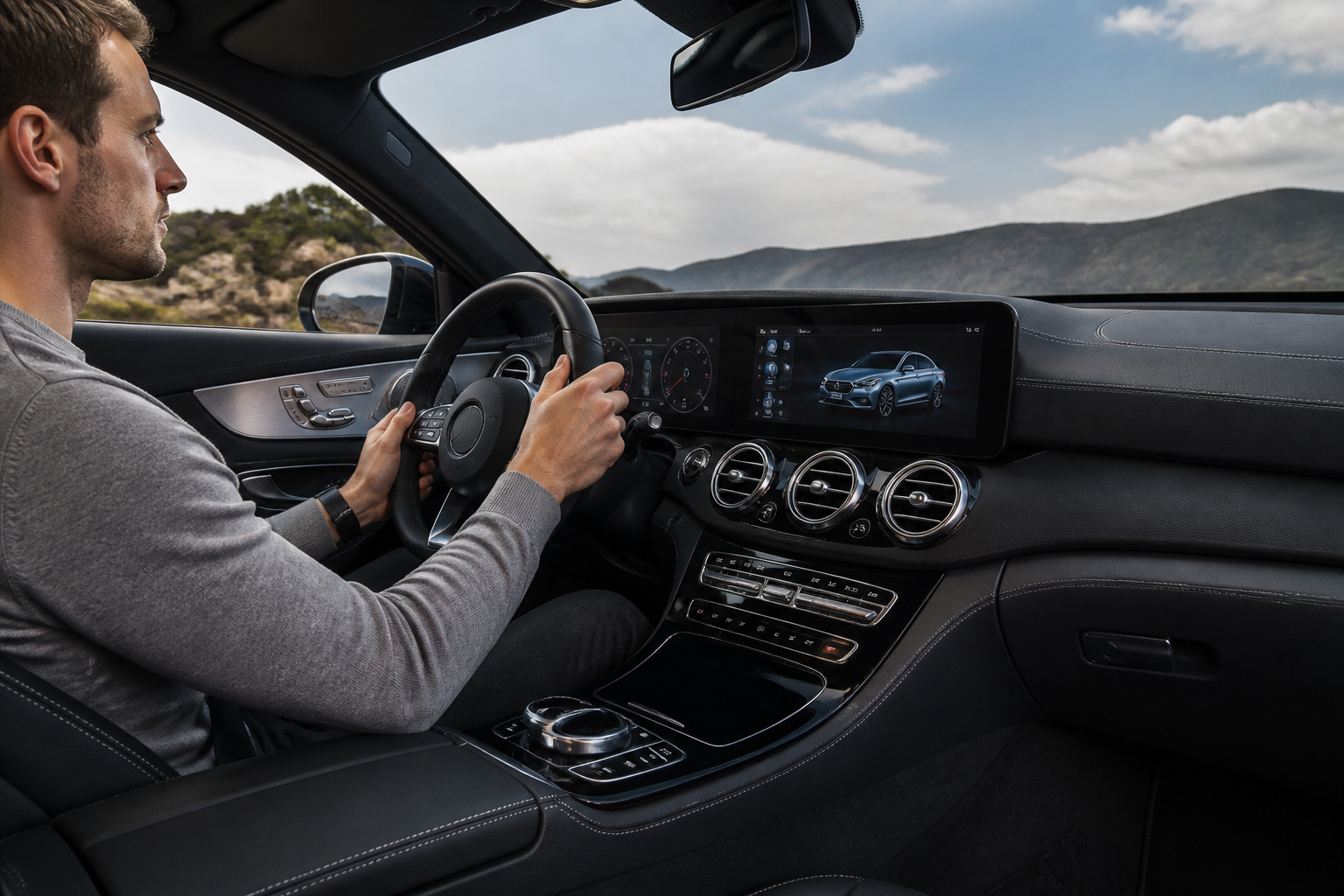
On many Mercedes-Benz models, you switch drive programs using either a dedicated DYNAMIC SELECT switch or through the vehicle’s multimedia system. The change reconfigures engine/transmission management, suspension, steering, and, depending on the software and model, ESP and driver-assistance behavior. In daily driving you’ll notice differences in throttle response, shift timing, steering feel, and ride quality as you move from, say, Comfort to Sport. It’s worth noting that some functions, such as ECO start/stop, may be enabled or disabled by program choice, while others—like brake feel or lane-keeping assistance—remain available but behave differently per mode. For precise steps, refer to your model’s operator’s manual: the cited 2016 C-Class Sedan manual and 2018 E-Class Wagon manual provide practical switching guidance and the exact effects described for those vehicles.
Practical guidance for common driving scenarios
- Urban stop-and-go: Comfort or Eco is typically appropriate, offering smooth responses and efficient operation without demanding driver effort.
- Expressway cruising: Comfort continues to be a balanced choice, but if you want quicker response for overtakes or merging, Sport can be engaged.
- Curvy rural roads or a spirited drive: Sport or Sport Plus often deliver more immediate throttle response, sharper steering, and a more immediate connection to the road; be mindful that ride may become stiffer and road imperfections more noticeable.
- Variable conditions or mixed driving: Individual lets you tailor engine feel, transmission mapping, and chassis response to current conditions without leaving the general drive-mode family, providing a personalized balance of comfort and performance.
Model-specific variations you should know
While the broad concept remains consistent, the exact changes attributed to each drive program can differ by model year and by the hardware/software combination in a given car. AMG-tuned variants and AMG-specific supplements may separate the on-road and off-road drive programs and provide more granular adjustments to steering, throttle control, shift timing, and stabilization logic. The AMG GLS Owners Manual Supplement (March 2025) explicitly notes that some off-road drive programs are not suitable for public roads and underscores that you can tweak certain parameters like suspension and drive-related components within the Individual drive program. Always consult the program descriptions in the vehicle’s official manual for your exact model and year to confirm which systems are affected and how to operate them safely.
Best practices for using DYNAMIC SELECT responsibly
Use DYNAMIC SELECT as a tool to optimize comfort, efficiency, or performance for the current drive context, not as a substitute for attentive driving. Changes to a mode take effect as soon as the system applies the new settings, but you should still monitor steering feel, brake response, and stability as you transition. If you regularly drive in a family of conditions (city, highway, occasional sporty back roads, varying weather), testing a short sequence of modes on a safe stretch can help you understand how each setting changes your car’s behavior before you need it in a critical moment.
Conclusion: leveraging DYNAMIC SELECT to fit your day-to-day needs
Dynamic Select provides a straightforward way to tailor Mercedes-Benz driving dynamics to your priorities—comfort for daily life, sport for engaging driving, or economy for efficiency. By selecting from Individual, Sport Plus, Sport, Comfort, or Eco, you influence how the drivetrain responds, how the chassis and steering feel, and how some driver-assistance features interact with the vehicle. To ensure you’re applying the right program for your model, check the operator’s manual for your specific year and trim; the fundamentals described here are grounded in published Mercedes-Benz guidance and illustrate how drivers typically experience these modes across common road conditions. Primary source materials cited include the 2016 C-Class Sedan Operator’s Manual and the 2018 E-Class Wagon Operator’s Manual, which demonstrate the standard functionality and the practical steps to switch drive programs.
Sources