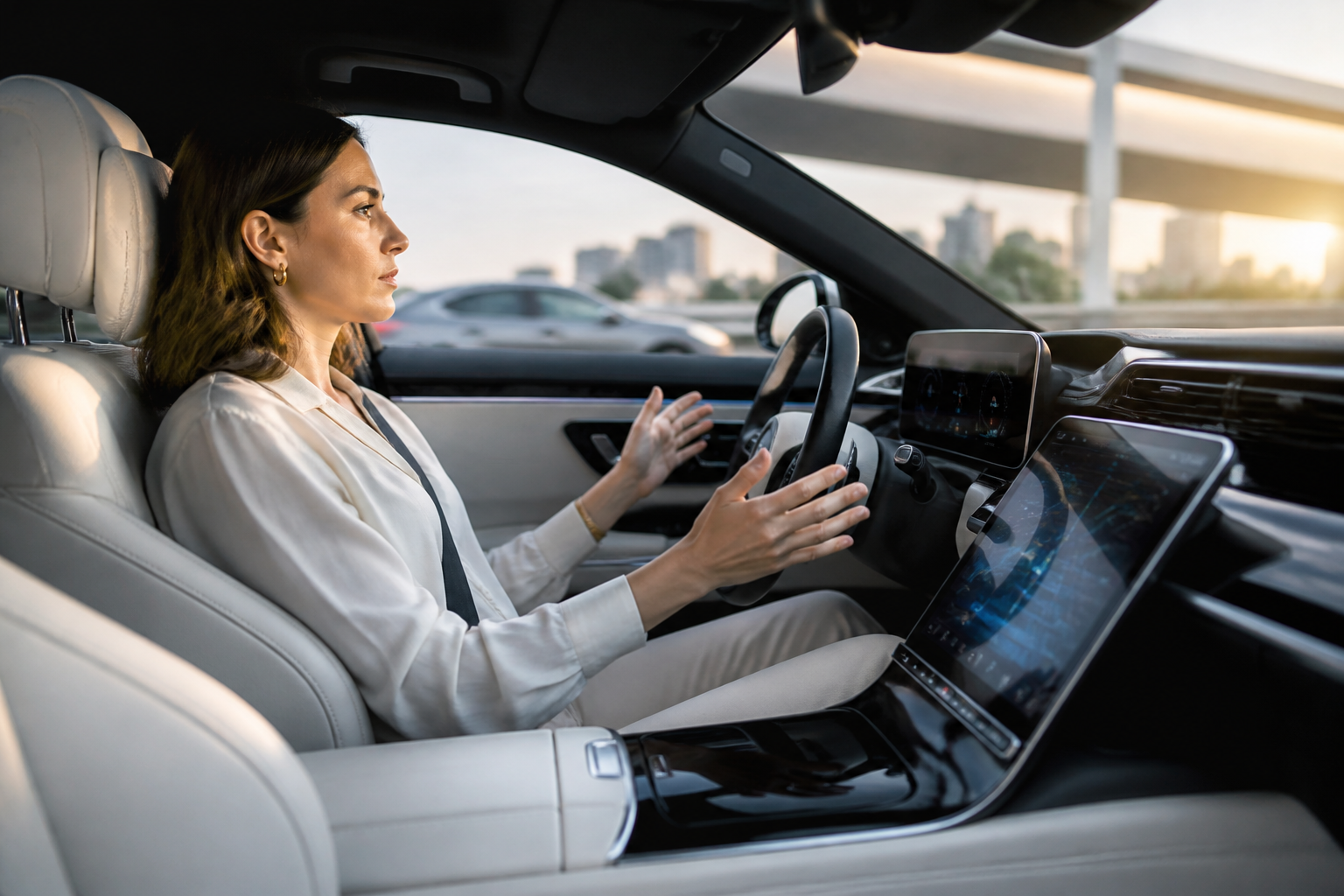
When a DRIVE PILOT takeover request is issued, immediately take back control by placing hands on the steering wheel and keeping eyes on the road, then steer, brake, or accelerate as needed. If you do not respond within the ten-second window, the vehicle initiates an emergency stop: brakes in the lane, hazard lights on, parking brake engaged, emergency call activated, and doors unlocked for emergency access.
Key takeaways
- DRIVE PILOT is conditional automation requiring driver readiness to intervene when prompted.
- Respond within ten seconds by taking hands-on control and keeping eyes on the road.
- A missed takeover triggers an automatic emergency stop with hazard signals, parking brake, emergency call, and door unlocks.
What to do during a DRIVE PILOT takeover request
Mercedes-Benz positions DRIVE PILOT as SAE Level 3 conditional automation on eligible routes. In this setup, the driver remains the fallback operator and must be ready to resume manual control when the system asks. The core instruction is straightforward: at the moment DRIVE PILOT issues a takeover request, the driver should immediately begin reestablishing full manual control. This means hands on the wheel and eyes on the road, prepared to respond to conditions the system may not handle.
To execute a takeover effectively, use a practical, in-situ approach that fits your current driving context. The following steps translate the guidance into actionable habits you can practice on familiar routes and in unfamiliar conditions alike:
- Hands and eyes on task: Place both hands on the steering wheel with a ready-to-steer grip. Keep your eyes scanning the road ahead, avoiding prolonged glances at devices, smartphone mounts, or the cabin screens. Establish a neutral, ready position that minimizes delay when you need to steer, brake, or accelerate.
- Manual control readiness: Be prepared to steer to avoid hazards, brake to reduce speed when needed, and smoothly reapply throttle to reestablish full control as the situation requires. Your input should be calm, deliberate, and coordinated with the vehicle’s cues to avoid destabilizing maneuvers.
- Situational re-scan: Reassess mirrors, blind spots, and the traffic around you. Expect other road users to react to your takeover and to the vehicle’s ongoing maneuvers during the transition. A quick, methodical sweep helps you understand nearby gaps, pedestrian activity, and potential follow-on decisions.
- Communicate intent implicitly: If the system allows, smooth transitions in steering and speed communicate to surrounding drivers that you are resuming control. Predictable, gradual inputs help maintain safety margins for vehicles adjacent to you.
This approach aligns with the SAE concept of a takeover-ready role: the system performs driving tasks within its limits, while the human must be ready to intervene promptly when prompted. The emphasis is on active attention and timely action, not passive monitoring or disengagement.
What happens if you don’t respond within the 10-second window
Official guidance from Mercedes-Benz describes a defined takeover response window. If you do not respond within the maximum allotted time, DRIVE PILOT enters an emergency stop protocol designed to minimize risk. The typical sequence includes the following phases, though exact implementation can vary by software version and vehicle model:
- Autonomous withdrawal: The system prioritizes safety by initiating controlled braking and maintaining the current lane position as it brings the vehicle to a stop within its lane.
- Signal and hazard indication: Hazard lights activate to alert following traffic that the vehicle is stopping under automated control and requiring human intervention to resume operation.
- Post-stop safety procedures: After coming to rest, the vehicle may engage the parking brake and activate emergency call or alert functions. Doors often unlock to facilitate assistance if needed by responders.
Once stationary, the vehicle remains in a safe, standstill state until human intervention occurs. A recovery path exists once the driver meets the takeover criteria, or if the vehicle’s safety logic requires intervention under abnormal conditions. In practice, this emergency-stop logic is a last-resort safety mechanism to limit exposure to ongoing risk when the operator cannot or will not respond.
Safety framework and operational context
Understanding DRIVE PILOT requires viewing it within a broader safety and regulatory landscape. Mercedes-Benz describes DRIVE PILOT as conditional automation (SAE Level 3) with a “fallback-ready” driver. The operational takeaway for owners is that the system can manage many driving tasks on eligible routes, but the human must be prepared to take over when prompted and remain attentive during automation-enabled driving.
Regulatory bodies reinforce this responsibility. The U.S. National Highway Traffic Safety Administration (NHTSA) emphasizes driver availability for takeover in automated driving scenarios and frames the user’s role as a shared safety responsibility. SAE J3016 provides standardized terminology to explain the different levels and intervention requirements, including the concept of a takeover-ready user when the system requests intervention. These standards help set expectations for how to interact with conditional automation across vehicles and manufacturers.
In practice, you should expect a staged sequence: a takeover cue (visual, auditory, or haptic), a brief window to respond (commonly referenced as a 10-second interval), and a controlled stop if the window is missed. The exact choreography can vary by model, software version, and road conditions, but the guiding principle remains: the driver must be ready to resume manual control when the system asks.
For further reference, consult the official DRIVE PILOT materials and safety guidance sources. Notable documents include the Mercedes-Benz DRIVE PILOT overview and the NHTSA automated vehicle safety resources. Mercedes-Benz DRIVE PILOT overview and NHTSA automated vehicle safety.
Practical considerations for owners
- Know your window: The takeover window is designed to be short and decisive. Plan to have hands ready and eyes on the road as soon as the system signals a takeover. Don’t delay by searching for controls or looking away from the road too long.
- Choose your environment wisely: On highways or in dense traffic, stay especially vigilant for the need to intervene promptly. In unfamiliar or constrained environments (construction zones, narrow lanes), the system may require faster or more precise inputs to reestablish safe control.
- Prepare for stakeholder actions: Other road users may react to your takeover, such as adjusting their own speed or lane position. Make your reentry maneuvers smooth and predictable, using clear steering, moderate braking, and controlled acceleration to reestablish safe margins.
- Avoid overreliance and device distraction: Do not assume automation will handle every scenario. Maintain situational awareness, keep hands ready, and use the system within its defined limits. Treat DRIVE PILOT as a tool that augments driving, not a substitute for attention.
Limitations and caveats to consider include that takeover timing can be affected by software version, sensor performance, or environmental conditions such as adverse weather or poor road markings. Different Mercedes-Benz model variants may implement the takeover sequence with minor variations, so always refer to your vehicle’s user manual for model-specific guidance. Also remember that the emergency stop behavior is a safety feature intended to reduce risk, not punitive action; it is designed to bring the vehicle to a secure halt when the system cannot ensure safe operation without human input.
For readers seeking deeper understanding, the source material from Mercedes-Benz and regulatory bodies offers the most authoritative guidance. The DRIVE PILOT overview provides direct explanations of when and how to take over, while NHTSA resources frame safe operation in the broader context of automated driving systems. Consider reviewing SAE J3016 definitions to better understand the terminology and expected human role across different automation levels.
Sources