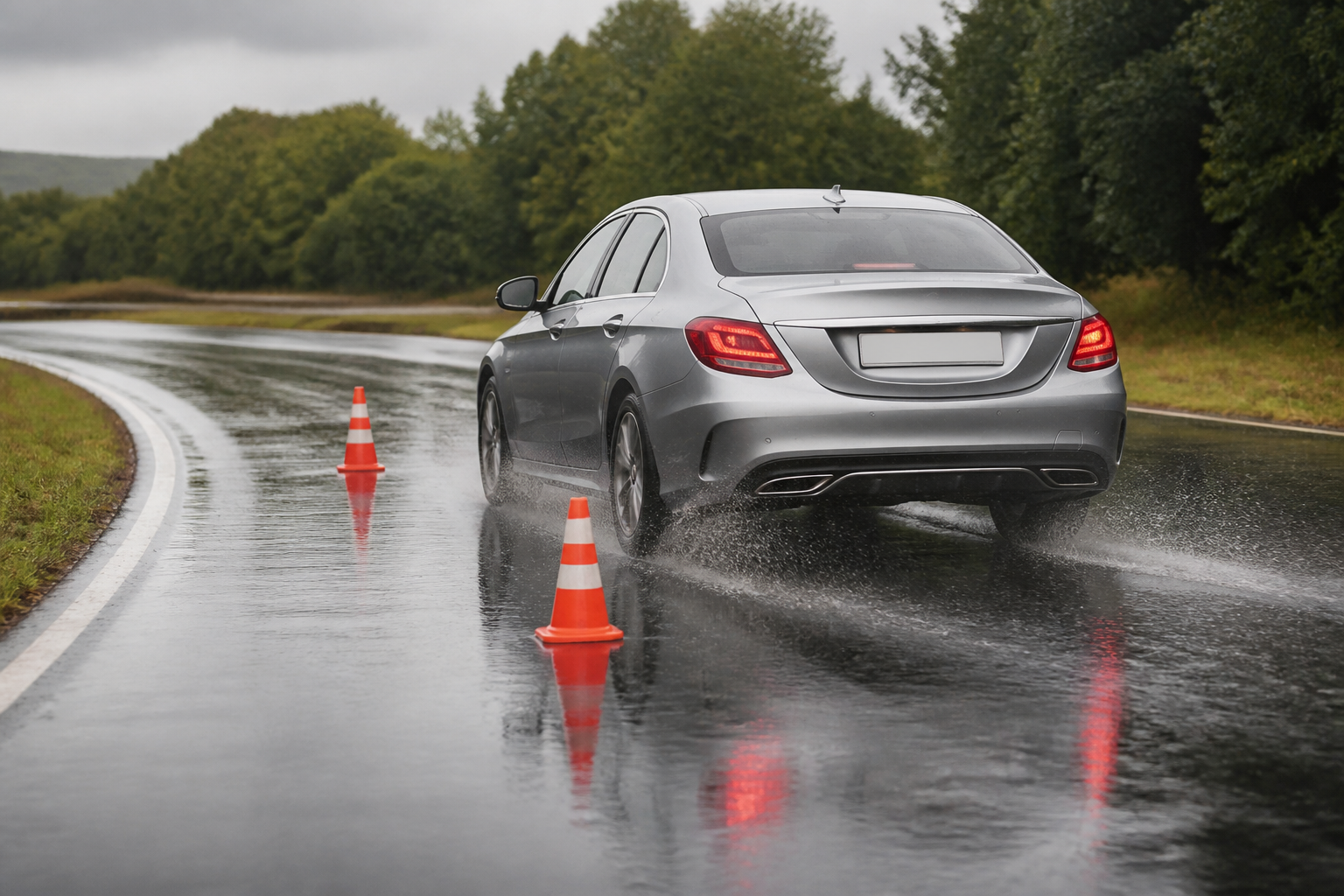
Mercedes ESP® stabilizes the vehicle on wet roads by targeted wheel braking and steering assistance. When ESP® is active, it intervenes to keep the vehicle on a safe path; turning ESP® off is not recommended in slippery conditions because stability control helps prevent loss of control. Drivers should use smooth inputs, anticipate ESP® activation, and rely on the system while adjusting speed and steering to maintain control.
Key takeaways
- ESP® stabilizes with wheel-specific braking to maintain control on wet surfaces.
- ESP® is part of a broader safety system and should not be turned off in wet conditions.
- When ESP® intervenes, drive with smooth inputs and stay attentive to lamp indicators; abrupt actions can override stability and increase risk.
Mercedes ESP® (Electronic Stability Program) is a cornerstone of modern driving safety, especially when road surfaces are wet, slick, or otherwise unpredictable. Far from a mere fault indicator, ESP® actively coordinates braking and, when required, torque distribution to help keep the vehicle on the driver’s intended path. Its core purpose is to support the driver’s inputs, not to override them; on slippery surfaces it serves as a safety net that counters oversteer, understeer, and yaw that can lead to a loss of control.
Understanding how ESP® behaves on wet roads requires appreciating how grip, steering input, and vehicle dynamics interact. The system continuously monitors wheel speeds, steering wheel angle, yaw rate, and lateral acceleration. When it detects a deviation from the driver’s intended trajectory that could precipitate a skid, ESP® responds in fractions of a second by applying brake pressure to individual wheels and, if necessary, modulating engine torque. This targeted intervention helps re-align the vehicle with the driver’s intended path, reducing the likelihood of a sudden spin or slide.
Recognizing ESP® lamp states helps you interpret how the system is acting. By default, ESP® remains active, and you may see an indicator flash or illuminate briefly when the system intervenes. If the ESP® OFF warning lamp is lit, ESP® has been disabled; in that state, the system no longer curtails engine torque and does not actively stabilize the vehicle. Traction control may still function, but stability assistance is reduced. Interpreting these cues allows you to adjust your inputs proactively rather than reacting to a late intervention.
Crucially, even with ESP® active, the driver’s inputs determine the outcome. The system cannot compensate for excessive speed, abrupt steering, or sudden, hard braking. In practice, ESP® is most effective when paired with a calm, measured driving style. The goal is to maintain directional stability through a combination of smooth steering, progressive braking, and measured throttle application, particularly through wet corners, where grip can change rapidly as surface texture and water film vary across the lane.
What to do when ESP® intervenes on wet roads
- Expect and respect the intervention: on wet pavement, ESP® may brake one or more wheels to rebalance yaw and slip. Avoid fighting the system with abrupt steering or heavy throttle that could worsen instability.
- Maintain smooth inputs: keep steering motions gradual, steer toward the intended path with small, controlled corrections, and apply throttle gently. Sudden inputs can provoke new slip even as ESP® works to stabilize the vehicle.
- Follow lamp cues: a flashing ESP® indicator typically signals active intervention. If the lamp stays steady or shows OFF, reassess speed and steering. If you notice abnormal braking behavior or persistent instability, plan a stop to check the system.
- Anticipate grip changes: surface texture changes—such as painted lines, metal intersections, or manhole covers—can create abrupt grip variations. Anticipate these with lighter, more progressive inputs and allow ESP® to maintain control through the transition.
Driver inputs during ESP® intervention should align with the system’s intent: preserve directional stability, minimize yaw, and maintain momentum along the planned line. The combined effect of wheel-selective braking and steering assistance is to nudge the vehicle back toward the driver’s intended course, especially in curves or during transitions. The recommended approach is to work with the system rather than attempting to “get more power” by turning ESP® off or by aggressive throttle or steering in a moment of perceived instability.
Why turning ESP® off is rarely helpful on slippery surfaces
Disabling ESP® removes a critical layer of stability control that helps the vehicle stay connected to the road when grip is compromised. With ESP® off, engine torque is less restricted and wheel spin can increase, making it harder to maintain a controlled trajectory through corners or during braking on wet pavement. ESP® provides coordinated brake actuation and, when needed, torque management to damp slip and yaw, which is especially valuable on wet asphalt where traction is inconsistent.
There are rare, specialized scenarios where some drivers consider disengaging ESP® (for example, certain off-road or deep-snow maneuvers). In standard on-road driving, however, the consensus among manufacturers and safety organizations is to keep ESP® engaged and to adapt driving style to the conditions rather than deactivate stability control.
Practical guidelines and limitations
- ESP® is part of a broader stabilization toolkit, including traction control, brake assist, and steering inputs. It supports but does not replace driver skill, judgment, and vigilance.
- In many Mercedes-Benz vehicles, ESP® works with other safety features (such as brake assist and torque management) to stabilize the vehicle more efficiently under low-traction conditions.
- When ESP® is active, engine torque reduction helps reduce wheel slip and supports maintaining the intended path through corners or during acceleration on a slippery surface.
- If you notice persistent instability, unusual braking behavior, or the system failing to regain control, have the stability-control system inspected. Sensor or actuator issues can degrade ESP® performance and require service.
Interpreting ESP® in the context of safety research
Independent safety assessments emphasize that Electronic Stability Control systems, including ESP®, provide meaningful real-world benefits on wet and slippery roads. ESC/ESP contributes to maintaining control through curves, reduces the likelihood of loss-of-control crashes, and is associated with reduced rollover risk. This aligns with the driver-focused technique of recognizing lamp cues and adjusting inputs rather than bypassing the system. Stability-control systems are designed to assist the driver, particularly in cornering and braking events where grip is marginal, rather than function as a substitute for cautious, proactive driving.
In summary, when driving on wet surfaces with ESP® active, the safest, most effective approach is to maintain a steady speed, apply inputs smoothly, and rely on the system’s targeted braking and torque-management to keep the vehicle on its intended path. Do not attempt to defeat ESP® with aggressive inputs or deliberate wheel spin; instead, anticipate, adapt, and let the stability system work as designed.
Source material and research notes illustrate how ESP® behaves in practice, including operator’s manual guidance on activation states and steering assistance on wet surfaces, Mercedes-Benz technology overviews, and IIHS analyses of ESC benefits.
Source excerpts:
- Driving safety systems — Deactivating/activating ESP® (Mercedes-Build Operator’s Manual, MY15 B-Class Electric) – MBUSA: https://www.mbusa.com/content/dam/mb-nafta/us/owners/manuals/2015/operators/MY15_B-Class_Electric_Operator.pdf
- Pioneer for increased safety — ESP® stabilizes through targeted braking intervention – Mercedes-Benz Group: https://group.mercedes-benz.com/technology/innovation/development/accident-free-driving.html
- Life-saving benefits of ESC continue to accrue – IIHS: https://www.iihs.org/news/detail/life-saving-benefits-of-esc-continue-to-accrue
Sources