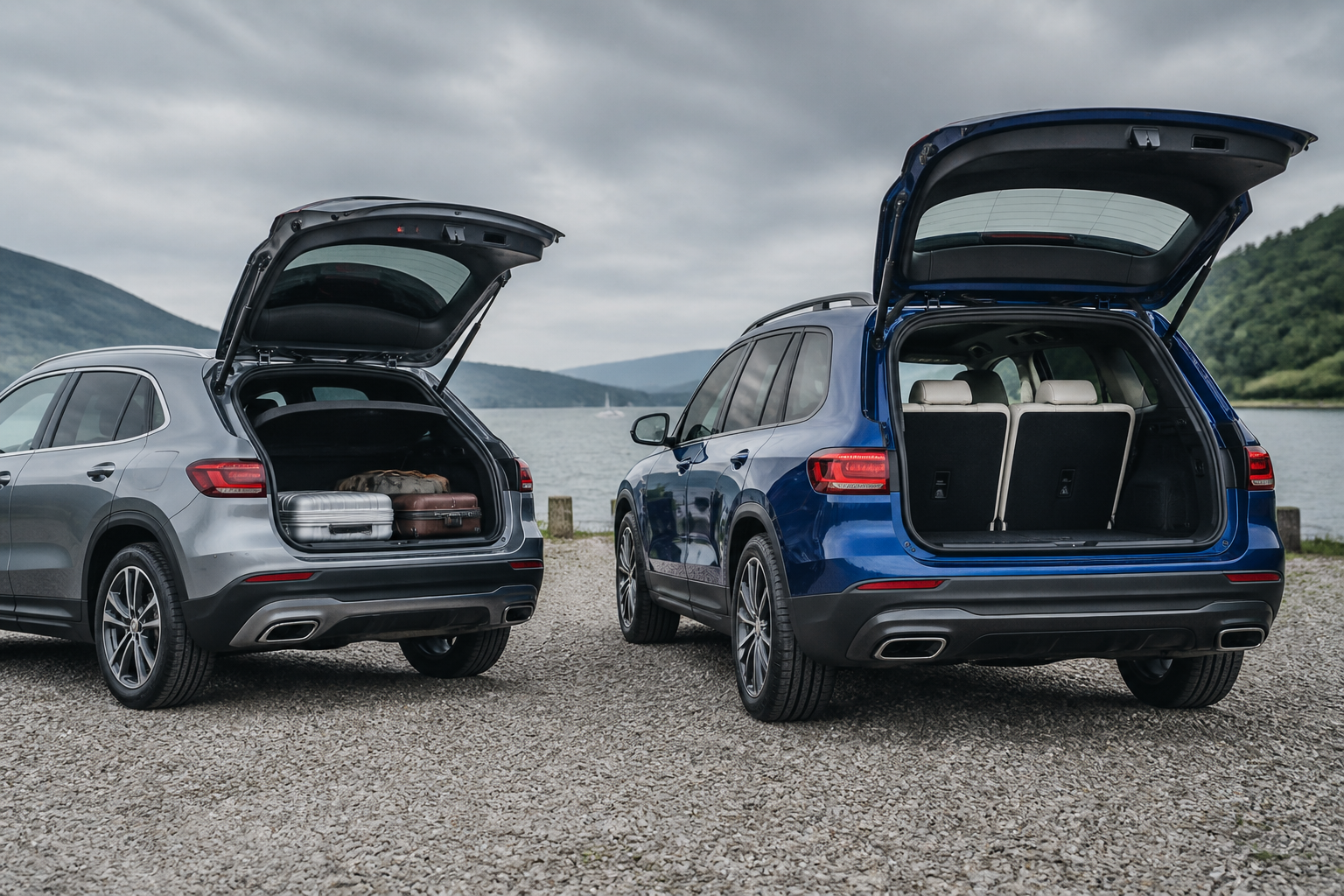
For families choosing between the GLA 250 and GLB 250, the GLB generally offers more rear-seat headroom and cargo versatility due to its taller interior, making it a stronger pick for frequent cargo-heavy trips. The GLA 250 provides a more compact footprint with solid cargo where seats are folded but may be less forgiving for bulkier items. Refer to MBUSA official specs for exact cargo capacities and compare with independent cargo-space analyses like Edmunds to confirm which layout best fits your daily hauling needs.
Key takeaways
- GLB 250 typically offers more interior height and flexible cargo space when seats are folded compared to the GLA 250.
- GLA 250 has a smaller footprint with solid cargo capacity behind the rear seats when upright, suitable for city driving and lighter family trips.
- Official MBUSA specifications and independent comparisons should be consulted to quantify cargo dimensions and confirm which model best suits stroller and luggage needs.
Choosing between the Mercedes-Benz GLA 250 and GLB 250 comes down to how each model handles family cargo and rear-seat practicality. This piece combines official specifications with independent assessments to illuminate how much room there is for real-world hauling—strollers, groceries, and weekend luggage—while keeping daily usability in sharp focus.
Baseline dimensions and cargo capacity: what the numbers say
The GLA 250 SUV provides a defined cargo capacity figure in its official specifications, establishing a baseline for comparison against the GLB. Manufacturer data lists cargo capacity as a key metric for evaluating how much fits behind the rear seats with seats up and how that changes when space is reconfigured for larger loads. Official pages emphasize cargo volume as a major factor in everyday practicality, including how easy it is to load items such as a stroller, a couple of carry-on bags, and a grocery run. Independent comparisons corroborate how this space translates to real-world use, particularly when the rear bench is in its standard position.
In parallel, the GLB 250’s official specification sheet confirms its cargo metrics, which are often framed against the GLA’s footprint. The GLB’s taller, more upright packaging has a direct bearing on trunk volume and load length, with practical implications for families that frequently travel with multiple bags or child gear. Independent readers and editors note how the GLB’s higher load floor and taller interior can influence cargo arrangement and accessibility when loading items from the tailgate, especially when stacking taller objects or using modular storage solutions.
Rear-seat practicality: how comfortable are passengers?
Rear-seat room is a frequent deciding factor for family buyers. Manufacturer data for the GLA 250 includes passenger capacity and interior dimensions that establish the baseline for legroom and headroom with seats arranged for typical family use. This helps determine how comfortably it accommodates children and car seats on longer trips, and how that space compares to the GLB, which tends to offer a taller roofline and a more accommodating second-row space in similar configurations.
Independent assessments of rear-seat usability emphasize real-world implications: how easy it is to install child seats, how accessible features are for rear passengers, and how seats up/down affect usable cargo length. The GLB’s design emphasis on interior height can translate to more cargo versatility when the rear seats are folded, supporting taller items and flexible packing for weekends, school runs, and sports gear.
Practical hauling in daily life: what fits when life is busy
For families juggling strollers, sports gear, and luggage, the key question is whether cargo becomes easier to manage in the GLB’s more upright interior versus the GLA’s more compact footprint. The GLA’s trunk volume with the rear seats up provides a compact but efficient space for everyday items; expanding cargo by folding seats down can handle larger loads, though some taller items may require careful loading due to the compact tail opening. The GLB, with its vertical interior geometry, generally offers a more accommodating loading path for bulkier objects when seats are released or folded, aiding trips that mix cargo and passengers.
In both cases, Mercedes-Benz provides clear official figures for cargo capacity to guide buying decisions, while independent editors translate those numbers into usable everyday scenarios. For buyers evaluating either model, a practical check is to measure how many typical items—stroller, two large suitcases, and a grocery run—fit behind the rear seats with seats up, then reassess with seats folded or removed to gauge total capacity for longer trips.
Real-world testing notes and caveats
Because official cargo figures are often reported under standardized conditions, real-world loading can vary with options, trim, and wheel/tyre setups. For example, a model equipped with a full-size spare, underfloor storage, or a panoramic sunroof can slightly alter usable space. In daily life, practical tests—such as loading a standard stroller, two large suitcases, and a week’s worth of groceries—help translate the spec numbers into actionable expectations. Independent editors frequently highlight how accessible loading height and the width of the tail opening influence how easily families can maneuver gear, especially when loading while handling child duties.
How the shapes influence usability
The GLA’s compact footprint is advantageous for urban parking and maneuverability, but its cargo bay sits behind a more traditional hatch opening that can feel narrow when loading bulky items. The GLB’s taller roofline and more upright cargo area improve vertical storage and load-length flexibility, often benefiting families who routinely transport taller items or multiple bags in one go. The trade-off is a slightly larger overall footprint, which matters in tight garages or dense city driving.
Practical guidance for choosing between GLA and GLB
If your priority is maximizing rear-seat space and cargo flexibility for frequent trips with multiple passengers, the GLB’s taller interior and fold-flat second row often translate to more adaptable cargo volumes. If you value a more compact footprint for city driving while still offering a capable cargo load when the rear seats are folded, the GLA 250 remains a strong contender. Both models align with Mercedes-Benz’s emphasis on practical, family-oriented packaging, and the final choice will hinge on whether you prioritize overall volume or a tighter, city-friendly footprint.
For the most reliable assessment, consult the manufacturer pages for exact cargo and interior dimensions and review independent cargo-space comparisons to understand how the numbers translate to your daily routine. See MBUSA’s GLA 250 SUV specifications and GLB 250 SUV specifications for the official figures: GLA 250 specs and GLB 250 specs. Independent comparisons from Edmunds also explore how the cargo volumes stack up, including practice-based insights on rear-seat and cargo changes: Edmunds: GLA vs GLB.