
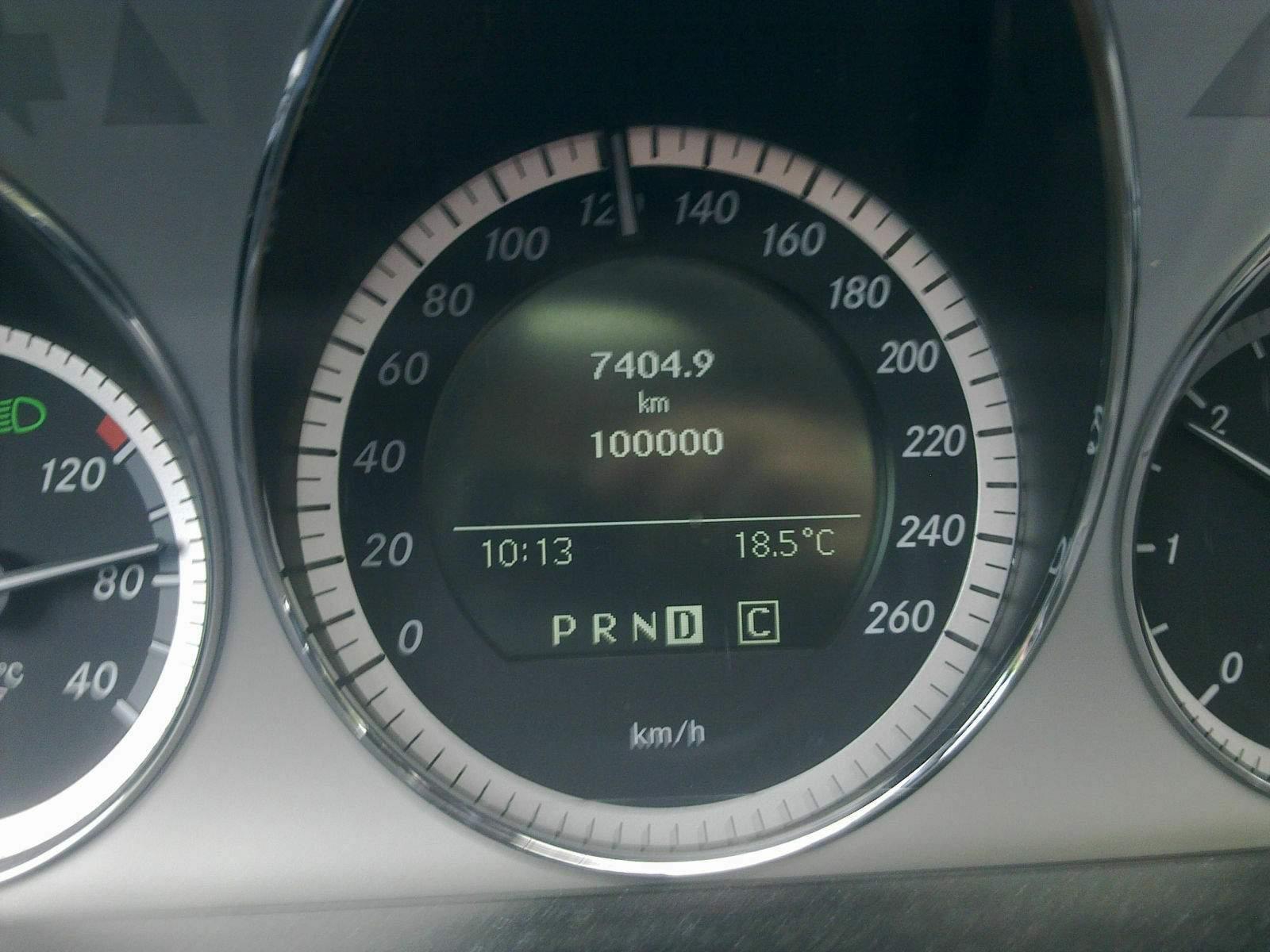
There is no universal mileage at which a used Mercedes-Benz becomes a bad purchase. A 160,000 km car that spent most of its life on long motorway journeys and received correct servicing can be a stronger buy than a 70,000 km car used for repeated short trips, neglected for years and repaired only when warning lights appeared.
Mileage matters, but it is only one variable. The correct buying question is: what does the mileage tell you about the car's use, maintenance and remaining wear items?
Is 100,000 km high mileage for a Mercedes?
For a modern used car, 100,000 km is not automatically excessive. It is a useful threshold because many components may be entering their second phase of service life, but the condition at that mileage varies enormously.
At 100,000 km, look less at the odometer number itself and more at evidence. Has the car received scheduled services? Are the transmission, cooling system, brakes, suspension and batteries healthy? Are the tires evenly worn? Is there evidence of repeated fault-code clearing without repairs?
Mileage bands: how to think about them
| Mileage | What it means to a buyer | Main focus |
|---|---|---|
| Under 50,000 km | Low mileage, but not automatically low risk | Age, short-trip use, accident history, warranty |
| 50,000-100,000 km | Normal used-car territory for many models | Service consistency, tires, brakes, batteries |
| 100,000-160,000 km | Condition and maintenance become dominant | Suspension, leaks, drivetrain service, electronics |
| 160,000 km+ | Can still be viable with strong history | Repair reserve, major wear items, evidence over appearance |
These bands are decision aids, not mechanical expiration dates.
Motorway mileage and city mileage are not equal
A car accumulating distance at stable motorway speed may experience fewer cold starts, less stop-start braking and less low-speed steering input per kilometer. By contrast, a low-mileage urban car may have thousands of short heat cycles, curb impacts, parking damage and long periods where the engine never reaches ideal operating temperature.
Ask the seller how the vehicle was used. Fleet, company and long-distance cars can accumulate mileage quickly while still receiving systematic servicing. A privately owned low-mileage car can look more attractive in an advertisement but have weaker documentation.
Age can matter more than mileage
Low annual mileage does not stop rubber, seals, batteries, tires and fluids from aging. A ten-year-old Mercedes with only 45,000 km still needs an age-based inspection. Check tire date codes, battery history, brake-fluid changes, cooling-system condition and signs of long storage.
Do not pay a large premium for low mileage unless the overall condition supports the odometer story.
Service history: what useful evidence looks like
- Invoices showing date, mileage and actual work performed.
- Consistent intervals rather than a long unexplained gap.
- Correct fluids and parts for the specific engine and transmission.
- Evidence that warning lights and faults were diagnosed, not simply reset.
- Receipts for expensive wear items such as brakes, tires, suspension or batteries.
- Records that match the odometer progression.
A stamp alone is weaker evidence than an itemized invoice.
High mileage can be an opportunity
Some buyers automatically filter out cars above 100,000 km. That can create value if a well-maintained example has already received expensive work. A vehicle with recent tires, brakes, battery, suspension components and complete servicing may be more financially predictable than a lower-mileage car about to need all of those items.
The key is to verify the work. Do not pay for a seller's verbal list of replacements without invoices or physical evidence.
When high mileage should make you walk away
- Service history is missing or inconsistent.
- Multiple dashboard warnings are dismissed as “just a sensor.”
- Engine or transmission behavior changes significantly when hot.
- There is coolant loss, oil leakage or evidence of overheating.
- Tires show severe uneven wear.
- The seller refuses an independent inspection.
- The VIN, mileage and documents do not tell a consistent story.
How much repair reserve should you keep?
There is no single percentage that fits every Mercedes. Build a reserve from the actual car. Price the next service, tire replacement, brakes, battery and any inspection findings before purchase. Then add contingency for failures that cannot be predicted.
Das Motor's out-of-warranty repair reserve guide explains why an average annual maintenance figure is not enough for an older premium car.
A practical buying rule
Do not reject a car because it crossed an arbitrary mileage threshold. Reject it when the mileage, condition, records and asking price no longer form a credible value proposition.
Before purchase, complete the 60-minute Mercedes pre-purchase inspection checklist. If you are comparing generations, also read our guides to W205 vs W206, W213 vs W214 and X253 vs X254 GLC.
Buyer FAQ
Is 200,000 km too much for a Mercedes?
It is high enough that maintenance history and inspection become critical, but the number alone cannot decide the purchase. A neglected 120,000 km car can be worse than a documented 200,000 km motorway car.
Is low mileage always worth more?
No. Low mileage has value only when the condition, age, history and storage pattern support it. Very low mileage can still coexist with old tires, weak batteries, corrosion or repeated short-trip use.
Should I buy a high-mileage diesel?
It can make sense when its previous use, emissions-system condition and service history are appropriate. It is less attractive if the vehicle has spent years doing short urban journeys and shows unresolved emissions or regeneration-related faults.
Continue the cluster


