
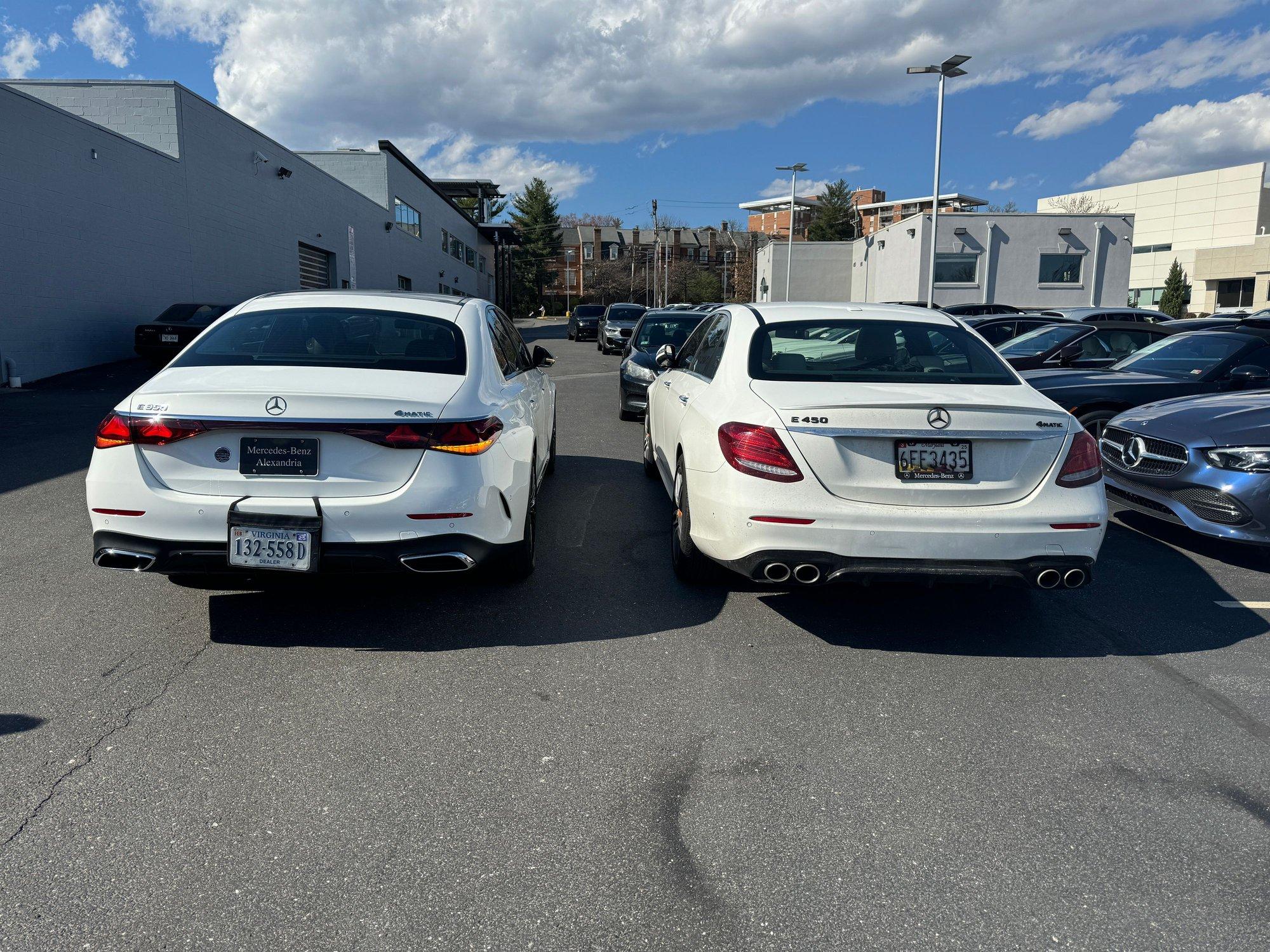
The W213 and W214 Mercedes-Benz E-Class appeal to the same buyer for very different reasons. The W213 is established, widely available and now priced across a broad used-market range. The W214 is the newer generation with more recent digital architecture, electrified powertrains and updated cabin technology. In 2027, the real question is not which car is newer. It is whether the W214's advantages are worth the premium over a carefully selected W213.
W213 vs W214: the buyer's comparison
| Area | W213 | W214 |
|---|---|---|
| Market position | Established used choice | Newer and normally more expensive |
| Technology | Varies significantly between pre-facelift and facelift cars | Newer MBUX generation and more app-focused cabin |
| Powertrain strategy | Wide mix across years and markets | Strong emphasis on electrification and mild-hybrid systems |
| Best value case | Late W213 with strong history | W214 with useful warranty and desired options |
| Key risk | Age, mileage and deferred maintenance | Paying a large technology premium |
The W213 is not one single buying experience
One of the biggest mistakes is comparing every W213 with every W214 as though the older generation remained unchanged. A later facelifted W213 differs meaningfully from an early car in infotainment, steering-wheel design, lighting and available powertrains. That matters because a late W213 may deliver much of the daily technology a buyer wants without the W214 price.
Das Motor already has a focused guide on identifying a facelifted W213 E-Class. Use that before paying a premium for a seller's “facelift” description.
Where the W214 earns its premium
The W214 moves the E-Class further toward a software-defined cabin. Its newer MBUX architecture, available passenger-display concepts, updated connectivity and newer assistance systems make it a stronger choice for drivers who prioritize digital features. It also starts from a newer production date, which may mean more remaining manufacturer coverage on younger examples.
Those advantages are valuable only when you use them. If your priorities are long-distance comfort, quietness, seat quality and a conventional ownership experience, a high-specification W213 can remain extremely competitive.
Comfort: compare wheel size and seats, not just generation
E-Class buyers often focus on chassis generation while ignoring the equipment that has the largest effect on daily comfort. Wheel diameter, tire type, suspension specification and seat design can change the car more than a model-year difference.
Test both vehicles on the same types of roads. Include broken urban surfaces, highway expansion joints and low-speed parking. Listen for suspension noise and compare tire roar. A newer car on aggressive wheels can ride worse for your use than an older example on a more comfort-oriented setup.
Technology check before paying for the W214
- Confirm every display operates without flicker, freezing or warning messages.
- Pair your own phone and test wired and wireless functions where supported.
- Check cameras, parking sensors and driver-assistance systems.
- Verify subscription-dependent features and whether any service must be renewed.
- Confirm the exact factory specification from the VIN.
The Mercedes-Benz VIN and options verification guide explains why badges and dealer descriptions are not enough.
Running-cost reality
The W213 may cost less to purchase, but the oldest examples have accumulated more years of wear. Rubber components, batteries, cooling-system parts, suspension joints, brakes and tires should be budgeted according to condition, not average internet estimates.
The W214 may need fewer age-related repairs at first, but newer electronics and higher initial value can affect insurance, financing and depreciation. A buyer keeping the car for only two or three years should pay particular attention to resale assumptions. A buyer keeping it for eight years should focus more on serviceability and long-term repair exposure.
How to choose between them
Buy a late W213 if you want the strongest value point. Search for a documented, correctly specified car rather than the cheapest listing. A facelift model can be especially attractive because it narrows part of the technology gap.
Buy a W214 if you actively want the newer MBUX environment, newer design, more recent safety architecture and the benefit of a younger vehicle. The premium is easier to justify when the vehicle still has meaningful warranty coverage.
Questions to ask the seller
- What is the VIN and original in-service date?
- Is the car pre-facelift or facelift if it is a W213?
- Which driver-assistance and parking packages are factory-installed?
- Are all software updates and campaigns complete?
- What tires are fitted and how much tread remains?
- Can I see itemized service records rather than only stamped intervals?
- May I arrange an independent pre-purchase inspection?
Buyer FAQ
Is a W214 automatically more reliable because it is newer?
No. It is younger, which can reduce age-related wear, but reliability still depends on the exact powertrain, build, history, software status and use. A poorly maintained newer car can be a worse purchase than a documented older one.
Which is the better motorway car?
Both can be excellent. Compare seat comfort, tire noise, suspension specification, adaptive cruise equipment and actual road condition. Do not infer comfort from generation alone.
Is a facelift W213 the sweet spot?
For many used buyers it can be because it combines a mature chassis with later-generation infotainment and styling. The value depends on the price difference from an early W214 in your market.
Continue the cluster


