Use exterior cues (redesigned headlights and taillights, updated grille, and hood) plus interior changes (MBUX infotainment replacing COMAND and an updated steering wheel) and an engine/trim shift (E450 inline-six mild-hybrid) to verify a facelifted W213 E-Class (2021–2023). Cross-check VINs and service records to avoid price mismatches when the visual cues are subtle.
Key takeaways
- Facelifted W213 E-Class models (2021–2023) have distinct exterior signals: redesigned headlights/taillights, grille, and hood details.
- Interior upgrades include MBUX in place of COMAND and a new steering wheel design.
- Powertrain changes, such as the E450 inline-six mild-hybrid, help confirm model-year beyond visuals.
- Always verify VIN, window sticker, and service history to avoid price mismatches.
- Rely on credible sources for contextual guidance on the facelift features.
When shopping for a used Mercedes-Benz E-Class, distinguishing a facelifted W213 (2021–2023) from earlier builds is essential to avoid overpaying for a model that looks similar on the surface. Buyers should rely on verifiable signals beyond visual appeal: engine and infotainment updates, interior materials and switches, and lighting details that changed with the facelift. This guide expands on practical cues you can verify in photos or in person to ensure you’re comparing like-for-like when assessing asking prices, and it provides decision criteria to help you build a robust buying case.
Exterior cues: the face and the body language of the facelift
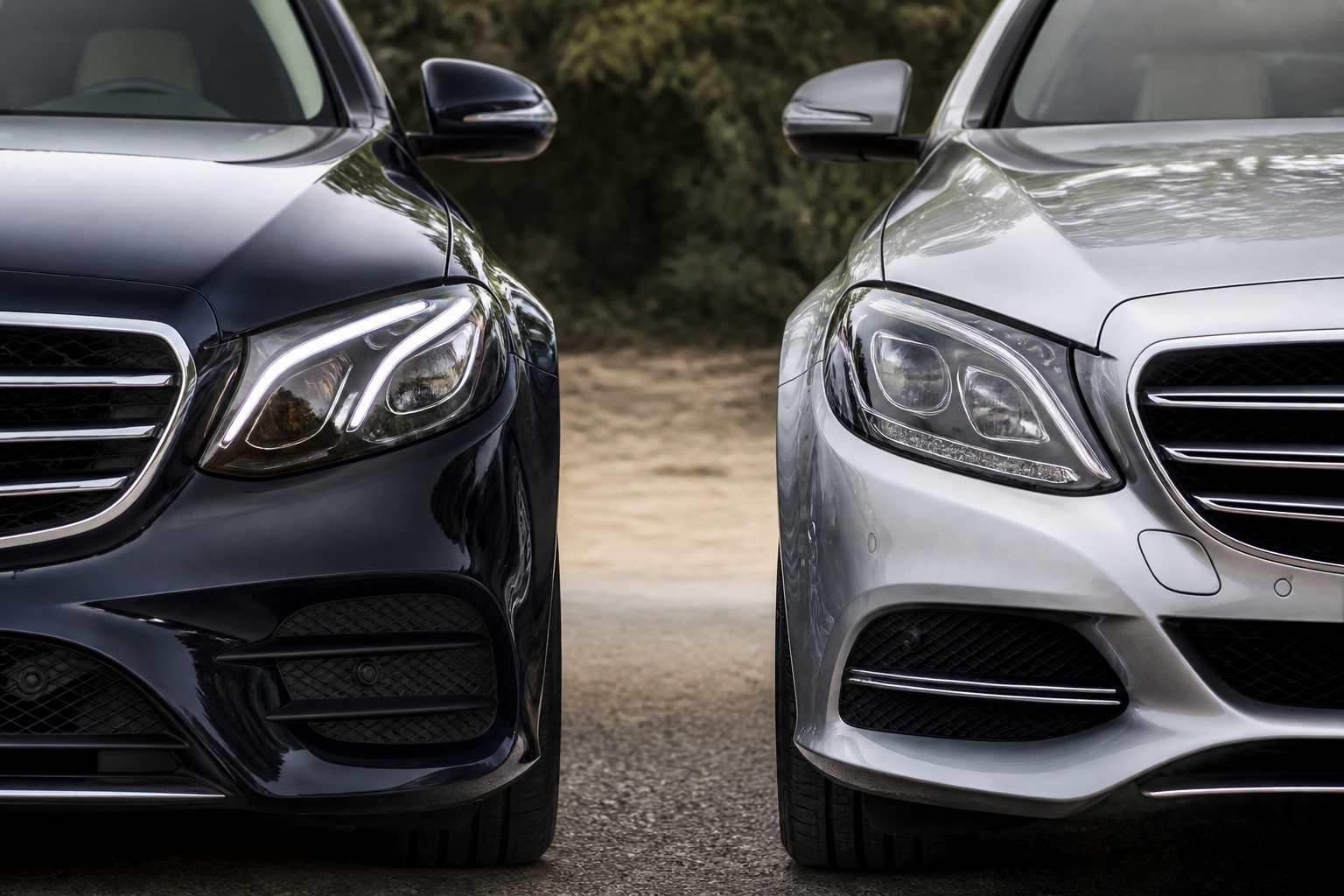
The 2021 refresh brought a clearly defined family look to the W213 generation. Key exterior indicators help you separate facelifted cars from pre-facelift models at a glance, but you should verify several signals in concert to avoid misclassification.
- Headlights and taillights: The facelift features redesigned headlamps with altered internal geometry and, in many trims, revised LED signatures. Taillight assemblies were refreshed as part of the rear-end update. A quick check of light shapes in person or in high-quality photos can be decisive, but keep in mind that aftermarket lighting or later mid-cycle updates in some markets may blur distinctions.
- Grille and front bumper: The grille geometry and the surrounding bumper silhouette receive subtle changes during the facelift. Look for a refined grille pattern and a slightly altered lower air intake area. The overall front fascia tends to look more cohesive with the new headlight design, but exact details can vary by market and trim.
- Hood and fender contours: The updated hood line and smoother transitions near the A-pillar are common in facelift cars. Compare the line flow across several images to confirm alignment with the 2021+ visuals.
- Trunk lid and rear bumper: Minor reshaping around the trunk lip and the lower rear bumper indicate the facelift era. Confirm by comparing the trunk lid emblem placement and the taillight wraparound style in context with the bumper treatment.
Tip: when in doubt, photograph a vehicle from multiple angles (front three-quarter, profile, rear three-quarter) and overlay the images with reference photos from credible sources to spot subtle cues.
Interior and technology cues worth checking
Inside the cabin, the facelift commonly coincided with an upgrade in the multimedia and user-interface experience. The most visible, driver-facing changes are tied to the infotainment system and the steering wheel, but there are broader cabin signals to verify.
- Infotainment system: The switch from COMAND to MBUX is a strong indicator of facelift-era vehicles in many markets. MBUX brings touch-capable controls, voice assistant enhancements, and new menu structures. If a car uses older navigation logic, fewer screens, or an aged control layout, it may predate the 2021 update.
- Steering wheel design and instrumentation: The 2021 refresh often pairs MBUX with a redesigned steering wheel and updated instrument cluster graphics. Contrast the shape, button layout, and display fonts with references to confirm alignment with the facelift model.
- Materials and trim: The facelift often accompanied upgraded interior materials and revised trim finishes. Look for consistent material quality across door tops, dash surfaces, and seat fabric or leather that aligns with documented updates for the post-2020 model year.
Because interior features can be swapped or retrofitted, verify the exact configuration against the VIN and official build sheets rather than assuming based on visuals alone.
Powertrain and related changes you should know
In some markets, the facelift period included engine and drivetrain adjustments that extend beyond the exterior. The E-Class lineup saw the introduction of the E450’s inline-six mild-hybrid engine in place of certain V-6 variants, along with associated tuning and transmission calibrations. While availability varies by region and trim, this powertrain shift is a reliable non-visual cue to corroborate model-year claims made by sellers.
If a seller emphasizes a performance narrative that sounds aligned with a pre-facelift V-6, request documentation such as build sheets, service records showing engine type, or a VIN-derived spec breakdown. Engine notes alone can be misleading if a car has an extensive service history or aftermarket exhaust changes; corroborating with documentation is essential.
Verifying model-year and avoiding price mismatches
Effective verification relies on a combination of official documents, service history, and demonstrable feature checks rather than listing photos alone. A structured approach helps you avoid paying a premium for a car that is not truly the facelift edition.
- VIN-based verification: Use the vehicle identification number to pull the official build data and confirm the model year, powertrain, and infotainment configuration. Cross-reference with Mercedes-Benz databases or authorized services where possible.
- Infotainment and hardware validation: Ensure the car’s advertised features align with the facelift era (MBUX, updated headlamps/taillamps, and the revised interior). If there is any ambiguity, request a printed spec sheet or a window sticker from the original sale, ideally VIN-linked for accuracy.
- Documentation quality: A complete service history, original window sticker, and any recall/Service Campaign documentation bolster buying confidence. Look for consistency between the claimed model year, features, and the documented maintenance milestones.
When prices appear inconsistent with the visible cues, perform a stricter cross-check of model-year claims, trim levels, and drivetrain details. If necessary, engage a pre-purchase inspection by a technician familiar with Mercedes-Benz interiors and electronics to confirm the facelift features.
Practical buying scenarios
- Private-party purchase: Request high-resolution images that clearly show headlight and taillight shapes, grille geometry, and the trunk lid. Obtain the window sticker or Mercedes spec sheet to confirm MBUX versus COMAND and engine type. If photos are insufficient, arrange a face-to-face inspection or a virtual walk-through with a trusted advisor.
- Used-car dealer lots: Evaluate a batch of vehicles for consistency between exterior cues and the stated year. If a 2021+ claim is made but the car shows older lighting elements or a pre-facelift interior, treat it as a potential mismatch and seek clarification or alternatives.
- Certified pre-owned (CPO) programs: Prioritize listings that confirm facelift-era features (MBUX, updated lighting) and provide a complete VIN-linked service history. A credible CPO program should also include a warranty and a transparent inspection report.
What buyers should avoid
Relying solely on photos or superficial cues can lead to misidentification. Visuals may hide interior trim discrepancies, instrument cluster variations, or infotainment hardware differences. If a seller cannot provide verifiable confirmation of the model year or exact configuration, request additional documentation or arrange a pre-purchase inspection with a qualified technician.
For further visual references and context on the facelift changes, consult contemporary coverage from Car and Driver and Edmunds, which detail the visible and non-visual updates introduced with the 2021 W213 refresh: Car and Driver: How to identify a facelifted W213 Mercedes E-Class—and why a 2021–2023 car is not just a cosmetic update and Edmunds: How to identify a facelifted W213 Mercedes E-Class—and why a 2021–2023 car is not just a cosmetic update.
Additional background on the facelift-era changes, including the powertrain and interior updates, is documented in credible reviews that discuss the hybridization trend and cabin refinements. Refer to the linked sources for broader context and verification guidance.
Related Mercedes-Benz guides
- Genuine Mercedes-Benz V Class Rear Wiper Blade For 447 Models
- Genuine Mercedes-Benz SL Class Heated Front Wiper Blades For R231 Models
- Genuine Mercedes-Benz G Class Rear Wiper Blade For 461 & 463 Models
- Genuine Mercedes-Benz G Class Front Wiper Blades For 463 Models
- Genuine Mercedes-Benz G Class Front Wiper Blades For 461 & 463 Models