
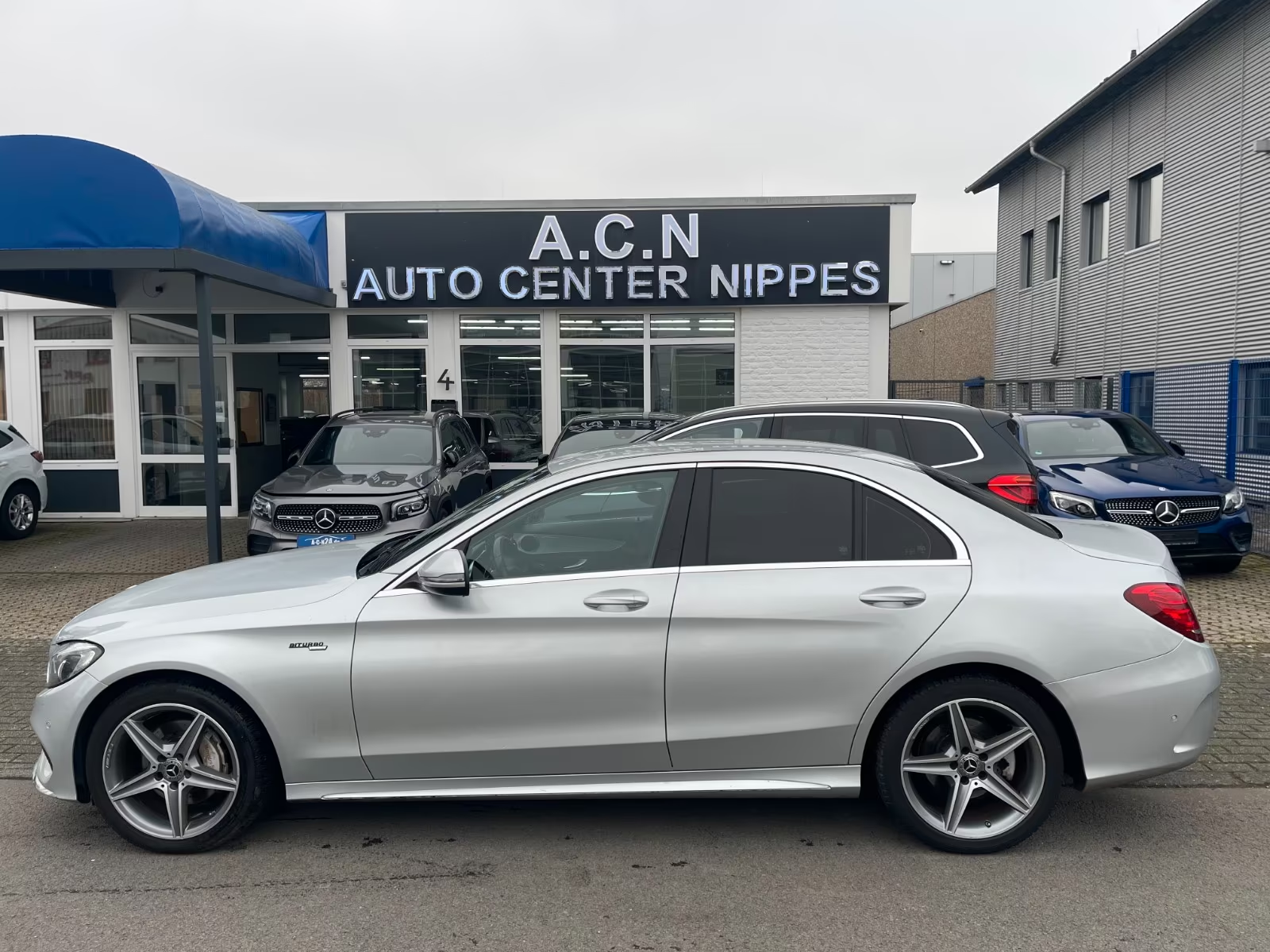
Germany has one of Europe's deepest markets for used Mercedes-Benz vehicles, which makes German-origin cars attractive to buyers across the EU and beyond. The large supply can improve choice, but an imported Mercedes introduces extra verification work: the car's identity, original specification, mileage, service history, ownership documents, tax status and physical condition must all agree.
This guide is not a customs-rate calculator. Tax and registration rules depend on the buyer's country, vehicle age, business status and transaction structure. Its purpose is to show what to verify before money changes hands.
Start with the VIN before discussing price
Ask for the full 17-character VIN before traveling or paying a deposit. Compare it against the windshield, body label and registration documents. Use VIN-linked factory data to identify the model, production period and equipment.
Do not rely on an advertisement that says “AMG,” “Night Package,” “full option” or “German spec.” Appearance parts can be changed. Use the Das Motor VIN and options verification guide to separate factory equipment from later modifications.
Documents to request before travel
- VIN and current odometer reading.
- German registration documents or equivalent ownership records.
- Service invoices and digital-service evidence where available.
- Recent technical-inspection documentation where applicable.
- Purchase invoice or draft sales contract.
- Written statement of whether the advertised price includes or excludes VAT.
- Details of any export, transit or registration process the seller expects you to use.
VAT: never assume the advertised price is your final price
European vehicle advertisements may show gross consumer pricing, net export pricing or both. The correct tax treatment depends on the transaction and buyer. Before paying, ask the seller to state in writing which amount you will actually transfer and what tax treatment appears on the invoice.
If you are buying through a company, provide the seller with the correct legal-entity details before the invoice is issued. Do not try to reconstruct the tax treatment after payment from an advertisement screenshot.
Mileage: build a timeline, not a belief
An odometer reading becomes more credible when it fits a sequence of dated evidence. Compare mileage across service invoices, inspections, repair receipts and ownership records. Look for a smooth progression rather than isolated numbers.
A high-mileage German motorway car is not automatically undesirable. In some cases, fast mileage accumulation with regular servicing can be easier on a vehicle than years of short urban trips. Read our high-mileage Mercedes buying guide before filtering cars purely by kilometers.
Verify the actual specification
German-market cars can have option combinations different from cars originally sold in your country. Check headlights, navigation region, language support, driver-assistance packages, heating equipment, towing hardware, wheel sizes and any subscription-linked functions.
Do not assume that a visually impressive AMG Line car has the same equipment as another AMG Line vehicle. Package content can vary by model year and market.
Accident repair: inspect beyond the paint
Imported cars often pass through multiple sellers before reaching the final buyer. That makes physical inspection important even when a history report looks clean.
- Compare paint texture and color in daylight.
- Look for overspray on seals and plastic trim.
- Check panel gaps and fastener marks.
- Inspect headlamp, bumper and radar/camera mounting areas.
- Check the underbody and suspension mounting points.
- Scan all control modules for stored faults with appropriate diagnostic equipment.
A history report is useful evidence, but it is not a substitute for an independent inspection.
Diesel buyers: match the car to your future use
German used inventory includes many diesel Mercedes-Benz models. They can be excellent for long-distance driving, but buyers who will mainly use the car for short urban journeys should consider whether a diesel emissions system matches that use pattern.
During inspection, verify that there are no emissions warnings, abnormal regeneration symptoms or unresolved diagnostic faults. The exact checks depend on engine and model year.
Plug-in hybrid and electric imports
For a plug-in hybrid or battery-electric Mercedes, the standard used-car inspection is only the beginning. Confirm charging cables, charging-port operation, high-voltage warranty terms, battery diagnostics where available and whether the car's connected services function in the destination market.
Das Motor has a separate used electric Mercedes-Benz buying checklist for battery and charging verification.
Calculate the landed cost before paying a deposit
Your comparison should include more than the seller's price. Build a worksheet with the vehicle price, tax treatment, temporary plates or transport, insurance, registration, technical inspection, travel, currency conversion where relevant and immediate maintenance.
An imported car only represents value if the final registered cost remains attractive after those items are included.
Red flags in an import deal
- The seller will not provide the VIN.
- The invoice price does not match the amount requested by bank transfer.
- The tax explanation changes during the transaction.
- Mileage cannot be supported by dated documents.
- The car is advertised with major options that cannot be verified.
- The seller refuses an independent inspection.
- The buyer is pressured to pay before receiving basic documents.
A safe sequence for the purchase
- Receive VIN, mileage, photos and draft paperwork.
- Verify identity and factory equipment.
- Build a service and mileage timeline.
- Clarify price and tax treatment in writing.
- Arrange an independent inspection.
- Calculate total landed and registration cost.
- Only then finalize payment and transport.
Buyer FAQ
Are German Mercedes-Benz cars better maintained?
Some are exceptionally well maintained and others are not. Country of origin is not proof of maintenance quality. Judge the individual car from records and inspection.
Is a German service book enough?
No. It is useful, but itemized invoices, mileage history and diagnostic inspection provide stronger evidence.
Can I trust a clean history report?
Use it as one source, not the final verdict. Not every repair or incident is guaranteed to appear in a database.
Should I buy from a dealer or private seller?
Either can work. Compare legal protections, documentation, inspection access, payment terms and total price rather than assuming one channel is automatically safer.
Continue the cluster


