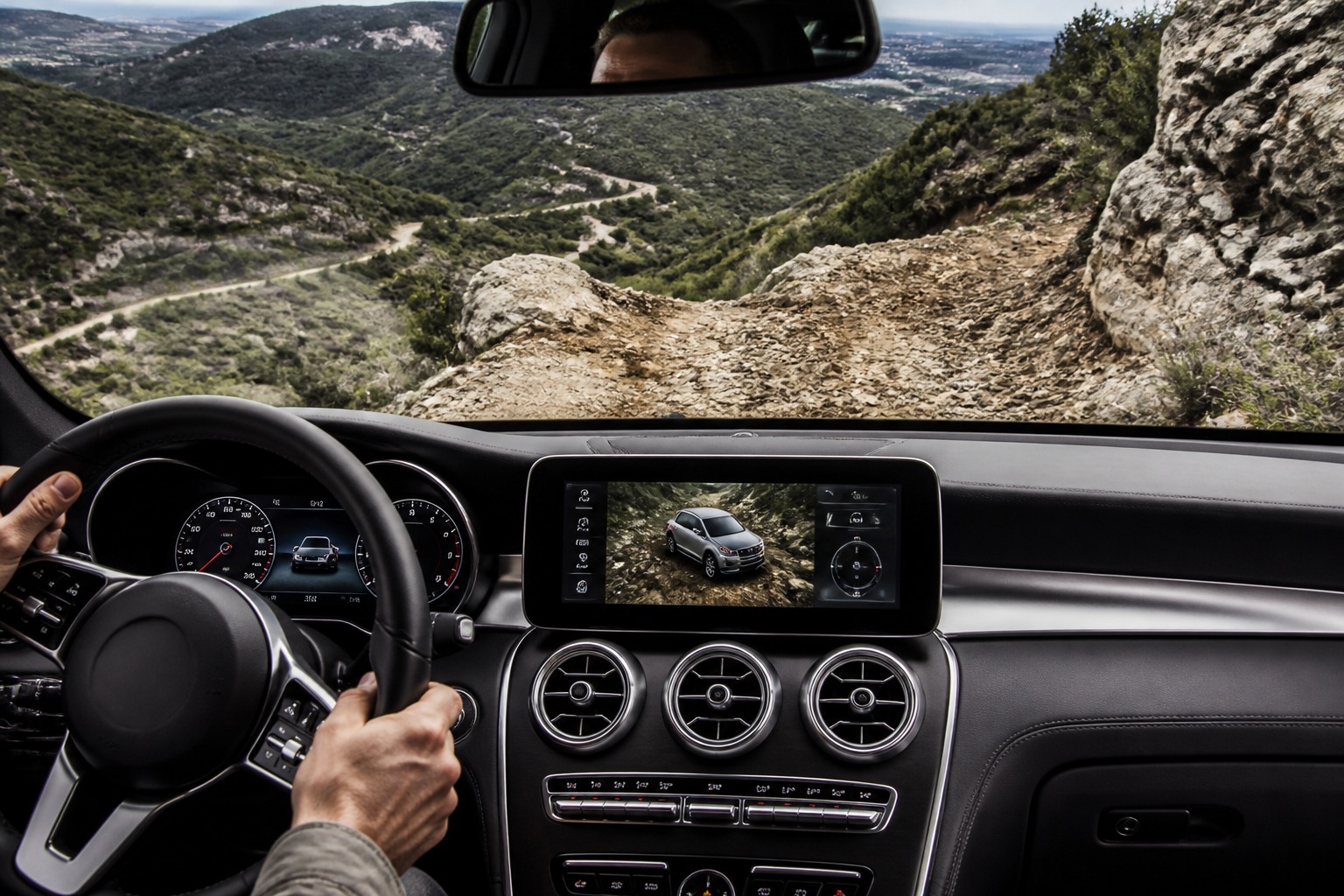
DSR is Mercedes-Benz’s downhill speed control designed to hold a steady, low speed on descents, but it is not a substitute for driver judgment. Engage DSR on predictable downhill grades, set a conservative speed after selecting a lower gear, and be prepared to intervene with steering and light braking if traction changes. Use DSR as an aid, not a replacement for careful descent technique, and always verify terrain conditions and tire health before relying on DSR.
Key takeaways
- DSR helps manage descent speed but does not replace driver control.
- Always select a lower gear before descending to boost engine braking.
- Engage DSR early on steady grades and adapt or disengage when surfaces change or traction is poor.
- DSR is most effective when paired with attentive steering and progressive braking as needed.
- Model availability and behavior vary; consult your specific Mercedes manual for exact instructions.
Downhill speed regulation (DSR) is Mercedes-Benz’s implementation of hill-descent control, a driver-assistance feature designed to help manage vehicle speed on steep descents. It is intended to support the driver by maintaining a controlled pace, reducing the risk of runaway speeds, and minimizing abrupt throttle or brake inputs. DSR does not replace driver judgment or reaction; it is a tool that operates within the constraints of surface conditions, tire grip, weight distribution, and overall vehicle dynamics. The practical takeaway is that successful use of DSR hinges on integrating the system with deliberate steering, throttle control, judicious braking, and constant assessment of terrain. This article lays out a practical decision framework for when to engage DSR, what speeds are reasonable to set, and how to pair DSR with driver input across different grades and surfaces. It draws on live guidance from Mercedes-Benz owner materials and independent evaluation sources to reflect real-world behavior in SUVs and select passenger models.
Core principle: view DSR as an aid that helps maintain a chosen pace on downhill runs, while the driver remains responsible for steering line, surface assessment, and responses to traction changes. DSR is most effective on steady grades with predictable traction and may not prevent loss of control on compromised surfaces. Always anticipate that surface conditions can vary—wet patches, loose gravel, oil on the road, frost, or painted road markings can alter traction suddenly.
Decision framework: when to engage DSR
Use the following practical sequence to decide whether to activate DSR on a descent and how to manage the human–machine interaction:
- Assess the grade and length of the descent. If the slope is long and continuous, DSR can be beneficial for maintaining a consistent speed without requiring constant brake input.
- Evaluate surface conditions before and during the descent. If you encounter patches of water, gravel, ice, oil, or uneven pavement, prepare to intervene even if DSR is active.
- Set an initial target speed that corresponds to the road grade and traffic context. Start conservatively; you can increase or decrease the set speed only if the terrain remains within DSR’s stable operating window.
- Enable DSR before you reach the steeper segments, not in the middle of a sudden decline. A steady ramp-down in speed is easier for the system to manage than a abrupt change.
- Maintain hands on the wheel and eyes on the road. DSR requires driver awareness to respond to steering corrections and unexpected grip changes.
Across Mercedes-Benz models, DSR activation and control can vary by model year and trim. Some vehicles offer a dedicated DSR switch or button, while others place DSR in the vehicle’s driver-assistance or off-road menus. In many configurations, you adjust the target speed using the steering-wheel cruise-control controls. Given those variations, consult your owner’s manual for the precise activation method and settable speed range for your specific model.
Setting the speed: what numbers to use
DSR generally operates within a low-speed, controlled-range. The safe and effective speed is not a single universal value; it depends on grade, surface, tire condition, and vehicle load. Practical guidance from manufacturers and independent reviews points toward these working principles:
- Choose a speed that corresponds to the slope: gentler grades can use 6–15 mph (10–25 km/h) as a starting reference, while steeper descents may require slower speeds. Do not set a speed higher than what you could safely manage with manual braking and steering control.
- Avoid oscillation: if you notice the vehicle repeatedly accelerating and decelerating, reduce the set speed or disengage DSR and resume manual control.
- Correlate speed with traction signals: on wet or uneven surfaces, a lower target speed generally improves stability and gives you more time to react to changes in grip.
When setting the speed, also consider the overall vehicle length and weight distribution, which affect braking distance and the tendency to squat or pitch under gravity. Heavier vehicles demand more caution on poor surfaces, and snow or wet leaves can reduce effective traction even at modest speeds.
DSR versus manual braking: a practical comparison
DSR is an aid, not a substitute for driver input. On smooth, well-maintained grades with good traction, DSR can help keep a steady pace and reduce the cognitive load of constant braking. However, on rough pavement, washing curves, or irregular surfaces, relying solely on DSR can mask evolving hazards. In contrast, manual braking and throttle modulation allow you to respond instantly to surface changes, steering deviations, or obstacle avoidance. A practical approach is to use DSR to maintain a safe baseline speed on long, predictable descents, while keeping your foot near the brake and your eyes ahead to detect changes in road texture, water, or debris. If conditions worsen, switch to full manual control and be prepared to counter steer, adjust gear selection, or apply more aggressive braking if necessary.
Techniques to pair DSR with driver input
Effective use of DSR hinges on a disciplined driving routine:
- Line selection: stay aligned with the fall line to minimize lateral slip. DSR cannot compensate for intentional drift or crossing the center line on narrow descents.
- Gear management: if your descent includes long, gentle grades, engage a lower gear before the descent to boost engine braking in conjunction with DSR. This reduces reliance on the brakes and helps maintain stability.
- Braking discipline: use light, progressive braking only if DSR is insufficient to hold the desired speed. Avoid heavy, abrupt braking that could lead to skidding or loading the axle unevenly.
- Surface monitoring: continuously scan for changing traction indicators such as water spray, glare ice, or loose gravel. Be prepared to disengage DSR and resume manual control as needed.
Limitations and caveats
DSR does not guarantee loss-free descent. Its effectiveness depends on accurate sensor input and stable traction. Limitations include:
- Variations in road texture, slick oil patches, and wet surfaces can cause grip loss beyond what DSR can safely manage.
- Tire condition and inflation pressures significantly influence spin-up, slip, and braking performance on downhill grades.
- Hill descent behavior can differ across model lines and powertrain configurations; EQ models or non-traditional platforms may exhibit different responses to DSR activation.
- DSR should be treated as a system to assist, not to replace driver pay attention and readiness to intervene.
Practical scenarios and recommended actions
Consider a few representative descent scenarios to illustrate decision-making:
- Long, dry, well-surfaced grade with light traffic: engage DSR at a conservative speed, monitor the road, and be ready to override if you encounter unexpected surface changes.
- Steep, wet, and gravelly descent: reduce the target speed further, ensure the fall line is correct, and be prepared to disengage DSR to allow more aggressive control if needed.
- Descent with changing terrain and patches of oil: avoid relying on DSR as the sole control; switch to manual control as soon as surface conditions begin to degrade and re-engage only if you regain stable traction.
What to do if you need to override or disengage DSR
If you determine DSR is not appropriate for a given segment, disengage safely and resume direct control. The common safe disengagement approach is to briefly lift off the accelerator to decouple throttle input, then use the brake pedal or steering inputs to maintain control while reducing speed in a controlled manner. After disengaging, re-evaluate the descent line and terrain before re-engaging DSR if conditions improve.
FAQ highlights
When is it unsafe to rely on DSR? DSR is unsafe to rely on when traction is inconsistent or rapidly changing, such as on flooded, icy, or oily surfaces, or on surfaces with loose gravel or sand. How do you override or disengage safely? Identify the appropriate time to take manual control, ease off the accelerator, and use gradual braking to maintain control; consult your vehicle’s manual for the exact disengagement procedure for your model.
Sources
- Mercedes Downhill Speed Regulation: When to Use DSR, How to Set It, and Why It Doesn’t Replace Careful Descent Technique
- Mercedes GLE Downhill Driving: Use a Low Gear, Keep the Wheels Straight, and Treat DSR as an Aid
Frequently asked questions
When is it unsafe to rely on DSR?
DSR should not be relied upon on surfaces with poor traction (ice, loose gravel, snow) or where visibility and terrain demand precise control. Always be ready to override with braking or steering as conditions require.
How do I disengage or override DSR safely?
If you need to take manual control, smoothly reduce the set speed or switch off DSR using the vehicle controls, then resume normal braking and throttle input as needed while maintaining control of steering.
Does DSR replace the need to check road conditions?
No. DSR aids speed management, but drivers must assess surface conditions, tire condition, and steering alignment before and during descent.
Related Mercedes-Benz guides