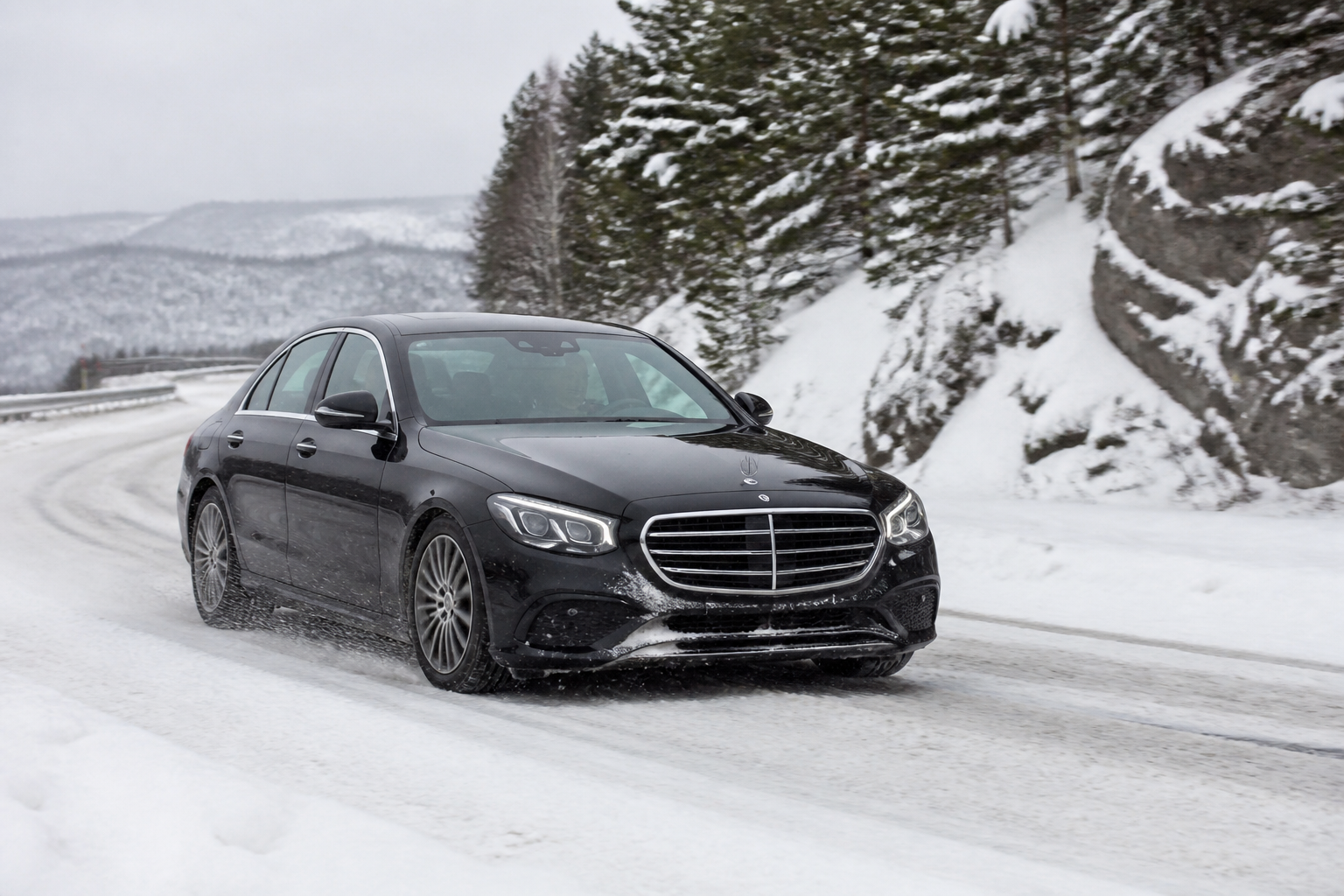
4MATIC helps you start moving and maintain momentum on snowy surfaces, but it does not improve braking or turning limits. For safety, combine gradual inputs and longer following distances with four winter tires, which provide a larger safety margin than AWD alone.
Key takeaways
- 4MATIC aids acceleration in snow but does not reduce tire grip limits for braking or turning.
- In snow, tire grip governs braking and cornering; AWD cannot compensate for degraded tire traction.
- Four winter tires deliver the largest safety margin for winter driving on Mercedes-Benz models.
- ABS should be used with steady, progressive braking and steering when necessary.
- Regular maintenance of tires and winter-ready preparation enhances safety beyond drivetrain advantages.
Winter driving with 4MATIC traction limits is a topic that frequently surfaces among Mercedes-Benz owners and prospective buyers. The core reality remains: all-wheel drive and traction electronics improve confidence on slippery surfaces, but they do not create an unlimited envelope of grip. The decisive factor in winter safety is tire capability, particularly the grip provided by dedicated winter rubber. This expanded piece digs into how 4MATIC interacts with snow and ice, what drivers should expect in braking, steering, and cornering, and how to make practical decisions about tire equipment, driving technique, and risk management.
Direct answer: 4MATIC aids launch and stability, not stopping power or cornering grip
In snow, 4MATIC helps reduce wheel spin during acceleration and can smooth out some traction-related disturbances when moving away from a standstill. It does not inherently increase braking force or the ability to steer through a corner once tire grip is exceeded. The same tire contact patch that provides road holding when the surface is dry must still manage the forces during braking and lateral movement on snow and ice. Therefore, the practical takeaway is clear: use measured inputs, extend stopping distances, and rely on tire grip—ideally from winter tires—to govern braking and cornering performance.
How 4MATIC changes driving dynamics in snow: what actually improves
Acceleration, launch, and hill starts
4MATIC distributes torque to the wheels with better initial traction on slippery surfaces, which helps the vehicle survive a cold start, light incline, or a soft accelerator input without spinning wheels excessively. The improvement is most valuable during takeoff from rest or when negotiating gentle grades. It does not compensate for a marginally loaded tire or glare ice specifics that cap grip. For best results, pair 4MATIC with moderate throttle, smooth steering, and consistent engine power to keep traction within the tire’s available grip.
Braking and stopping: why tires matter more than AWD
Braking on snow or ice is largely limited by how much grip the tires can generate. AWD systems do not inherently shorten stopping distances on slippery surfaces because braking load must be managed within tire-road interaction. Anti-lock braking systems operate to prevent wheel lock and help steer during emergency stops, but their effectiveness depends on the available friction. In practice, drivers should anticipate longer stopping distances, brake progressively, and avoid pumping the brakes in cars with ABS. If you notice pedal pulsation, that is the ABS doing its job, not a fault.
Cornering, steering feel, and vehicle rotation
On snowy or icy roads, cornering is where grip is most easily exhausted. 4MATIC can keep power delivery and weight transfer more predictable during a lean into a corner, but the actual limit of rotation comes from tire adhesion to the surface. Gradual steering inputs and avoiding abrupt throttle or brake shifts are essential to staying within the available grip envelope. Remember that AWD does not create a magic cornering radius; it simply broadens the safe operating window before slip occurs.
Tire choice: winter tires beat AWD for snow safety
Across independent testing and expert guidance, four winter tires typically provide a materially larger improvement in braking, acceleration, and handling than relying on AWD alone. Car and Driver and Consumer Reports have highlighted that AWD can assist with moving off on slippery surfaces but does not reliably improve stopping power or turning capability in snow. For drivers who encounter regular winter weather, the recommended approach is to equip four winter tires—potentially at the expense of performance tires in other seasons—and adjust driving technique accordingly. This is particularly true for Mercedes-Benz models equipped with 4MATIC, where the tire-patch quality becomes the dominant limiting factor in snow and ice conditions.
Key practical takeaway: AWD is a helper, tires are the decider. If you can only choose one, prioritize winter tires to materially improve braking margins and cornering stability on snow and ice.
Practical scenarios and decision points
Daily commutes in light snow
With light snow, 4MATIC helps you retain forward momentum, but you should still anticipate longer braking distances and drive with smooth inputs. If your tires are worn or are not winter-rated, upgrading to four winter tires will yield a noticeable safety margin for most drivers.
On icy roads or during sudden stops
In icy conditions, brace for longer stopping distances, and rely on ABS to modulate braking while steering to avoid a slip angle that exceeds the tire grip. Upgrading to four winter tires remains the most effective measure to regain stopping power and grip during rapid maneuvers.
Hill starts and sloped driveways
4MATIC helps reduce wheel spin during takeoff on a slope, which lowers the risk of getting stuck. When combined with winter tires, this advantage translates into more predictable starts and reduced likelihood of wheel slip on glare ice—provided throttle inputs stay gentle and deliberate.
Maintenance, preparation, and safe habits
Beyond tire selection, implement a winter readiness checklist: inspect tread depth and wear indicators, ensure correct cold tire pressures, verify that tires are matched in four-wheel sets, and confirm that traction control and ABS are functioning properly. Regular maintenance, including brake fluid condition and battery health, complements winter tire effectiveness. Plan ahead for seasonal storage or seasonal tire swapping if your climate demands it, and ensure a professional installs four winter tires with correct torque on the wheels.
Decision framework: when to fit winter tires vs. rely on AWD
Use a practical decision framework based on your local climate and driving patterns. If your winter driving mostly involves daily commutes on snow or ice, or if your region experiences frequent temperature swings that lead to icy patches, four winter tires offer the most robust safety improvement. If you drive primarily in dry or lightly snow-affected conditions with occasional slush, 4MATIC will aid starts and help you maintain momentum, but the safety margin will still hinge on tire grip and cautious driving technique. In all cases, the combination of four winter tires and measured, anticipatory driving yields the most consistent winter performance for a Mercedes-Benz with 4MATIC.
Conclusion: AWD is a helper, but tires determine the outcome
Mercedes-Benz 4MATIC provides meaningful assistance for starting, stability, and traction in light to moderate snow. It does not erase the fundamental limits of tire grip when braking or cornering on snow or ice. For reliable winter safety, invest in four winter tires and couple them with careful driving, disciplined throttle and brake inputs, and well-maintained vehicle systems. The best winter strategy for a Mercedes-Benz owner is a deliberate balance: 4MATIC support for movement and control, complemented by the superior grip of winter tires when conditions demand it.
Sources
- Does 4MATIC Make a Mercedes Safer in Snow? Why AWD Helps You Pull Away—but Not Stop or Turn
- Does 4MATIC Make a Mercedes Safer in Snow? Why AWD Helps You Pull Away—but Not Stop or Turn
Related Mercedes-Benz guides