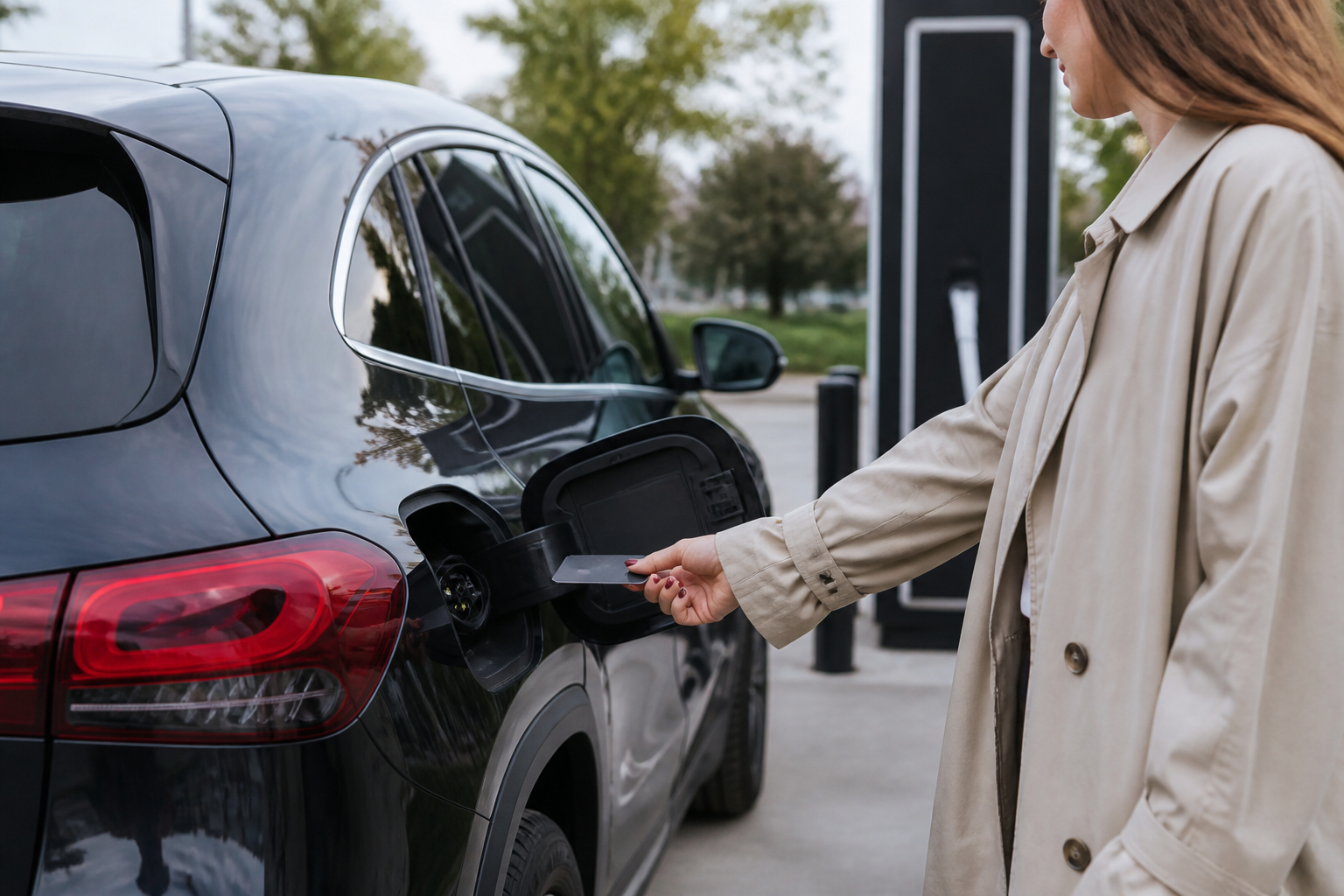
You can start a Mercedes me Charge public charging session by activating Mercedes me Charge and tapping the RFID card to the station’s marked area, then stop by pressing the illuminated stop button. If a station doesn’t support RFID, use the Mercedes-Benz app to start the session. For longer-term charging management, MB.CHARGE Public supports app-based authentication in addition to RFID or Plug & Charge where available.
Three practical takeaways
- RFID is a primary start method for public charging but isn’t universally supported at all stations (Electrify America is given as an example).
- If RFID is unavailable or unsupported, start charging via the Mercedes-Benz app using MB.CHARGE Public.
- MB.CHARGE Public also supports authentication via Plug & Charge with cooperating operators, offering alternatives beyond RFID.
Overview: RFID as a first-option for public charging
For Mercedes-Benz owners using public charging networks, the Mercedes me Charge system supports initiating sessions via an RFID card, which can simplify the process when you’re near a charger and want to avoid handling a phone. Official materials frame RFID as a primary authentication/start method, but they also acknowledge that some charging stations may not support RFID technology. A common example cited in the guidance is Electrify America®, highlighting that station-level compatibility can vary by network and location. This reality shapes how you plan trips and manage charging stops, especially when traveling through regions with a mix of networks.
Prerequisites and setup: getting ready to charge
Before you rely on RFID, ensure your Mercedes me Charge account is active and linked to your vehicle. Activation is a prerequisite for using the RFID card in the public charging flow. It’s also wise to keep the Mercedes-Benz app installed and linked, because it provides a reliable fallback path and helps you monitor charging activity across networks. If you switch phones or reset app data, verify that your account credentials and vehicle association are still intact to avoid interruptions at a charger.
Step-by-step: initiating a charging session with the RFID card
- Activate Mercedes me Charge within your vehicle or via the Mercedes-Benz app. Ensure the RFID card is registered to your account and has not expired or become deactivated. If you loan or hand the card to another driver, remember that access rights are tied to the registered account.
- Drive to a compatible public charging station and plug in the charging cable to your vehicle and into the station’s connector. Confirm that the station shows a ready or idle state before attempting to start.
- Hold the activated Mercedes me Charge RFID card to the marked area on the charging station until the session begins. You may see indicator lights or a confirmation message indicating that charging has started.
- Monitor the session via the station’s display or the MB app if you wish to track progress. When you’re ready to end the session, use the illuminated stop/finish button next to the charging socket, as described in the official guidance. Some stations automatically disconnect when the cable is removed, so follow the on-station prompts if present.
This RFID-start workflow is documented in the EQE/EQS Quick Start Guide and is intended to offer a quick, hands-free way to begin charging when a station supports RFID authentication.
Fallback when RFID isn’t supported at a station
Because not all charging points permit RFID authentication, Mercedes-Benz provides a clear fallback path. If you encounter a station that does not recognize the RFID card, open the Mercedes-Benz app and initiate the charging session from there. The app-based flow mirrors the “start charging” action and connects to the same MB.CHARGE Public system behind the scenes, ensuring you can still begin charging without RFID. In some cases, you may see on-screen prompts or station messages directing you to use the app; following those cues helps keep the session active and properly billed.
Alternative authentication: MB.CHARGE Public in the Mercedes-Benz app
Beyond RFID, Mercedes-Benz Group promotes MB.CHARGE Public as a unified authentication avenue. The system supports three main entry methods at public chargers: the Mercedes-Benz app, the RFID charging card, or Plug & Charge where the station/operator supports it. This multi-method approach accommodates a wider range of stations and operator capabilities. For frequent travelers, the app can provide a single portal to view active sessions, charging history, and, where available, estimated costs per kWh and per session. Some regions may also display real-time station availability and pricing within the app, enhancing trip planning accuracy.
Practical considerations and limitations
- RFID compatibility varies by charging network. Some networks, including Electrify America, have historically had limited or no RFID support at certain stations, so plan for an app-based start as a backup. Check station signage or network maps for RFID availability before you set out on a leg of a trip.
- Activation status matters: if your Mercedes me Charge account isn’t active, or the RFID card isn’t recognized, the RFID-based start will not work even at compatible stations. Always verify access in the app if in doubt. If you see an error message, re-scan the card and confirm the account status in the MB app.
- Session control is generally straightforward: start by initiating the session (RFID or app), and stop by using the station’s stop button or by ending the session in the app, depending on the workflow dictated by the station and the MB.CHARGE Public system.
- Plug & Charge is available on compatible stations and may simplify the process further by letting the vehicle authenticate automatically through the plug. This option requires station compatibility and may not be available everywhere. When Plug & Charge is in use, ensure the connector fully seats and acknowledges a charging session on the vehicle’s instrument cluster or display.
- If you frequently use public networks, it can be helpful to know which stations in your area support RFID and which require app-based authentication. This knowledge minimizes surprises during trips and helps plan charging stops more efficiently. In dense urban areas, some networks have multiple station configurations, including RFID, app-based, and Plug & Charge; mapping apps or the operator’s site can provide current status at specific addresses.
What to do if you’re unsure at a given station
When you reach a charger and aren’t sure which method to use, start with the Mercedes-Benz app to verify availability and to trigger charging if RFID is not recognized. If the station’s display or staff indicate RFID is unavailable, the app-based start is typically the quickest course of action. Keeping the app handy also lets you review session details and estimated costs after charging completes. If you’re near a staffed location, you can also ask for station-specific guidance, especially at newer or less common networks.
Summary of the official workflow landscape
Mercedes-Benz presents a cohesive charging experience through MB.CHARGE Public, encompassing three authentication/start pathways: RFID card, Mercedes-Benz app, and Plug & Charge where supported. This structure aims to minimize friction with public charging by offering a fallback mechanism and by consolidating session management under one ecosystem. The RFID method remains a fast, contactless option where it is supported by the station, while the app-based path provides universal coverage across networks that may not implement RFID consistently.
Practical tips for everyday use
- Keep your RFID card in a dedicated wallet sleeve or key fob to avoid misplacing it in a pocket or bag that’s not easily reached at the pump.
- Use the Mercedes-Benz app as a routine reference for station locations, compatibility notes, and charging history, which can simplify expense tracking and reimbursement if needed.
- Before a long trip, map out preferred charging networks and note which stations support RFID vs. app-based starts. This preparation reduces delays at unfamiliar chargers.
What to expect in the charging landscape
The move toward MB.CHARGE Public reflects a broader industry trend toward multi-method authentication at public chargers. RFID offers speed and convenience in compatible locations, but the ecosystem recognizes that not every station supports RFID, especially when networks deploy newer standards or negotiate cross-network access. By offering app-based and Plug & Charge options as complementary pathways, Mercedes-Benz aims to deliver a reliable charging experience across a diverse network landscape.
Sources