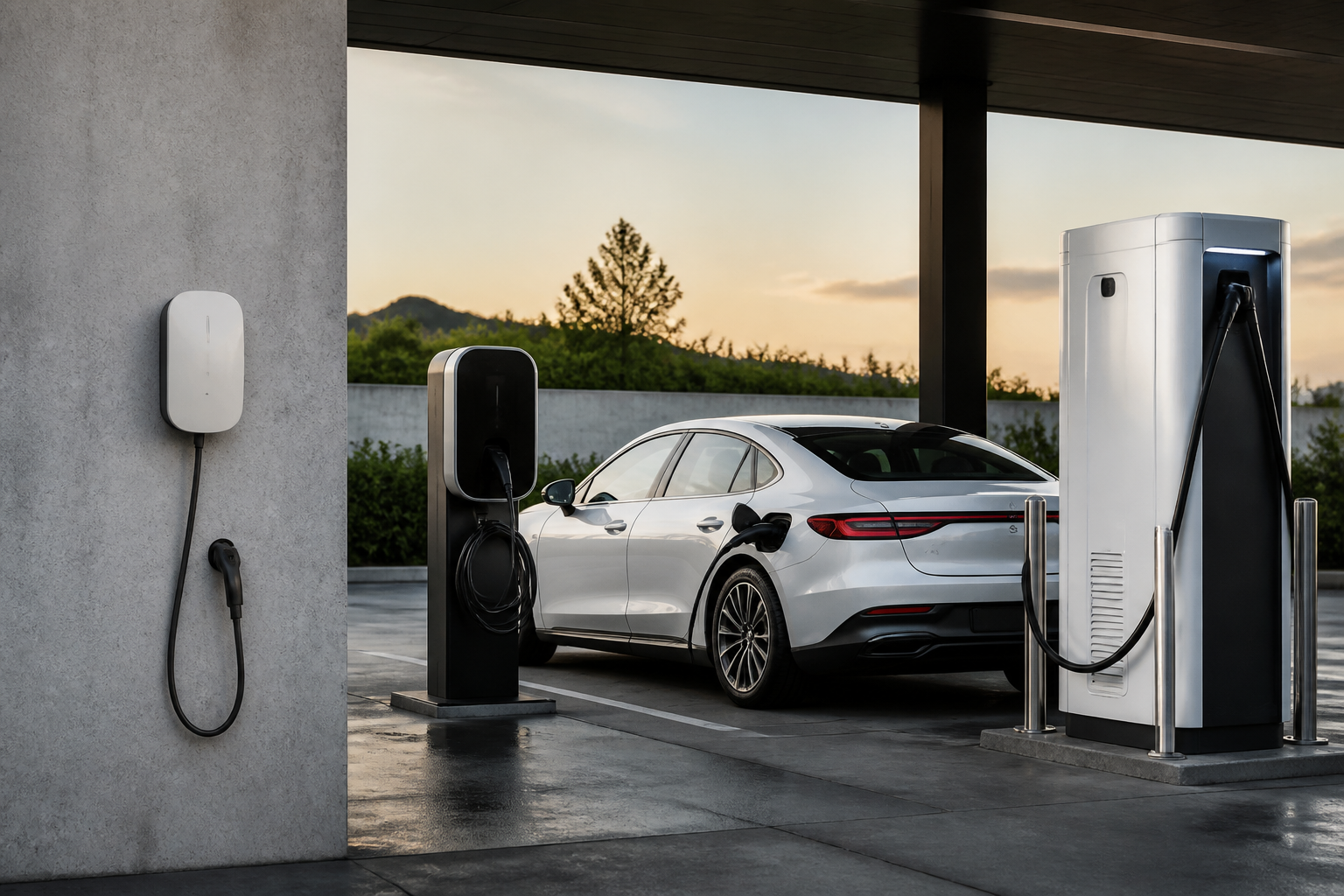
Level 1 is a basic 120V household charging option best for very light use or overnight topping. Level 2 uses 240V and higher current, suitable for daily home or workplace charging with faster replenishment. DC Fast Charging (Level 3) delivers high power at public stations for rapid top-ups during trips. Choose Level 1 for minimal setup and long parking times, Level 2 for regular home or work charging, and DC Fast for speed on the road when you’re near a fast charger.
Key takeaways
- Level 1 is slow but convenient at home or on the go with a standard outlet.
- Level 2 offers significantly faster charging where available, ideal for daily use.
- DC Fast Charging accelerates replenishment on trips but is limited to public networks and higher-power equipment.
- Real-world speeds depend on the Mercedes-Benz model’s onboard charger output.
- Use EPA and AFDC definitions to set correct expectations for charging times and availability.
Understanding how Mercedes-Benz EV charging breaks down into Level 1, Level 2, and DC fast charging helps owners decide where and how to plug in. This guide translates the charging levels into real-world expectations so you can pick the right method for home use or public charging. It also highlights practical decision criteria, common limitations, and model-dependent caveats you’ll encounter with Mercedes-Benz electric vehicles.
What the three charging levels mean in practice
Charging definitions commonly used in the United States categorize charging into three levels. Level 1 and Level 2 are typically associated with standard electrical outlets and home or workplace installations, while DC fast charging (Level 3) delivers high power from a dedicated fast charger at public locations. These distinctions influence how long a charge takes, where you can use each option, and what equipment you’ll need. Real-world charging speeds depend on the vehicle’s onboard charger, the charger’s output, battery state of charge, and any temperature or state-of-health factors. For foundational context, refer to EPA’s overview of plug-in charging basics and AFDC definitions of charging stations.
Level 1 (120V household plug)
Level 1 charging uses a standard household outlet with a basic portable charger. It is convenient for overnight topping off or for scenarios where higher-power options aren’t available. In Mercedes-Benz models, the effective charging speed is limited by the vehicle’s onboard charger capability and the actual outlet current (often 12–16 amps on an ordinary residential circuit). Live performance will vary with circuit loading in multi-occupant homes and any in-circuit appliance demand. Level 1 is typically best for very light daily use or as a compatibility fallback when no higher-power option is accessible.
Level 2 (240V, higher current)
Level 2 charging relies on a 240V supply and higher current capability, typically installed at home, work, or public stations. It substantially speeds up charging compared with Level 1 and is the common solution for daily use or extended stops where faster replenishment is helpful. Availability and speed depend on the charger’s power rating and the vehicle’s onboard charging limit. In Mercedes-Benz EVs, the actual charge rate at Level 2 will be capped by the car’s onboard AC charging capability (for example, if the car can accept up to 9.6 kW, the charger will usually deliver that, provided the home or workplace circuit can supply it). Real-world results are influenced by ambient temperature, battery state of charge, and the presence of any energy management settings in the vehicle that throttle charging to preserve battery health.
DC Fast Charging (Level 3)
DC fast charging supplies high power through specialized equipment at public sites. It can restore a large portion of the battery quickly, which is useful for long trips or when time is limited. The actual speed varies by charger output (commonly 50 kW, 150 kW, 350 kW or higher in many networks), battery state of charge, and the vehicle’s maximum charging rate. In Mercedes-Benz EVs, DC charging speed is often substantially faster than Level 2, but can be limited by the car’s own DC charging acceptance and thermal management. In cold weather or during high-power draws, some vehicles temporarily reduce charging rate to protect battery health, which can affect real-world times. It’s also important to note that DC fast charging is typically delivered at public stations and is less practical for daily charging compared to Level 2 at home or work.
Choosing the right charging method for a Mercedes-Benz
Decision criteria should start with where you spend most of your parked time and how urgently you need to replenish range. Use Level 1 for convenience when you’re parked for long durations with minimal driving, Level 2 for regular daily charging at home or at work, and DC fast charging for urgent, long-distance needs when you’re near a fast charger. The practical speed you’ll see depends on the specific Mercedes-Benz model’s onboard charging capability, the charger’s power rating, and the battery’s current state of charge. Consider the following decision framework:
- Assess daily driving and parking patterns. If your typical day involves short trips and long dwell times at home, Level 2 at home is often the sweet spot. If you frequently drive more than 20 miles in a day with a long commute, Level 2 will reduce charging interruptions more effectively than Level 1.
- Evaluate available infrastructure. Do you own or rent, and can you install a Level 2 charger at home or workplace without significant electrical upgrades? If you rent, you may rely on public Level 2 or Level 1 aboard a portable charger, or negotiate building-wide improvements with the property manager.
- Plan for trips and contingencies. For weekend road trips or frequent long trips, map DC fast charging stops along your route and check what Mercedes-Benz models can accept at non-Tesla-standard fast-charging rates, as the vehicle’s coolant and battery temperature can influence performance.
- Consider battery health and thermal management. DC fast charging can generate heat; if you routinely tap into rapid charging, ensure your vehicle’s thermal management system is functioning properly to minimize derates during busy travel periods.
- Account for cost and charging efficiency. Public DC fast charging can be more expensive per kWh than home Level 2 electricity, and some networks apply session fees or idle charges. Efficiency losses are higher at charging extremes, so the total energy delivered to the battery isn’t perfectly proportional to the energy drawn from the grid.
In practice, many Mercedes-Benz owners use Level 2 charging at home as the backbone of their daily routine, reserving DC fast charging for travel or urgent needs when fast turnaround is essential. Always check your vehicle’s onboard charging capability, including the maximum AC charging rate, maximum DC charging rate, and any battery management features that could influence charging behavior under different conditions.
Model-dependent caveats you should know
Charging performance can vary between Mercedes-Benz models and trim levels due to differences in onboard charger ratings, battery chemistry, and thermal management systems. Some EVs in the Mercedes-Benz lineup support higher Level 2 charging rates than others, and their DC fast charging acceptance may have different maximums. Carwise, the experience also depends on:
- Battery state of charge and temperature at the start of charging
- Charger availability and network load at the location
- Vehicle firmware versions that optimize charge curves for battery longevity
- Connector compatibility and regional charging standards
When planning charging strategy, consult your owner’s manual or the Mercedes-Benz mobile app for model-specific charging curves, recommended charging practices, and any regional advisories about public charging networks. If you frequently road trip, you may want to identify a few reliable Level 2 chargers near home and along common routes, and have a backup Level 1 option for very low-demand days.
Context and sources
For standardized definitions and factors that affect charging speed, the EPA and AFDC provide foundational resources that remain relevant for Mercedes-Benz owners navigating Level 1, Level 2, and DC fast charging. They describe how charging times depend on battery state of charge, charger output, and vehicle limits, and they offer language that helps translate charging hours into practical planning.