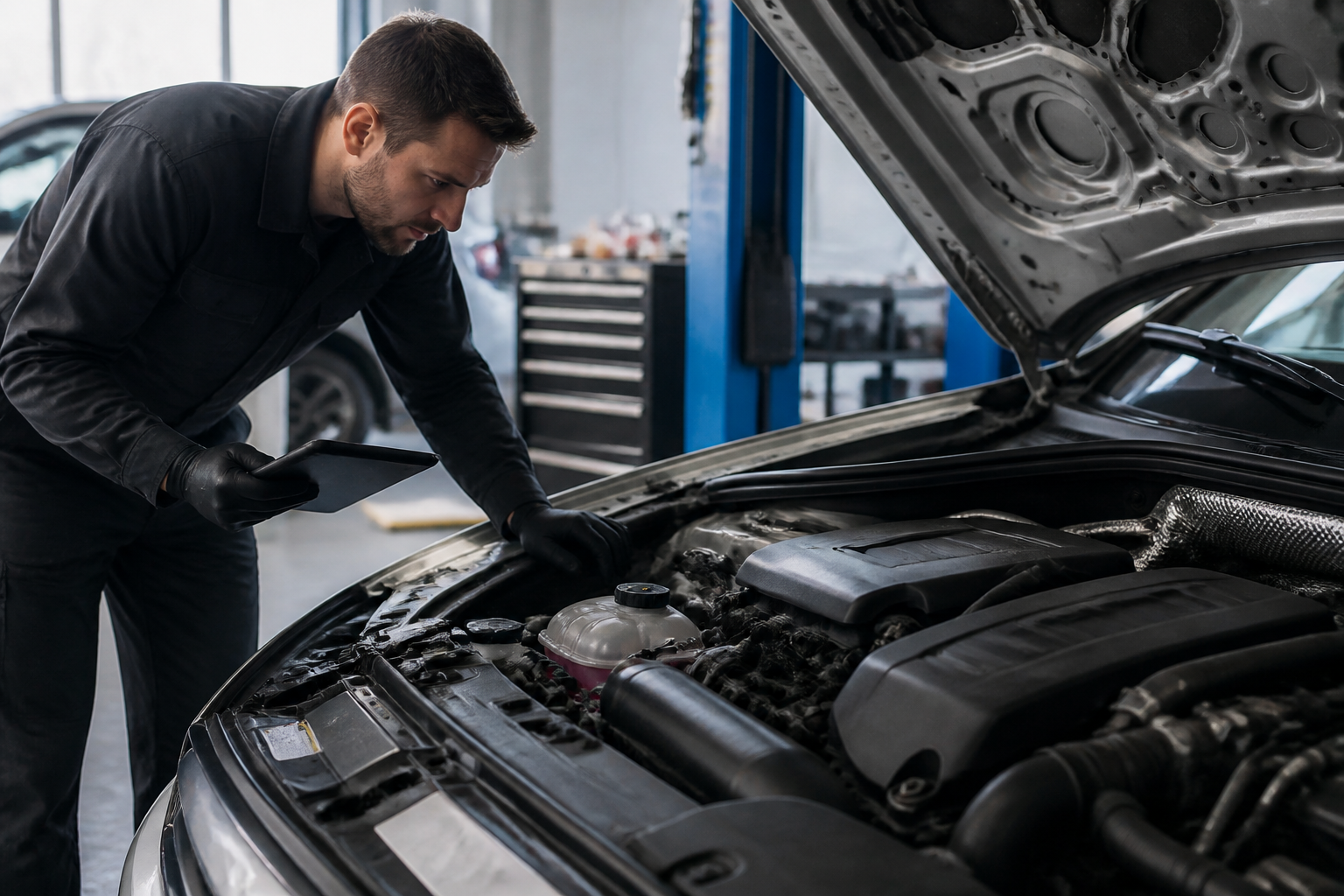
When you see a Mercedes-Benz coolant warning, first verify you can safely top up coolant following the manual’s guidance and observe the warning notes. If topping up is needed more often than usual or the warning persists after topping up, arrange a qualified workshop inspection to check for leaks, expansion-reservoir hose contact, and venting problems that could indicate a larger cooling-system fault.
Key takeaways
- A “Check Coolant Level” message means the coolant level is low and should be topped up with the correct coolant. (Mercedes-Benz Canada manual)
- If you must top up frequently, have the cooling system checked by a qualified technician to identify leaks or hose/venting issues. (Manuals and guidance linked)
- Warning-related checks may involve expansion-reservoir hose contact and venting; workshop diagnostics can distinguish leaks from air-related issues. (NHTSA/ODI and DOT communications)
When a Mercedes-Benz driver sees a coolant-related warning, it triggers an immediate need to assess the cooling system without overreacting to self-inflicted conditions or alarmist conclusions. This article expands on a practical, owner-first diagnostic flow for interpreting a coolant/low-coolant warning, distinguishing safe topping-up steps from situations that point to a leak or faulty component, and outlining when a qualified workshop inspection is warranted. It integrates manufacturer guidance with practical decision criteria and caveats dependent on model and system variant.
What the warning means in practice
The commonly seen message “Check Coolant Level See Operator’s Manual” is tied to a detected low coolant level in the reservoir or related sensors. In many Mercedes-Benz models, a low level does not automatically imply a catastrophic leak; it can also arise from small, intermittent issues such as hose contact at the expansion reservoir, air in the system from venting, or a sensor that momentarily reads low due to a small fluctuation. Manufacturer guidance frames this as a direct indication that the coolant level is below the acceptable range, paired with a cue to add coolant while observing safety and system-pressurization notes, and a signal that topping up becoming a frequent event warrants inspection by a qualified specialist.
Official materials also emphasize that gradual coolant loss can occur from hose contact with the expansion reservoir or venting issues, which may trigger warnings without an obvious external leak. This underlines a practical diagnostic approach: first confirm safe topping up, then investigate whether observed symptoms point to a venting issue, hose connection fault, or a true leak that requires repair. Some communications point to pump venting and air that can manifest as short-lived fluctuations in the level reading, particularly after a cold-start or during active cooling-cycle operation.
Step-by-step owner's diagnostic flow
Use this flow as a practical triage for models with a coolant warning. It helps separate safe, home topping-up from issues that require a workshop check.
- Ensure safety and prepare to top up: Park on a flat surface, engine cool if possible, and wear eye protection. If the system has been recently topped-up, allow several minutes and re-check the level to avoid overfilling once the engine warms up. Do not open the system while hot; the expansion reservoir can be under pressure even if the exterior feels cool.
- Check the coolant reservoir level and condition: Confirm the level is between the MAX and MIN marks on the correct reservoir for the cooling system. Note the coolant color and clarity; traces of oil or a milky appearance can indicate other issues but are not definitive on their own.
- Inspect for obvious external signs of leakage: Examine hoses and clamps at the expansion reservoir and along the lower radiator hose routes. Look for dampness, crusty residue, staining, or hardened hose connections, which can hint at a slow leak or a hose fitting issue.
- Top up safely if the level is low but not empty: Use the coolant specification recommended for your vehicle (color, blend, and concentration). Add small amounts and recheck after a short engine run or after the system self-bleeds, following the vehicle’s manual directions. Do not mix coolant types or concentrations; incorrect mixtures can reduce cooling efficiency or cause corrosion. If your model uses an integrated coolant-glycol mix, be mindful of maximum fill levels after the engine has cooled.
- Run the engine and monitor: After topping up and a brief engine run, recheck the level once the engine cools. If the level stays within range, monitor for any repeat drops over the next several days. If it drops again, proceed to the next step.
- Assess venting and pump-related symptoms: If the warning recurs after topping up or if you notice bubbling in the reservoir, air in the system, or unusual noises, these can point to venting issues or a pump-related condition. Some Mercedes power units vent through the reservoir or a dedicated vent line; air pockets can cause temporary readings that mislead a casual check. In such cases, a more thorough diagnostic at a workshop is advised to distinguish venting from a leak or failed component.
- Evaluate the frequency of topping up: If topping up becomes necessary more often than normal for your vehicle (for example, within weeks rather than months), this strongly suggests an underlying fault such as a slow leak, a degraded hose, a vent path issue, or a failing reservoir.
- Decision point – need for workshop inspection: If any of the following are observed, arrange a professional inspection promptly:
- Persistent low-level readings after topping up.
- Notable drop in coolant level after a period of storage or engine shutdown.
- Visible leaks, damp lines, or oil in the coolant or coolant in the oil correlating with other symptoms.
- Repeated warnings even after topping up and basic checks.
- Unusual engine symptoms such as overheating, reduced heater performance, or persistent coolant smell inside the cabin (where applicable).
What to check first: common culprits and how to test them
The items below reflect typical fault sources a qualified technician will verify. They also help owners understand what is most likely to fail when a low-coolant warning reappears after topping up.
- Expansion-reservoir hose connections: A common source of gradual coolant loss is a loose or cracked hose at the reservoir. Technicians will inspect hose clamps, level sensor fittings, and the hose itself for cracks or creep that can permit slow seepage over time.
- Reservoir integrity: The reservoir itself can develop small cracks, especially at molded corners or along the upper tank, creating a slow leak that is difficult to detect by casual inspection.
- Radiator cap and vent paths: In some models, the venting path or cap can fail to vent properly, causing pressure changes that affect level readings and coolant distribution. This is often coupled with air in the system after a cold startup.
- Coolant pump and seals: A failing pump seal or an internally leaking pump can cause loss of coolant volume that climbs as the system cycles. Look for signs of a wet pump pulley area or dampness along the pump housing.
- Radiator and hose assemblies: External leaks or micro-leaks at radiator end tanks, clamps, or lower hose connections can produce slow losses that manifest as repeated topping-up events.
- Thermostat and temperature-sensor pathways: Inaccurate readings due to sensor fault or wiring issues can misreport level or masking a leak; technicians will verify sensor operation in conjunction with the level reading.
- Oil-coolant intermix or head-gasket concerns (less common in routine check): If coolant appears milky or oil shows coolant traces, it can indicate a deeper issue requiring engine diagnostic work beyond a simple topping-up check.
Practical examples and model-dependent caveats
Mercedes-Benz model lineups vary in cooling-system layout. Some engines share a single expansion reservoir with a secondary return path; others have separate reservoirs or integrated combinations with the heating system. In practice:
- On models with a pressurized expansion reservoir, follow the manual’s guidance on safe re-filling and pressure relief procedures to avoid scalding or sensor damage.
- Some warnings are time-stamped or tied to a particular driving cycle; note whether the warning appeared after a cold start, during warm-up, or under sustained highway speeds, as this information helps differentiate venting from an active leak.
- Digital instrument clusters may display a secondary message or fault code that indicates a specific component (for example, expansion reservoir, pump, or hose). A diagnostic code read with the appropriate Mercedes-Benz-compatible tool (or a shop-level scan) can accelerate pinpointing the fault.
- If you recently performed maintenance (coolant replacement, hose replacement, or sensor work), verify that the correct coolant specification was used for your engine and that any new clamps are tightened to spec and routed to avoid contact with hot surfaces or moving belts.
Bottom line: when to seek professional help
The safe topping-up procedure is typically straightforward and appropriate for routine maintenance. However, if topping up becomes a recurrent event, if level readings continue to fall after a full cool-down, or if you observe leaks, unusual noises, or overheating, a professional diagnostic is warranted. A Mercedes-Benz technician can perform a pressure test, cooling-system dye test, sensor calibration check, and a venting/air-bleed procedure to distinguish a slow leak from a venting issue or a failing pump.
For owners who want to capture the diagnostic logic in real-world terms, the decision tree typically follows: safe topping-up if level is low but stable after a cool-down; investigate venting and pump behavior if readings fluctuate or show bubbles; escalate to a workshop if leaks are suspected or if the problem recurs despite topping up. This approach aligns with manufacturer guidance while remaining practical for daily ownership.
Sources
- Mercedes-Benz “Check Coolant Level See Operator’s Manual” — what the message means and what to do next
- NHTSA / ODI TSB: Check expansion reservoir for coolant—replace if necessary (gradual coolant loss / warning lamps)
- LI20.00-P-080222: Mercedes-Benz coolant pump diagnostic and venting procedure (includes venting/air-related considerations)