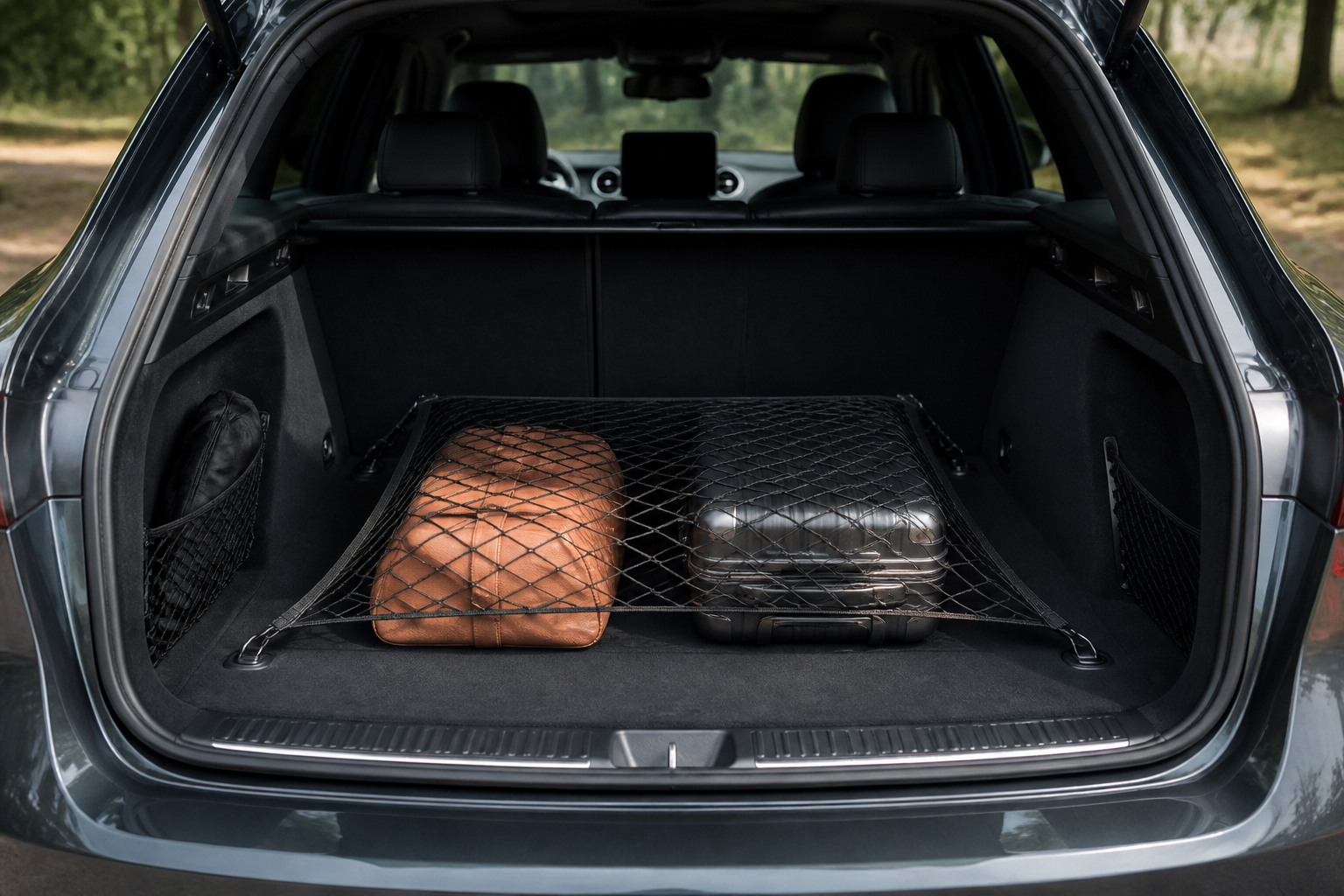
Mercedes cargo nets and trunk organizers are designed to contain light, everyday items and improve organization in the cargo area. They are not designed to restrain heavy or bulky loads in a crash or hard stop; for such loads, use the vehicle’s floor-mounted tie-down hooks in addition to the nets. Always verify compatibility with your model and installation requirements, and consult official MB sources for proper use.
Key takeaways
- Cargo nets/organizers are for lightweight containment and organization, not full restraint.
- Always use floor-mounted tie-down hooks for heavier or bulkier cargo.
- Refer to OEM guidance to confirm proper attachment points and compatibility with your vehicle.
- Official MB sources emphasize that nets do not replace tie-downs in safety-critical scenarios.
Overview: cargo nets, trunk organizers, and their role in daily use
Mercedes-Benz positions cargo nets, trays, and liners as vehicle-matched tools that aid organization and containment of lighter items in the cargo area. These OEM accessories help prevent small objects from shifting, rolling, or tipping during normal driving, reducing noise, clutter, and the temptation to rummage through luggage while driving. Importantly, Mercedes emphasizes a clear safety distinction: these nets and organizers are not designed to replace the vehicle’s tie-down system for heavy or bulky loads, nor are they a substitute for proper restraint in a crash. This separation—organization versus restraint—appears across official MBUSA product pages, brochures, and owner manuals. For readers seeking concrete references, the MBUSA cargo nets, trays, and liners page, and the MY18 C-Class Operator’s Manual’s stowage sections provide the core guidance.
Key takeaways for practical owners: use nets/organizers to tame light cargo, verify compatibility with your vehicle and other cargo-area features, and never count on them to secure heavy items in a sudden stop or collision. Always rely on floor-mounted tie-down hooks and the vehicle’s tie-down system for heavier loads. These distinctions are foundational for safe and predictable use in everyday driving.
How to use Mercedes cargo nets and trunk organizers correctly
Correct usage starts with selecting the right accessory for your vehicle model and cargo needs. OEM nets and organizers are designed to fit specific tie-down anchors or cargo-area recesses so that they can function without interfering with seatbacks, covers, or other storage options. Once installed, use the nets to hold smaller items—cans, tools, cables, personal belongings—that might otherwise shift or rattle. The common pattern across MBUSA materials is: containment and organization, not restraint.
Attachment and placement matter. Check that the net’s hooks or fasteners engage only at intended anchor points and that the net does not obstruct floor-mounted tie-downs or reduce access to them. When a trunk organizer is used, ensure its partitions and lids do not impede the operation of other cargo features or create pinch points. If your vehicle requires a particular installation sequence, MBUSA’s product pages or dealer staff can confirm the exact steps and any needed additional components, such as specific tie-down rings or adapters.
From a practical standpoint, the process looks like this: identify the correct net/organizer for your vehicle, install it at the designated locations, place lightweight, non-bulky items inside, and continuously verify that nothing protrudes into the path of doors or movement of the cargo floor. This routine keeps daily use smooth and reduces the chance of objects tipping or sliding during turns or braking.
What the official guidance says about limits and safety
Official safety communication from MBUSA clearly states that cargo nets and organizers are not designed to restrain excessive Weight or bulk in a collision or abrupt stop. The guidance is reinforced in two forms: a) the supplier’s brochure on cargo nets, trays, and liners, and b) owner’s manual sections describing stowage areas and tie-down usage. The core safety message is consistent: nets are for containment and anti-rolling within normal driving, not for crash-level restraints. When carrying heavier or larger items, you should secure cargo using floor-mounted tie-down hooks and the vehicle’s tie-down system. In some cases, installation of certain accessories may require professional fitment or additional components to ensure proper function and safety.
Owner-facing safety framing also appears in the stowage areas guidance, which reiterates that parcel nets are meant to manage slip and tipping risk, not to substitute for tiedown infrastructure designed to withstand dynamic loads in a crash. Practically, this means you should pre-map out where tie-down hooks live in your model, and choose to use them whenever cargo could exceed light-weight thresholds.
Real-world scenarios: what to expect and where to be cautious
Case 1: Daily groceries or a few tools. A compact bag of groceries or a small toolkit benefits from a parcel net or organizer to prevent sliding. In this scenario, the net keeps items from shifting during highway ruts and gentle braking, preserving cabin or cargo-area cleanliness and reducing load movement.
Case 2: Bulk or heavier items. If you’re transporting several heavy boxes, a suitcase, or a bulky item, you should engage the vehicle’s floor-mounted tie-down hooks and, if available, use additional securing straps. Relying solely on a net under these conditions risks movement of the load during abrupt maneuvers or a collision, which can compromise safety and damage luggage or vehicle interiors.
Case 3: Mixed cargo with fragile items. Use nets or organizers to separate light, delicate items from heavier ones. This arrangement helps prevent tipping or contact between items, but you should still secure the heavier pieces with the tie-down system and ensure fragile objects have protective padding.
Practical guidance for owners and installers
- Always verify that the cargo net or organizer does not block access to tie-down anchors or the floor-mounted hooks.
- Follow model-specific installation instructions; some attachments may require professional installation.
- Use OEM accessories designed for your vehicle to ensure fitment, function, and compatibility with the cargo area’s geometry.
- Do not rely on nets as the sole restraint for heavy or bulky loads in any driving scenario, including sudden braking or a collision.
- Regularly inspect nets, hooks, and anchors for wear, fraying, or damage, and replace any compromised components.
Limitations and fit considerations: what changes with model year and trim
Mercedes-Benz offers cargo nets, trays, and liners that are tailored to specific trunk configurations and trim packages. The exact attachment geometry can vary between models, years, and even body styles. For example, some models place tie-down anchors within recessed floor wells, while others rely on strap-ready loops integrated into the cargo floor. This matters because a net or organizer might coexist with a floor mat, a cargo cover, or a factory privacy screen. Always validate compatibility by checking the accessory’s product page for your exact VIN, or consult a dealer to confirm the recommended installation sequence and required anchor components. If a vehicle’s interior has optional power-folding seats or a cargo management system, ensure the net does not impede seat operation or reduce available cargo-length when seats are configured for cargo mode.
Bottom line: how to think about Mercedes cargo nets versus tie-downs in everyday use
Mercedes cargo nets, trays, and liners deliver tangible benefits for day-to-day organization and containment of lightweight items in the cargo area. They reduce shifting of small objects and help keep the cargo space tidy and functional. However, these accessories are not designed to restrain heavy or bulky loads in a crash or abrupt stop. For anything beyond light weight, always engage the vehicle’s floor-mounted tie-down hooks and, if needed, use additional tie-downs or straps. By using OEM nets as intended—and pairing them with the vehicle’s tie-down system when required—drivers can realize practical daily usability without compromising safety.
Sources