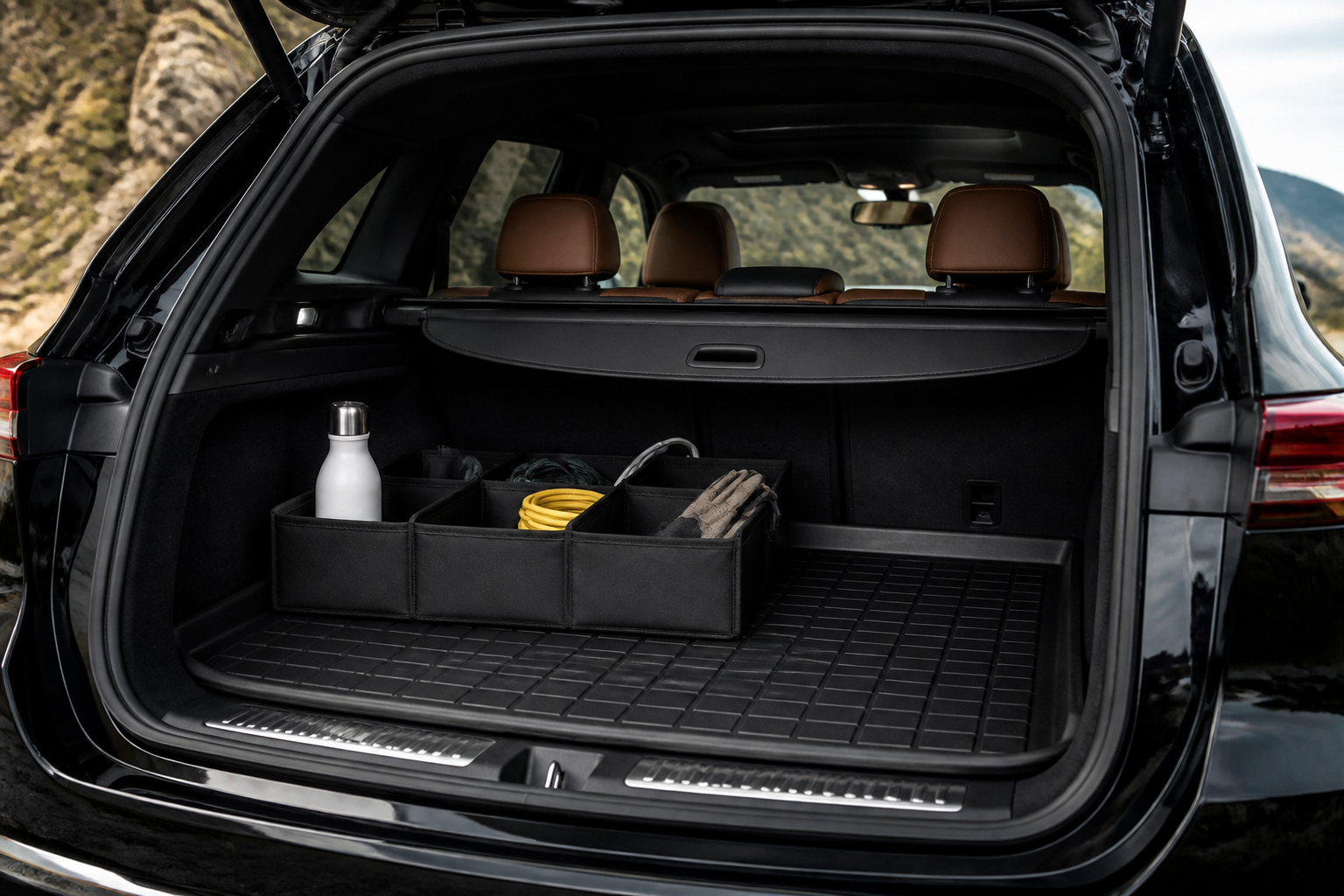
To select Mercedes cargo accessories without fitment mistakes, verify your vehicle’s exact year/model/trim/configuration against the accessory listing, confirm the part number matches your vehicle, and ensure the item does not interfere with tie-down points, underfloor storage, or seat operation. Treat trays/liners as containment solutions, nets as organization aids, and mats for daily-use protection, while acknowledging that they are not substitutes for proper load securing. Refer to official Mercedes sources for fitment guidance: MBUSA Cargo Guide and Mercedes-Benz Customer Solutions.
Key takeaways
- Verify year/model/trim/configuration before ordering any cargo accessory.
- Check the specific part listing rather than relying on photos; compatibility is vehicle-specific.
- Understand each accessory’s purpose: nets, trays/liners, and mats are for organization and containment, not load securing.
- Ensure accessories do not interfere with tie-downs, underfloor storage, or seat operation.
- Consult official Mercedes sources (MBUSA Cargo Guide; Genuine Accessories) for fitment and usage guidance.
Introduction
Choosing the right Mercedes cargo accessories—nets, trays, liners, and mats—requires careful attention to your exact vehicle configuration and how you intend to use the cargo area. This expanded guide synthesizes practical considerations from verified Mercedes-Benz sources and translates them into actionable steps: how to verify part numbers, how to confirm compatibility with year/model/trim/configuration, explicit purposes of each accessory, and safety cautions to prevent interference with moving parts or securing loads during daily use.
Why fitment matters: the risk of generic compatibility
Mercedes-Benz builds cargo areas with unique shapes, mounting points, floor heights, tie-down anchors, and underfloor storage solutions that vary across model lines and generations. A part that visually resembles an OEM accessory can still clash with seat tracks, lever mechanisms, or storage lids if it isn’t matched to the exact vehicle configuration. Relying on photos or a broad model-year label can lead to misfit, rattles, or interference with operation. The safest approach is to verify the exact part number against your vehicle’s year, model, trim, and body style before purchasing.
What to verify in listings
Key signals in a listing indicate proper compatibility and fulfill a safety threshold for daily use. Look for explicit statements that the accessory fits the trunk or cargo area of your exact configuration, not a generic “fits all Mercede s” claim.
- Exact model-year and body style compatibility referenced in the listing’s specifications or fitment notes.
- Specific part number that you can cross-check with your vehicle’s build sheet or parts catalog.
- Notes on the accessory’s intended use: containment/organization versus load securing.
- Any warnings about interference with tie-downs, underfloor storage, or seat operation.
Part-number and fitment verification checklist
- Identify your vehicle’s year, model, trim level, and body style (e.g., sedan, hatch, SUV, van, with any interior package).
- Find the exact OEM part number listed for the accessory you’re considering.
- Cross-check the part number against the vehicle’s official parts catalog or a trusted dealer portal.
- Review the product description for statements about fitment to trunks/cargo areas and whether it is an organization/containment accessory (nets, trays, liners, mats).
- Check for any notes about non-interference with tie-down points, seat adjustment mechanisms, or underfloor storage.
What each type of accessory is designed to do—and what it isn’t
Mercedes cargo accessories are primarily presented as organization and containment tools intended to manage movement, reduce spills, and help with cargo visibility. They are not substitutes for proper load securing or vehicle safety systems. Distinguishing their roles helps prevent misuse and ensures you select the right tool for the job.
- Nets: Cargo nets are typically used to contain loose items and prevent shifting within the cargo area. They help keep small items in place during normal driving but do not replace the need to secure heavier loads with straps or cargo anchors.
- Trays and liners: Trays and liners create defined compartments and can contain spills, rainwater, or dirt from wet cargo. They are especially useful for separating damp items, muddy footwear, or groceries that might roll around. Their design often includes raised edges to contain liquids and reduce cross-contamination between zones.
- Mats: Cargo mats cover the floor for daily use, protecting the vehicle’s carpet from dirt and wear. Mats may be configured to fit more flexibly than rigid trays but offer less containment of spills than dedicated liners.
Important caveat: an accessory’s framing as an organization tool does not imply it reduces the need for proper load securing during transit, especially for dynamic driving conditions, braking, or cornering. If a load can shift, secure it with appropriate straps or the vehicle’s built-in tie-downs even when using a tray, liner, or net.
Fitment cautions to prevent interference with moving parts and functions
Interference with seat operation, seat-fold mechanisms, or under-seat storage is a common and avoidable pitfall. Before finalizing a purchase, confirm that installation will not impede:- Seat adjustment or folding mechanisms that alter interior configuration.- Access to tie-down anchors or storage divisions you regularly use.- The operation of sliding tracks or pallet supports that may exist in the cargo floor.
Some accessories may require removal or repositioning of existing anchors or floor panels. If the accessory installation requires tools or modifications beyond simple mounting, reassess whether it is appropriate for your vehicle and your intended use.
Official guidance and context from Mercedes sources
Mercedes-Benz consistently frames genuine accessories as designed for compatibility, quality, and established safety within the vehicle system. Key takeaways from official materials include:
- Genuine trunk/cargo accessories like luggage nets and trunk organizers are intended to improve organization and reduce slipping, not to eliminate standard load-securing practices.
- Compatibility is vehicle-specific: correct part numbers and model-year alignment are essential to ensure proper fit and function.
- Accessories should be used as designed and installed in accordance with the manufacturer’s instructions; they do not change the fundamental load handling requirements of the vehicle.
Representative sources
- Mercedes-Benz Cargo Guide | Mercedes-Benz USA LLC — emphasizes matching accessories to year/model/trim and verifying part details before ordering, with guidance on what each accessory is typically for. https://mbparts.mbusa.com/blog/mercedes-benz-cargo-guide
- Mercedes-Benz Customer Solutions: Genuine Accessories — notes that trunk/cargo accessories are designed to help prevent slipping and should be used as designed. https://mercedes-benz-customer-solutions.com/en/genuine-accessories
- Genuine Accessories (Sprinter US) PDF — safety framing that these items are for organization and not a substitute for proper load securing. https://assets.mbvans.com/Mercedes-Benz-Vans/Parts-Services/MB_sprinter_accessories_USA_2018.pdf
Practical pick-and-check workflow for shoppers
When assembling your selection, follow a practical workflow that blends catalog data with your vehicle’s configuration and your real-world cargo needs:
- Define your primary use case: frequent wet cargo, small-item containment, or general daily use.
- Match to the exact part number that lists your vehicle’s year/model/trim/configuration.
- Evaluate whether the accessory will live primarily in the trunk, cargo area, or a specific storage compartment and whether it interfaces with any existing anchor points.
- Compare against official guidance: ensure it is a genuine accessory or a compatible OEM-recommended item, and review any caveats about load security.
- Plan for installation: confirm hardware, required tools, and whether the accessory will affect seat or floor configuration.
- Order with a return plan in case of misfit or unforeseen interference.
Conclusion
Choosing Mercedes cargo accessories without fitment mistakes hinges on ensuring an exact part-number match for your vehicle’s year/model/trim/configuration, understanding the accessory’s intended purpose, and verifying that installation does not interfere with cargo-area functionality or safety features. Use the official Mercedes-Benz guidance to interpret listings accurately, and treat these accessories as organization tools that complement, rather than replace, proper load securing practices.
Sources