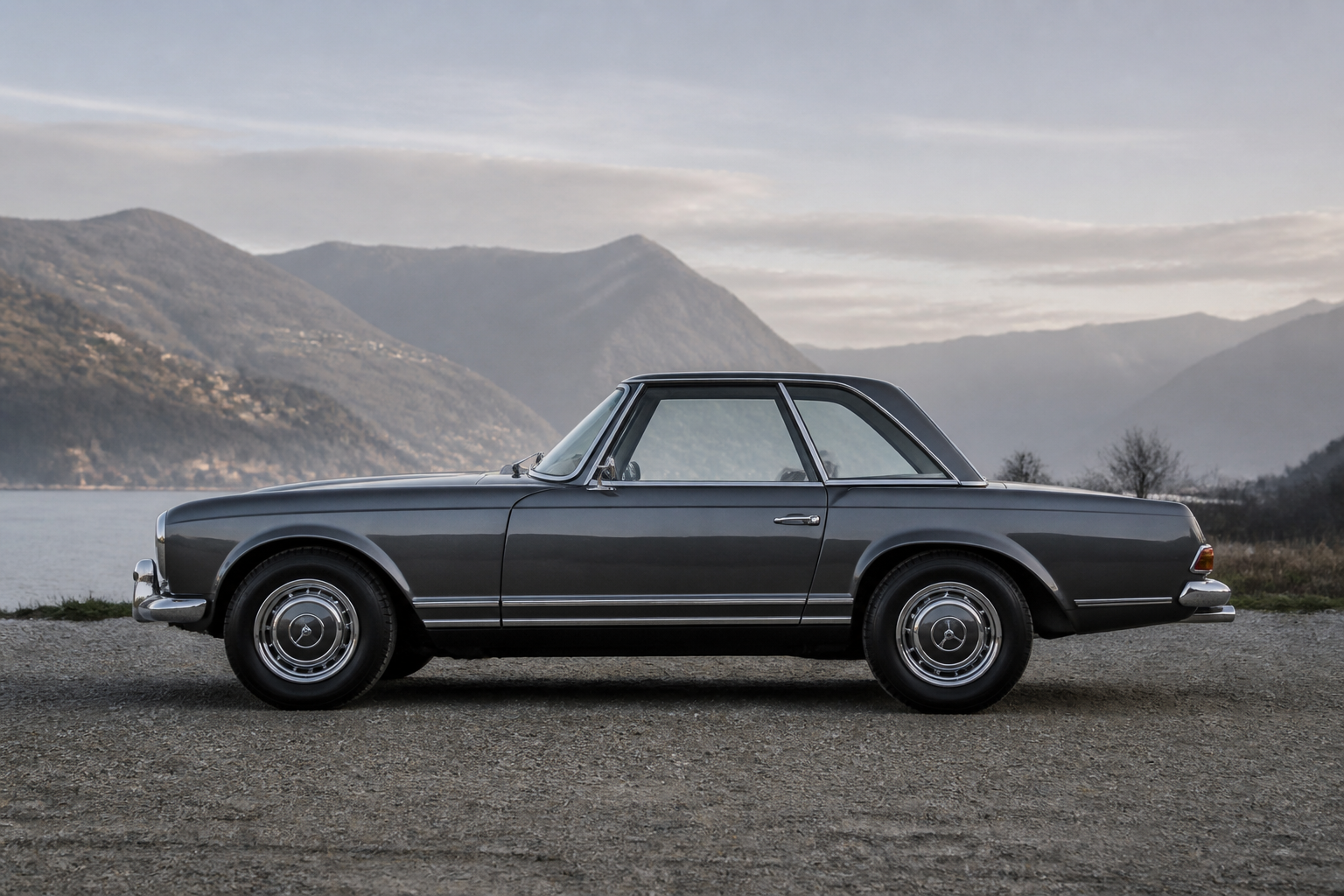
The W113 Pagoda roofline endures because Paul Bracq styled a concave, temple-like silhouette that produced a timeless look, while Béla Barényi’s safety-body thinking informed a stable, protective package. The combination of Bracq’s aesthetic intent and Barényi’s engineering principles created a design that remains visually iconic and structurally coherent with the era’s safety goals.
Key takeaways
- Bracq’s concave roofline gave the Pagoda its instantly recognizable silhouette.
- Barényi’s safety-body concepts influenced the overall packaging and protection emphasis of the design.
- The Pagoda’s calm, temple-inspired profile contributes to its timeless appeal across decades.
- Source-backed narratives link the visual identity to production-ready thinking and safety engineering, explaining the enduring legacy of the W113 design.
The W113 Pagoda, embodied by the 230 SL and its successors, is widely recognized as a design icon whose silhouette has endured since the early 1960s. This article expands on how the Pagoda’s concave hardtop—the distinctive “temple roof”—emerged from a clear and deliberate design-and-engineering logic. Rather than treating styling as decoration, the Pagoda represents a purposeful balance between form and function, where shaping choices were tied to packaging, aerodynamics, and occupant protection. The result is a timeless styling cue that continues to shape Mercedes-Benz design language decades after its debut.
Design authorship and the shaping of a concave profile
Mercedes-Benz attributes the Pagoda roofline to designer Paul Bracq. Bracq’s early work on the W113 package culminated in a concave roof that appears to tuck inward slightly, evoking the silhouette of traditional Asian temple rooftops. This temple-like curvature is not merely a stylistic flourish; it creates a calm, continuous line that harmonizes with the car’s rounded wheel arches, low beltline, and short overhangs. The result is a silhouette that reads as compact and poised, with a visual serenity that still reads as modern today. Bracq has described the design as one shaped with production realities in mind, a reminder that the Pagoda’s elegance rested on feasibility as much as on flair.
Beyond Bracq’s name, the Pagoda story is one of collaboration. The design brief for the W113 era called for refinement, agility, and performance suitable for the swinging ’60s—yet with a restrained, timeless aesthetic. The connection between Bracq’s shaping and the model’s practical packaging emerges in how the roofline’s curvature allowed for a stable center of gravity, balanced headroom, and a cabin that maintained a compact footprint without feeling cramped. In practice, the Pagoda’s roofline contributes to a low, stable visual center, reinforcing the car’s sense of agility whether parked or on the move.
The stylistic language of the Pagoda and its timeless feel
The concave roofline provides a calm, temple-like profile that contrasts with sharper lines seen on contemporaries. This choice yields a visual harmony: soft, continuous lines meet a low, grounded cabin, producing an image that feels both iconic and approachable. The Pagoda’s silhouette is thus as much a structural statement as a stylistic one—softening the car’s geometry while reinforcing a sense of solidity and safety through its rounded forms.
Safety-body logic and the Barényi influence
Béla Barényi’s safety-body thinking centers on protecting occupants by shaping a robust passenger cell and incorporating strategic deformation zones. While the Pagoda’s roofline is striking, the underlying packaging was influenced by Barényi’s broader safety philosophy: a crumple-zone concept and a stable occupant cell that could remain intact under a range of impacts. For the W113, this translated into a package that balanced a sculptural silhouette with the confidence that the structure would behave predictably under load, contributing to the model’s appeal during its era and echoing into later decades. In effect, the Pagoda’s shape encodes a belief that beauty and safety can share the same architectural logic: a stable exterior shell that channels energy away from the occupant cell while presenting a cohesive exterior language.
Barényi’s influence thus extends beyond isolated safety features; it underpins the broader packaging logic that allowed Bracq’s concave roof to coexist with protective geometry. The result is a form that is not only visually distinctive but also legible as a product of serious structural and safety thinking—an essential facet of the Pagoda’s enduring credibility.
Convergence: aesthetics meets engineering intent
At its core, the Pagoda represents a convergence of Bracq’s concave shaping and Barényi’s safety-driven thinking. This synergy yielded a package that was visually distinctive yet technically coherent. Designers and engineers worked toward a single objective: a roofline that was attractive in showroom renderings and practical in real-world use, from bonnet-to-rear cabin balance to considerations of aerodynamics and visibility. This alignment is a common thread in sources describing the Pagoda as design that achieved production-ready elegance—an important distinction that helps explain why the Pagoda’s roofline did not become a fleeting trend but a lasting design cue for Mercedes-Benz styling language.
Why the Pagoda has endured as an icon
Retrospectives converge on three core elements that solidify the Pagoda’s status: (1) the distinctive concave roof shape, (2) Bracq as the principal design author, and (3) the broader safety-body and stability ideas associated with Barényi. Taken together, these factors create a package whose aesthetic remains balanced as design trends evolve. The Pagoda’s ability to appear both restrained and expressive—never aggressive, but never dull—helps explain its enduring appeal in Mercedes-Benz’s design canon and its enduring status among classic-car enthusiasts.
Practical lessons from the Pagoda’s design logic
- Design for production without compromising identity: The Pagoda demonstrates how a signature silhouette can be developed with production realities in mind, ensuring the shape remains feasible to manufacture and cost-effective while maintaining a memorable uniqueness.
- Aesthetic as engineering feedback: The roof curvature informs not only the look but also the car’s center of gravity, aero behavior, and cabin geometry, illustrating how styling and engineering feedback loops reinforce each other.
- Safety as a design driver: Barényi’s safety principles offer a lens to view the Pagoda’s effectiveness beyond sculpture. The surrounding structure and deformation zones work in concert with the silhouette to deliver a coherent safety narrative, long before modern crash-testing became a public focal point.
- Timeless cues arise from restrained design practice: By avoiding aggressive lines and leaning into soft, continuous curvature, the Pagoda achieved a timeless profile that ages gracefully alongside the model line and broader Mercedes language.
Context and sources
Key source materials anchor the discussion: Mercedes-Benz Media’s overview of the Pagoda’s roofline and Bracq’s role, linking the shape to production-ready thinking; MercedesHeritage’s retrospective on the Pagoda’s design evolution, highlighting early briefs and collaborative authorship; and ZF Heritage’s account framing the Pagoda as a milestone in production-car safety coupled with Bracq’s silhouette. Collected together, these sources illuminate how the W113’s design story was shaped by a precise blend of artistry and engineering intent.
For reference, see: https://media.mercedes-benz.com/en/article/fed4e320-acc8-46ff-a67c-b6b47466b8d4 and https://mercedesheritage.com/mercedes-heritage/genesis-of-the-pagoda and https://www.zf.com/mobile/en/company/strategy/heritage_zf/stories/60_years_mercedes-benz-pagoda.html
Sources