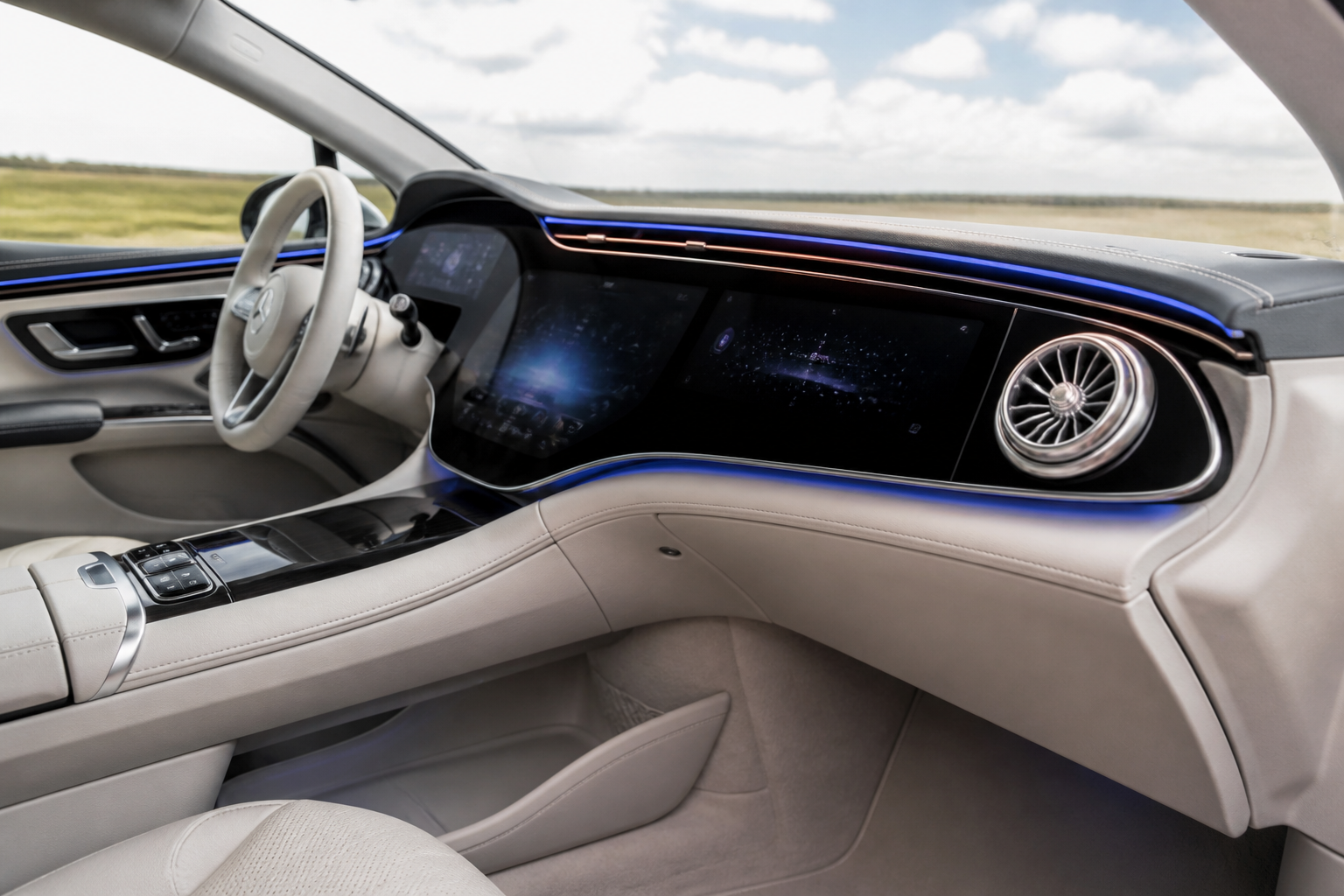
Mercedes-Benz moved from a traditional dashboard with an instrument cluster and numerous physical controls to the MBUX Hyperscreen by treating cockpit integration as the core design problem. The Hyperscreen is a single, continuous display that spans the cockpit width and integrates navigation, infotainment, climate, and controls within one glass surface. Key constraints shaped this solution: ergonomics (ensuring readable, reachable interfaces), safety/regulatory feasibility (integration with safety systems and driver attention requirements), and production feasibility (creating a reliable, heat-managed, software-integrated system). This approach represents a shift from a multi-panel layout to a unified digital cockpit designed for the EQS.
Key takeaways
- The Hyperscreen represents a cockpit-integration approach, replacing separate instrument clusters and switches with a single continuous display.
- Ergonomics, safety, and production feasibility were the dominant constraints guiding the design and integration effort.
- Public and supplier materials frame the Hyperscreen as the central ‘brain’ of the EQS cockpit, not merely an infotainment screen.
- CES communications and supplier documents corroborate the shift from conventional dashboards to a unified digital cockpit architecture.
From Dashboard to Hyperscreen: how the EQS redefined cockpit responsibilities and constraints
Mercedes-Benz’s shift from a traditional instrument cluster and a mosaic of physical switches to a seamless, wide-format digital cockpit represents more than a screen upgrade. It is a deliberate reallocation of responsibilities within the vehicle’s human–machine interface, aiming to unify navigation, climate, infotainment, and vehicle controls under a single design language. The following narrative builds on verified sources to explain how engineers translated a bold concept—an uninterrupted glass surface spanning the driver’s field of view—into a production-ready system that satisfies ergonomics, safety, and feasibility demands without compromising reliability or regulatory compliance.
What the Hyperscreen aimed to replace and why
Traditional dashboards organize information across separate domains: a driver’s instrument cluster for speed and critical indicators, a central display for infotainment, and a collection of hard controls (knobs, switches, climate dials). Mercedes-Benz reframed this as a cockpit integration problem. The Hyperscreen consolidates these elements into one continuous surface, with software responsible for presenting context-rich information through clearly delineated zones. This approach intends to reduce information fragmentation, enable a more coherent visual language, and leverage software as a platform for future features, updates, and services.
Design objectives tied to human factors
- Ergonomic reach and legibility: Placement, tilt, and brightness are calibrated so the driver can access controls and read information without excessive head movement or eye strain. The design must accommodate a wide range of body sizes and seating positions, providing consistent readability in varying lighting conditions.
- Tactile clarity and transitional cues: Even with a single glass surface, the interface requires visual and haptic semantics that tell the driver which zone controls belong to—navigation, media, climate, or vehicle settings—so attention can remain on the road.
- Cognitive load management: The digital cockpit must avoid overwhelming the driver with too many on-screen options. Context-aware interfaces and intuitive menus aim to minimize time spent navigating screens while driving.
Safety, regulation, and system reliability constraints
- Safety-critical integration: The cockpit software must operate in concert with safety systems and drive-assist features. The interface should not distract or obscure critical indicators in emergency or routine operations.
- Regulatory alignment: The design adheres to cockpit usability standards and automotive regulations that govern display brightness, glare, driver distraction, and accessibility for all drivers, including those with reduced vision or mobility.
- Electrical and thermal management: A large, continuous display increases power draw and heat generation. The engineering plan includes robust power management, cooling strategies, and redundant pathways to maintain reliability even under strenuous operating conditions.
Feasibility decisions that enabled production readiness
Portions of Mercedes-Benz’ supplier-facing documents emphasize that the Hyperscreen is not just a larger screen but a fundamentally different architecture. Key feasibility decisions included:
- Unified display architecture: Instead of multiple disjointed panels, the Hyperscreen uses a single glass surface segmented into zones that behave as distinct UI domains. This requires synchronized software across domains, a resilient operating system, and rigorous testing for long-term durability in a vehicle environment.
- Modular electronics and cooling: The system designs anticipate heat dissipation across a wide linear area and ensure stability of display performance across ambient temperatures, sun loading, and dynamic driving conditions.
- Production feasibility and supply chain alignment: Transitioning from a conventional dashboard to a continuous display involves manufacturing considerations, assembly tolerances, and integration with existing vehicle electronics architecture to fit the EQS production lines.
The contrast with a conventional dashboard: practical implications
In a conventional layout, drivers often rely on physical controls to perform frequent tasks with tactile feedback, while digital screens provide a layered interface with separate zones. The Hyperscreen flattens that division into a contiguous interface—potentially easing software updates and feature expansion but demanding new interaction paradigms. The trade-offs include reliance on software reliability, the risk of driver distraction if the interface is misaligned with driving behavior, and the need for meticulous calibration of visual hierarchy so essential information remains accessible at a glance.
Evidence and what the sources tell us about the design path
From Mercedes-Benz’s supplier portal and CES communications, the core narrative centers on the Hyperscreen as a cockpit integration solution rather than a mere display upgrade. Sources describe the Hyperscreen as a replacement for instrument clusters and physical switches, highlighting the feasibility and integration challenges of creating a single, continuous display span. The public unveiling at CES framed the Hyperscreen as the “brain of the car” and as a central interface connected to vehicle systems, underscoring the ambitious scope of cockpit-wide connectivity.
What this means in practice is a design story that emphasizes process and governance as much as aesthetics. The move required aligning software architecture, human–machine interface design, and vehicle electrical architecture so that the system could be safely and reliably produced in the EQS. The collaboration between Mercedes-Benz and supplier partners was pivotal in validating the approach against the constraints described above, ensuring the Hyperscreen could function across a range of use cases—from daily driving to advanced navigation and climate control—without compromising core vehicle safety or reliability.
Takeaways for engineers and buyers
- The Hyperscreen represents a shift from hardware-centric to software-centric cockpit design, with a focus on integrated control and a unified visual language.
- Design success hinges on ergonomic validation, robust safety integration, and dependable production feasibility—factors that shape not only the user experience but also the vehicle’s long-term reliability.
- Understanding the Hyperscreen’s design history helps explain why Mercedes-Benz pursued a cockpit-wide integration, and what constraints had to be solved to achieve a production-ready system in the EQS.
References and corroborating materials
The following materials anchor this narrative in verifiable sources that discuss the Hyperscreen’s concept, feasibility, and production realization:
- Creating the MBUX Hyperscreen — Mercedes-Benz Supplier Portal. Highlights the Hyperscreen as an alternative to the traditional dashboard, focusing on feasibility and integration as the defining design problem.
- Mercedes-Benz presents the MBUX Hypersceen at CES — CES press material. Frames the Hyperscreen as a central cockpit interface and as part of a broader connected-cockpit strategy.
Together, these sources illustrate a design approach that treats the Hyperscreen as a holistic cockpit solution—one that integrates multiple vehicle systems under a single digital canopy, with careful attention to human factors and production realities. This perspective helps explain how Mercedes-Benz navigated the engineering constraints to deliver a bold interpretation of the modern dashboard.