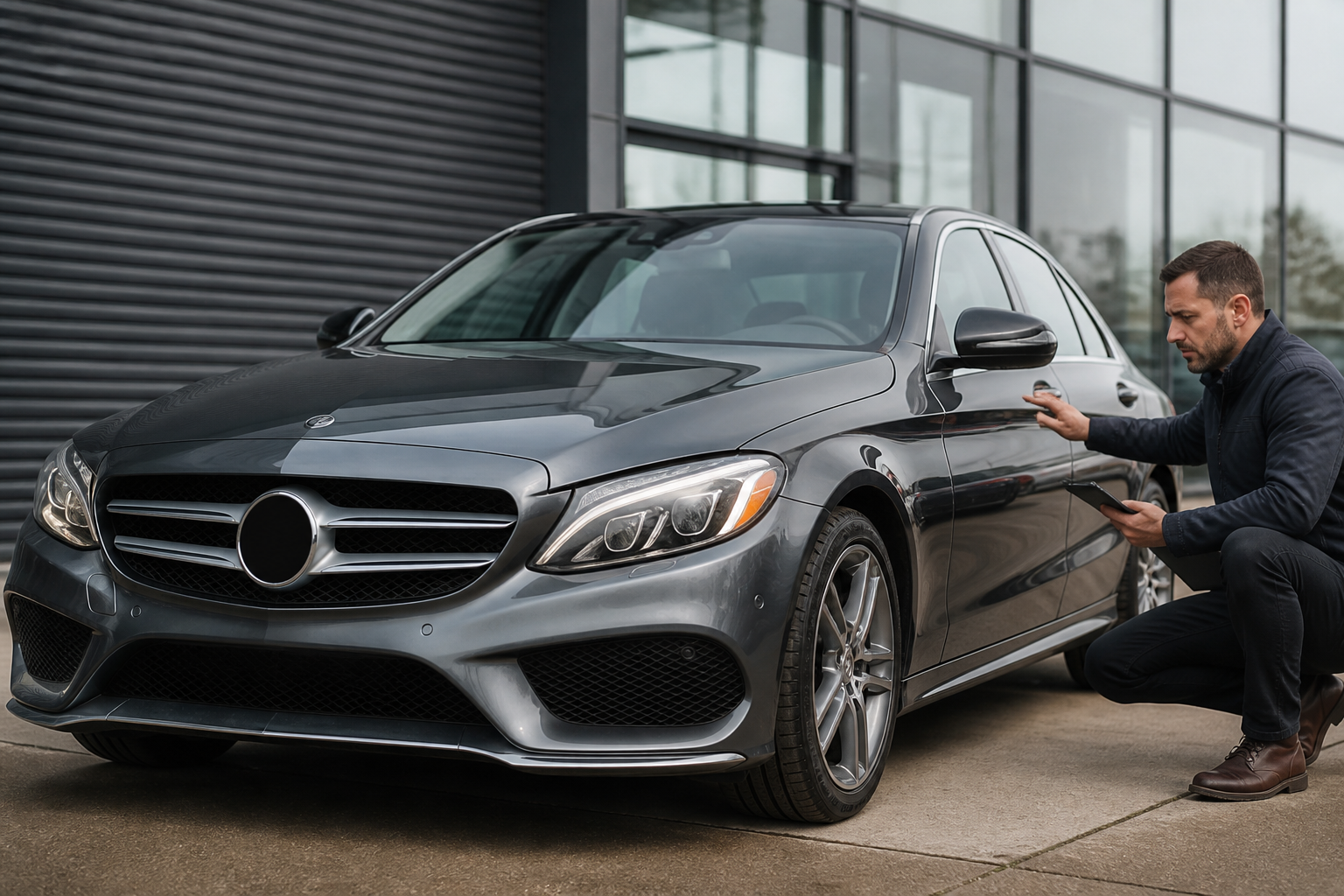
A step-by-step due-diligence workflow for a used Mercedes-Benz involves: (1) confirm whether the car is in the Mercedes-Benz Certified Pre-Owned program and review the exact warranty terms for that vehicle, using MBUSA’s CPO overview and the CPO Certifications Brochure; (2) understand Mercedes’ own CPO multi-point inspection expectations (documentation, mileage/history checks, structural and maintenance verifications, recalls/campaigns, and owner’s materials); and (3) add an independent pre-purchase inspection to verify condition beyond the paperwork (check for leaks, body and structural issues, tires/brakes, and run a code scan). This approach blends manufacturer-provided CPO coverage with independent verification to avoid relying solely on seller claims. See MBUSA CPO pages and brochure, and Consumer Reports’ pre-purchase inspection guidance. https://www.mbusa.com/en/cpo?msockid=2ae59b7bf21f649821d08d81f3456546, https://www.mbusa.com/content/dam/mb-nafta/us/cpo/CPO-Certifications-Brochure.pdf, https://www.consumerreports.org/cars/how-to-inspect-a-used-car-a1377126659/
Key takeaways
- MBUSA describes CPO offerings and warranty basics, but verify the exact vehicle’s coverage for the specific car.
- The CPO Certifications Brochure outlines Mercedes’ required inspection and reconditioning steps, which inform what the seller should have delivered.
- Independent pre-purchase inspections provide essential verification beyond the CPO paperwork and should assess leaks, structure/body, tires/brakes, and perform a code scan.
Expanded workflow for evaluating a used Mercedes-Benz: CPO paperwork, CPO inspection, and independent pre-purchase checks
Purchasing a used Mercedes-Benz—whether as a Certified Pre-Owned (CPO) vehicle or a non-CPO model—benefits from a disciplined, source-backed due-diligence process. This expanded guide translates the official Mercedes-Benz CPO framework into a practical, step-by-step verification workflow. It also adds a robust independent verification layer to prevent relying solely on seller claims or on brochures. The structure below helps buyers verify eligibility, understand the exact coverage, and perform a thorough mechanical and systems check before finalizing any deal.
Step A — Verify CPO status, eligibility, and the exact warranty terms
1) Confirm the vehicle is enrolled in Mercedes-Benz Certified Pre-Owned and identify the exact CPO terms tied to that car. Not all used Mercedes models qualify for CPO in every market or with every model year; coverage can vary by age, mileage, and regional program rules.
2) Obtain the precise warranty details for the specific vehicle. The CPO program generally includes a limited warranty, but the duration, mileage cap, and included services (such as roadside assistance or powertrain coverage) differ by vehicle and region. Record the warranty start date, remaining term, deductible (if any), and what is excluded.
3) Check the vehicle’s status against the MBUSA CPO documentation. Ask for the CPO eligibility letter or certificate that accompanies the car, and verify the vehicle identification number (VIN) on the certificate matches the car’s VIN and the window sticker. This ensures you’re not purchasing a car marketed as CPO when it does not meet the official criteria.
4) Confirm that any recalls or campaigns have been completed. CPO vehicles should have a clean service history with recall actions performed as required by Mercedes-Benz or the relevant regulatory authority. If recalls exist, verify completion dates and service records that show repairs were performed.
Sources framing these basics include MBUSA’s overview of CPO offerings and the CPO Certifications Brochure, which outline the scope of the coverage and documentation expectations. See: MBUSA CPO overview; CPO Certifications Brochure.
Practical tip: Ask the seller for the CPO packet or digital access to the vehicle’s certification records and cross-check with the dealership’s service records. If there’s any mismatch, demand clarification before negotiation or consider a non-CPO purchase and rely on independent verification instead.
Step B — Understand Mercedes’ multi-point inspection and reconditioning criteria (the manufacturer’s baseline)
The official CPO Certifications Brochure details the checks Mercedes performs to certify a vehicle. This is not a generic “pre-owned” check; it’s a structured, model- and mileage-appropriate rebuilder process. Expect documentation that covers:
- Mileage verification and driving history review to detect odometer tampering or inconsistent service entries.
- Structural and frame considerations, including checks for obvious collision damage, corrosion, and alignment concerns that could affect long-term safety or performance.
- Mechanical systems reconditioning—engine, transmission, drivetrain, suspension, steering, brakes, and major fluid services where applicable.
- Recalls and campaigns addressed as part of the reconditioning workflow, ensuring no outstanding regulatory items remain outstanding on the vehicle.
- Verification that owner’s manual, warranty booklet, and all required documentation are present and accurate.
The CPO Certifications Brochure is the primary reference for these expectations. It describes the categories of checks Mercedes considers essential to certify the vehicle and the reconditioning standards that must be met before stating a vehicle is CPO-ready. See the official brochure for the exact, model-specific criteria.
Practical note: If you’re evaluating a specific model (for example, a C-Class, E-Class, or GLE), the depth and emphasis of checks can vary by platform and year. Always request the most recent version of the CPO brochure relevant to your vehicle and compare it with the records you receive from MBUSA or the selling dealer.
Step C — Add an independent pre-purchase inspection (PPI) to corroborate paperwork
Even with a Mercedes-certified vehicle, independent verification adds a critical safety margin. A qualified independent mechanic should perform a comprehensive pre-purchase inspection (PPI) to validate the CPO paperwork and identify issues the documentation might not fully reveal. Focus areas include:
- Structural integrity and body condition: signs of past accidents, rust in exposed joints, frame damage, or poor alignment that could indicate hidden repairs.
- Suspension and steering: check for uneven tire wear, ride height differences, unusual clunks, or steering wander that may indicate worn components.
- Turning, braking, and tires: inspect brake pad/rotor wear, pedal feel, ABS indicators, tire age, and evenness of wear across all wheels.
- Fluid health and leaks: inspect engine oil, transmission fluid, coolant, brake fluid, power steering fluid, and check for fresh seals around the engine and under the vehicle for leaks.
- Electrical systems and diagnostics: run a full OBD-II scan to identify pending or stored codes, monitor for emissions-related issues, and confirm systems like airbags, lights, and sensors operate properly.
- Climate control and comfort features: verify HVAC operation, seat electronics, infotainment connectivity, and other model-specific features.
Why this matters: independent inspection complements the CPO paperwork and helps you quantify the car’s condition for negotiation. Consumer Reports explicitly advocates a targeted, thorough PPI as a decision-support tool, especially for used vehicles where the seller’s disclosures may be incomplete. See Consumer Reports’ guidance on how to inspect a used car.
Step D — Verify the paper trail: ownership history, service records, and documentation
The paperwork package for a CPO Mercedes should include a coherent service history, proof of maintenance adherence, and documentation supporting the CPO eligibility. Specifically look for:
- Untampered ownership history and consistent service entries showing maintenance at Mercedes- affiliated shops or approved service centers.
- Complete recall/tech campaign records demonstrating that open campaigns were addressed or are clearly documented as not applicable.
- Validation that the car’s manuals, warranty booklet, and the CPO certificate match the vehicle’s VIN and the dealership records.
Inconsistencies between the CPO certificate and the service history can raise questions about eligibility or the true condition of the car. When in doubt, request a certified copy or a direct verification from the MBUSA portal or the dealership’s internal CPO system.
Step E — Final pre-purchase scan and operational checks
With the paperwork and independent inspection in hand, perform a final test-drive-focused assessment. Key checks include:
- Test-drive to evaluate acceleration, transmission shift firmness, steering accuracy, suspension comfort, and braking response under varied speeds and road conditions.
- Diagnostic scan (where available) to confirm there are no outstanding fault codes that could portend future failures or required repairs beyond the CPO coverage.
- Condition notes for curb appeal versus functional condition—document cosmetic issues versus mechanical items that affect safety or reliability.
Integrated with the official CPO steps, this final phase helps you ensure that the car you’re paying for truly matches its documentation and the level of assurance guaranteed by the CPO program and the independent inspector.
Putting it all together: a practical, repeatable workflow
Adopt this sequence to build your confidence before purchasing a used Mercedes-Benz:
- Step 1 — Confirm CPO status and warranty terms for the exact vehicle from MBUSA materials and the dealership’s documentation.
- Step 2 — Read and compare the manufacturer’s CPO multi-point inspection criteria (as outlined in the CPO Certifications Brochure) to understand what Mercedes has already certified.
- Step 3 — Conduct an independent pre-purchase inspection with a qualified technician, focusing on leaks, structural integrity, tires/brakes, and an OBD scan.
- Step 4 — Review the complete paperwork package for consistency: ownership history, service entries, recalls, and the presence of manuals/warranty materials.
- Step 5 — Perform a final test-drive and diagnostic check to confirm operational readiness and alignment with the documented condition.
Limitations and caveats to keep in mind:
- CPO programs and coverage can vary by model year, region, and vehicle mileage; always verify the exact terms tied to the car you’re buying.
- The CPO inspection is a snapshot of vehicle health at the time of certification; it does not guarantee future reliability or prohibit all future wear-related issues.
- Independent inspectors have varying levels of access and expertise; choose a shop with Mercedes-Benz-specific training or experience with the exact model.
Conclusion
When buying a used Mercedes-Benz, a disciplined, source-backed approach—rooted in the official CPO framework and augmented by independent verification—reduces ambiguity and strengthens your negotiating position. By confirming CPO eligibility and warranty terms, understanding Mercedes’ multi-point inspection expectations, and adding a thorough independent pre-purchase inspection, buyers gain a clearer picture of value and risk and can proceed with greater confidence.
Sources
- Certified Pre-Owned (CPO) Cars and SUV | Mercedes-Benz USA
- Mercedes-Benz USA Certified Pre-Owned (CPO) Certifications-Brochure (PDF)
- Consumer Reports’ Used Car Checklist to Avoid Costly Repairs
Related Mercedes-Benz guides