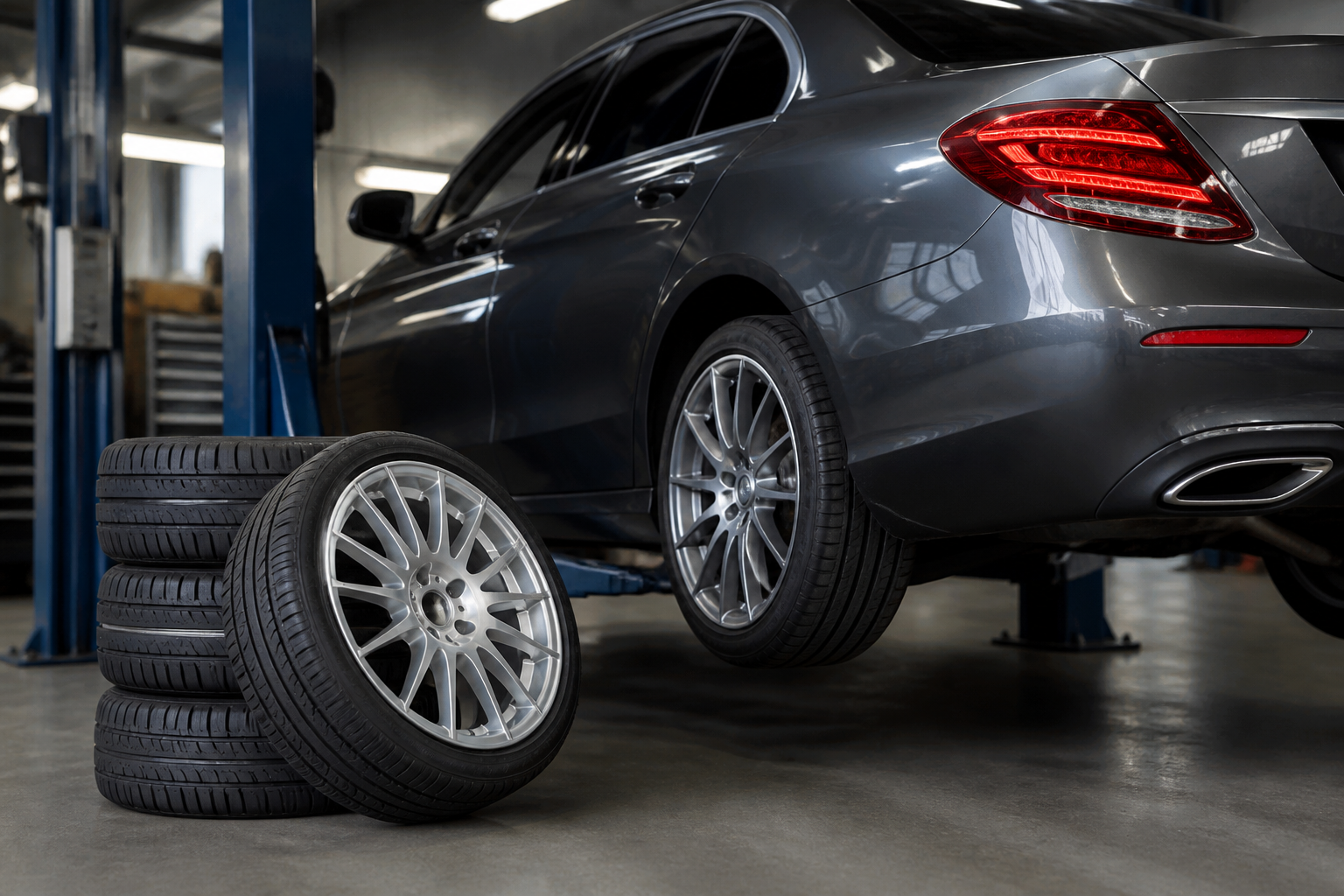
A practical 5-year budgeting framework for Mercedes-Benz tire costs considers (1) rotation feasibility with staggered sizes (rotation not possible on staggered setups; possible on equal sizes with front-to-rear rotation), (2) MOExtended run-flat behavior after a pressure loss (limited distance and speed, TPMS-required, replace tire after emergency use), and (3) independent tread-life data to guide replacement timing (typical tires often reach 70,000 miles with proper maintenance). Use MBUSA maintenance guidance to determine rotation eligibility and intervals, and MBUSA MOExtended manual guidance to plan emergency-drive scenarios and replacement needs; supplement with Consumer Reports tread-life benchmarks to translate mileage into budgeted costs. Key source links: MBUSA rotation guidance and MOExtended manual, and Consumer Reports treadwear testing article. https://www.mbusa.com/mbrace/vcm/MB/DigitalAssets/pdfmb/maintenancebooklets/MY13_Maintenance_Booklet.pdf, https://www.mbusa.com/content/dam/mb-nafta/us/owners/manuals/2016/operators/MY16_E-Class_Sedan_Wagon_Operator.pdf, https://pressroom.consumerreports.org/cars/tires/how-long-do-tires-last-consumer-reports-treadwear-testing-a5353952733/
Key takeaways
- Rotation is only possible when front and rear tire sizes match; staggered sizes prohibit rotation per MB guidance.
- MOExtended run-flat tires allow continued driving after a pressure loss but impose distance/speed limits and require TPMS; replacement planning follows emergency-use guidance.
- Independent tread-life testing suggests many family-car tires can exceed 70,000 miles with proper maintenance, informing mileage-based replacement budgeting.
- Document rotations in the maintenance booklet when performed to maintain a traceable service history.
- Build a 5-year plan that combines rotation eligibility, MOExtended contingency, and tread-life benchmarks to forecast replacement timing and costs.
Overview: five-year budgeting for Mercedes-Benz tires
This piece translates official Mercedes-Benz guidance and independent testing into a practical, five-year cost plan focused on tires. It addresses (1) when rotation is feasible with staggered sizes, (2) how MOExtended run-flat tires affect budgeting after a pressure loss, and (3) how tread-life estimates from independent testing translate into realistic replacement timing. The aim is to equip owners with a defensible, source-backed framework that connects maintenance policy to tangible 5-year costs.
Rotation feasibility with staggered tire sizes
Mercedes-Benz clarifies that tire rotation is possible only when front and rear tire dimensions match. Vehicles configured with staggered sizes (different front vs. rear tire widths or aspect ratios) do not allow a traditional rotation. This constraint changes the way wear is managed and replacement timing is planned. When rotation is possible, MB recommends rotating at the appropriate intervals and possibly at every service, depending on wear patterns and the maintenance schedule in the booklet.
- Same-size configurations: front-to-rear rotation is allowed and should preserve rotation direction as designed by the manufacturer.
- Staggered-size configurations: rotation is not performed; wear is tracked by mileage and tread depth rather than rotation cycles.
- Record-keeping: use the maintenance booklet rotation confirmation page to document when rotations occur and what pattern was used.
Practical budgeting takeaway: if your Mercedes has staggered sizes, plan tire replacement primarily by tread depth and mileage rather than by a rotation cadence. If rotation is possible, include rotation costs in the maintenance budget aligned with the service intervals. For owners who want precise accountability, maintain rotation records in the vehicle’s maintenance booklet.
MOExtended (run-flat) tires: emergency mode and budgeting implications
MOExtended tires enable continued driving after a loss of pressure, but with explicit limits. The vehicle may be driven a finite distance at a constrained speed, and only when the TPMS is active. Key elements include:
- Identification: MOExtended tires carry an MOExtended marking on the sidewall and require an active TPMS system to function as intended.
- Emergency-drive distances: the allowable distance varies with load; approximate figures cited in manuals are around 50 miles when lightly loaded and closer to 18 miles when the vehicle is fully laden.
- Speed limit: a maximum run-flat speed (~50 mph / 80 km/h) applies during emergency operation.
- Post-event procedure: after an MOExtended event, stop safely and inspect the wheel/tender area; replace the tire and inspect the wheel rims at a qualified workshop if symptoms such as smoke, unusual vibration, or ESP intervention occur.
Practical budgeting takeaway: include the cost of replacing MOExtended tires after any emergency run-flat use and allocate funds for wheel inspection and potential rim replacement if damage is detected. Recognize that a MOExtended replacement may occur sooner than a non-run-flat tire would have, depending on driving conditions and maintenance history.
Independent perspective: tread life expectations for budgeting
Independent tread-life assessments provide a useful anchor for planning, even when manufacturer guidance focuses on configuration and MOExtended behavior. Tread-life testing often shows that many family-car tires can deliver substantial mileage under proper care, with typical life in the range of 60,000–70,000 miles or more in favorable conditions. These figures are dependent on routine maintenance practices, including regular rotation (where allowed), correct tire pressures, and proper alignment. While MB-specific tires are categorized by fitment and MOExtended behavior, a broad tread-life benchmark helps translate mileage into replacement timing and cost expectations.
Source perspective: Consumer Reports outlines its treadwear testing approach and suggests that, with appropriate maintenance, tires on typical family cars can achieve substantial mileage, providing a baseline for budgeting per-mile costs and replacement timing.
Five-year budgeting framework: components and practical illustration
Construct a five-year plan by integrating these elements:
- Rotation eligibility by configuration: determine whether rotations are permitted and schedule them if applicable; otherwise, base replacement on tread depth and mileage progression.
- MOExtended run-flat contingency: account for emergency-drive distances, speed limits, and the obligation to replace the tire after an MOExtended event plus wheel inspection costs.
- Tread-life expectation: apply independent testing guidance to convert mileage into an annual replacement allowance, adjusting for driving style and climate where relevant.
Important: this article refrains from providing specific price points. Use local market pricing to populate the five-year cost estimate once you have the annual tire size, brand, and configuration. The budgeting framework aims to balance the official rotation guidance from MBUSA with independent tread-life expectations to produce a realistic, defendable plan.
Practical scenarios and budgeting examples
Scenario A: a sedan with staggered front/rear sizes (no rotation possible). Five-year planning should emphasize tread-depth-driven replacement milestones. Start by establishing a target minimum tread depth (for example, 2/32 inch for tread depth as you approach replacement thresholds) and map annual mileage to anticipated replacement events. Include the potential for MOExtended-related replacement if the vehicle experiences a loss of pressure and requires a non-repairable tire replacement.
Scenario B: a vehicle with the same-size front and rear tires (rotation allowed). Build a cadence that includes rotation costs at regular service intervals, while still planning for replacement based on tread wear and mileage. Keep a log of all rotations in the maintenance booklet to support resale value and maintenance transparency.
Notes on limitations and caveats
- MBUSA guidance is model-year and configuration-specific. Always verify current manuals for your exact vehicle and tire configuration, as rotation policies and MOExtended behavior can change with new tire designs or software updates.
- MOExtended distances and speeds can vary with load, temperature, road surface, and vehicle condition. Use the owner manual’s figures as upper bounds and adjust for your typical driving profile.
- Independent tread-life estimates are broad guidelines. Real-world wear depends on maintenance discipline, climate, road conditions, and driving style. Apply a conservative margin when budgeting.
- Prices for tires, wheel replacement, and mounting/balancing are not included in this framework and will differ by region, brand, and performance category.
Concise five-year budgeting guide
- Identify tire configuration: rotate-eligible or staggered (no rotation).
- If rotation is eligible, plan rotation at the recommended cadence and record it in the maintenance booklet.
- If rotation is not eligible, schedule tread-depth-based replacements with mileage milestones and account for a potential MOExtended tire replacement after emergency use.
- Reference independent tread-life benchmarks to set a realistic mileage interval for replacements, adjusting for your annual mileage and climate.
- Aggregate the expected replacement costs (tires plus mounting/balancing and potential rim checks) over five years to build your total ownership-cost projection.
Sources and further reading
- Mercedes-Benz Maintenance Booklet (MY13) — rotation eligibility and service-interval guidance: https://www.mbusa.com/mbrace/vcm/MB/DigitalAssets/pdfmb/maintenancebooklets/MY13_Maintenance_Booklet.pdf
- MOExtended (run-flat) tires: distance and speed guidance after pressure loss — MBUSA operator’s manual (MY16 E-Class): https://www.mbusa.com/content/dam/mb-nafta/us/owners/manuals/2016/operators/MY16_E-Class_Sedan_Wagon_Operator.pdf
- How long tires last (treadwear testing) — Consumer Reports: https://pressroom.consumerreports.org/cars/tires/how-long-do-tires-last-consumer-reports-treadwear-testing-a5353952733/
Conclusion
For Mercedes-Benz tire budgeting across five years, align the plan with whether rotation is possible for your configuration, factor in MOExtended run-flat contingencies after pressure loss, and apply independent tread-life guidance to set realistic replacement timing. Document rotations when performed, anticipate MOExtended replacement costs after emergency use, and translate mileage-based wear into a robust, defensible five-year cost framework.
Sources