Mercedes-Benz owner manuals emphasize reducing speed, avoiding tire ruts, and using smooth steering and braking inputs in rain or standing water; when fording water, drive at a walking pace, and after water exposure, brake cautiously until braking performance is fully restored.
Key takeaways
- Reduce speed in heavy rain and on wet roads to lower hydroplaning risk and improve traction.
- Avoid tire ruts and make smooth, gradual steering and braking inputs during hydroplaning-prone conditions.
- When driving through standing water, proceed at a walking pace to minimize water intrusion; after water exposure, brake carefully as traction returns.
Hydroplaning and water-logged roads pose persistent challenges for Mercedes-Benz drivers, even at speeds well below highway limits. The owner manuals across recent model years consistently present a conservative, methodical playbook for speed, steering, braking, and water crossing. The goal is to preserve directional stability, avoid abrupt inputs, and ensure that tires regain full grip as soon as possible after confronting standing water or a hydroplaning-prone surface. This expansion synthesizes the step-by-step guidance drawn from verified Mercedes-Benz documents to deliver a practical, owner-focused guide you can apply on real roads.
Core principles that drive the guidance
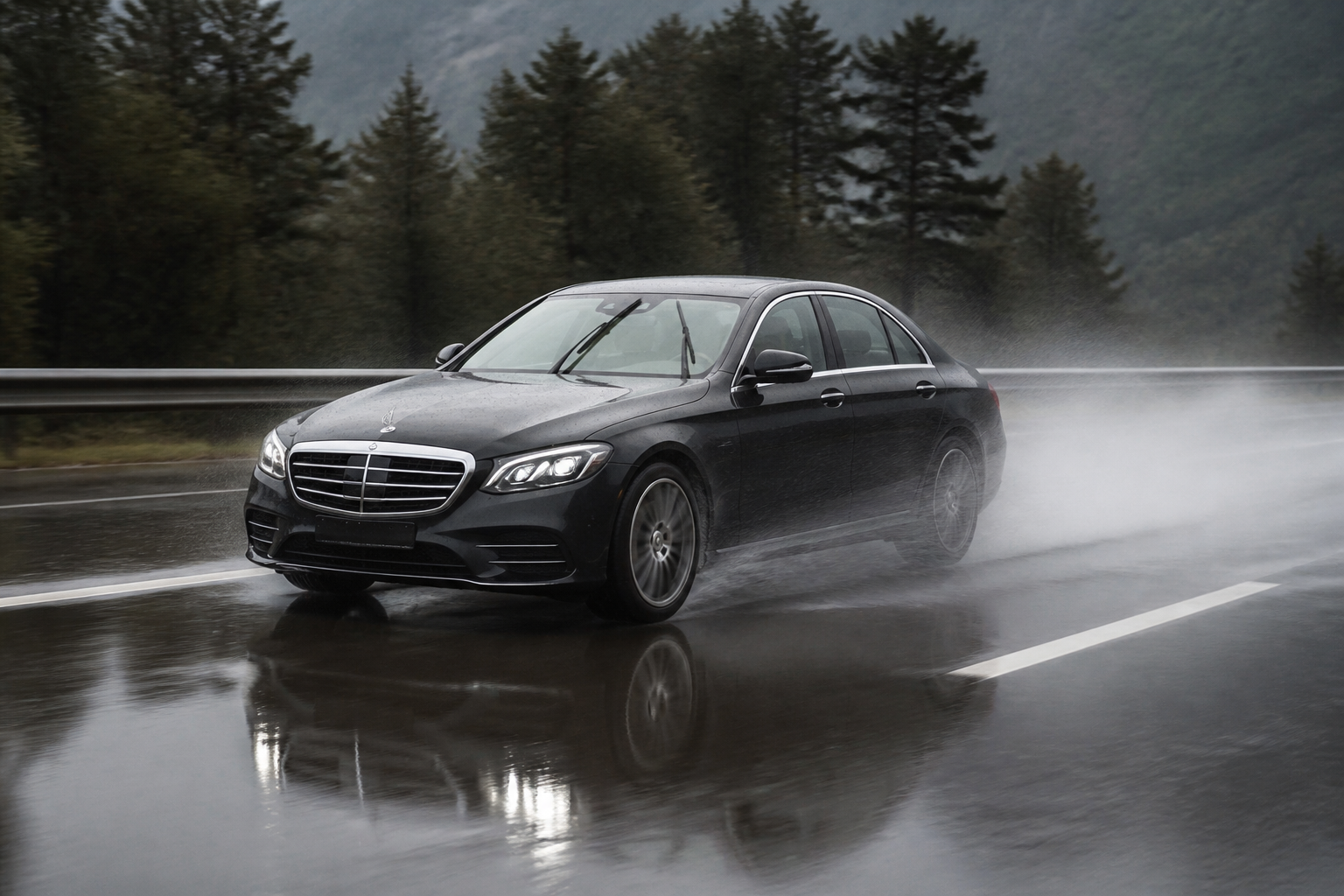
Engineers at Mercedes-Benz describe hydroplaning as a condition where a film of water reduces tire contact with the road surface. Critically, the risk is not reserved for high speeds or worn tires alone; even with adequate tread and modest speeds, water depth, water accumulation in wheel grooves, or spray from other vehicles can create a partial loss of traction. The manuals therefore emphasize restraint and predictability: reduce speed before entering water or wet patches, maintain smooth vehicle inputs, and avoid actions that could destabilize the vehicle when grip is compromised.
Several manual sources repeatedly warn that braking effectiveness can be reduced after fording or passing through water. The practical implication is a two-phase approach: (1) manage the immediate loss of traction with gentle inputs, and (2) re-establish full braking response gradually once tires reclaim grip. This framework applies across different Mercedes-Benz models and markets, reinforcing a consistent safety posture rather than model-specific exceptions.
Step-by-step techniques for heavy rain, standing water, and hydroplaning risk
- Reduce speed early and steadily. Begin deceleration before you reach patches of water or visible spray. Abrupt braking can destabilize the chassis when tires are already at the edge of grip. The recommended approach is to slow gradually as water depth or flow increases, which helps maintain steering feel and control.
- Avoid tire ruts and painted markings when possible. Water collected in wheel tracks or across lane markings can channel beneath the tire more efficiently, increasing hydroplaning potential. Favor a smooth, predictable line and steer with deliberate, light inputs to keep the vehicle centered in a safe path.
- Keep inputs smooth and progressive. Steering, throttle, and braking should be gradual. Sudden changes in direction or intensity can unsettle the car when hydroplaning risk is present. If you sense the vehicle sliding or the steering feel changing, ease off the throttle and restore grip with small, incremental corrections.
- Look ahead and plan your path. A clear view of the road ahead allows you to avoid deepest water pockets and to navigate around obstacles. A larger following distance provides additional time to react as you encounter standing water or changing road surfaces.
This technique set aligns with the 2019 GLC SUV Operator’s Manual and the 2024 GLC SUV Owners Manual and is echoed in other MB manuals. The consistency across sources provides a practical, repeatable routine you can rely on regardless of model year within the Mercedes-Benz family.
Water fording and safe passage through standing water
When crossing standing water, Mercedes-Benz manuals advise a walking pace or very gentle progression. The purpose is to minimize the risk of water intrusion into the engine intake or cabin and to avoid creating wave action that could flood components or disturb the interior. If fording becomes necessary, stay as steady as possible and avoid stopping in deeper patches unless absolutely required.
A key caution is to avoid abrupt throttle changes, sudden steering, or sharp braking while traversing water. Even if the water depth seems shallow, the combination of moving water, tire speed, and road irregularities can momentarily lift the tire away from the pavement, reducing grip and increasing the chance of losing control. After clearing water, return to normal driving inputs gradually as traction is confirmed and the vehicle’s grip sensors indicate stabilization.
Braking after water exposure
Brakes can feel briefly less responsive after driving through water. Mercedes-Benz guidance recommends re-applying braking force progressively as you return to dry pavement and grip. A staged approach—light, controlled braking, then a gradual increase in brake pressure—helps prevent wheel lock, ABS chatter, or sudden instability as grip transfers back to the tires.
Because water can alter brake response, it is prudent to increase stopping distances shortly after water exposure and to monitor traffic conditions ahead as you regain normal braking performance. This cautious braking mindset remains valid across model years and is emphasized in multiple MB manuals as part of the broader fording and hydroplaning guidance.
Practical owner-focused checklist
- In rain or standing water: slow early, scan ahead, and avoid the deepest water patches when possible.
- Approaching water: cross at a walking-like pace if crossing is necessary; avoid abrupt throttle, steering, or braking inputs.
- During hydroplaning risk: keep steering inputs smooth and deliberate; avoid sudden wheel movements or aggressive corrections.
- After water exposure: anticipate reduced braking effectiveness; brake progressively as grip returns.
Model-dependent caveats and limitations
The guidance above aggregates core principles from several Mercedes-Benz owner manuals, but real-world performance can differ based on tire type and condition, tread depth, tire pressure, ABS calibration, brake wear, suspension setup, and the presence of stability or traction-control systems. Some models feature advanced driver-assistance or stability systems that modify steering and braking responses in wet conditions. Always consult your exact Owner’s Manual for your model year, trim, and market, and apply the manufacturer-recommended procedures specific to your vehicle configuration.
Direct, practical guidance distilled for owners
When driving in heavy rain, through standing water, or in hydroplaning-prone conditions, Mercedes-Benz owners should: reduce speed to lower hydroplaning risk, avoid driving through tire ruts and deep water, and execute smooth, progressive steering, throttle, and braking inputs. If you encounter water, pass through it at a walking pace to minimize water ingress, and re-establish braking power cautiously after exiting the water. This approach is consistently echoed across MB manuals, including the 2019 GLC SUV Operator’s Manual, the 2024 GLC SUV Owners Manual, and the 2025 Canada E-Class Sedan manual, reinforcing a unified, safety-first framework for water-related driving scenarios.
Conclusion
Mercedes-Benz owner manuals advocate a conservative, controlled approach to wet and flooded driving environments. By slowing down early, avoiding abrupt steering or braking, and traversing standing water at a cautious pace when necessary, drivers can maintain stability and retain braking capability until full traction returns. Apply the guidance with your model’s specific manuals in hand, and adapt to road, weather, and tire conditions for the safest possible outcome.
Sources