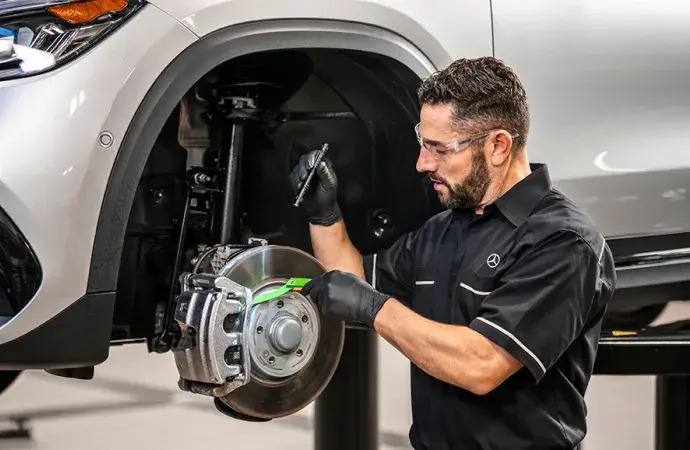
Brake service is not one job with one universal interval. Pads are friction material, rotors are working surfaces, brake fluid transfers hydraulic force, and electronic systems monitor or assist the process. A dashboard message, noise or vibration can point to different parts of that system. The correct response begins by separating routine wear from a safety-critical hydraulic or electronic warning.
Know when to stop
If the brake pedal becomes unusually soft, sinks, requires much more effort, the vehicle pulls severely, fluid is visibly leaking, or the manual displays a stop-driving instruction, pull over safely and arrange recovery. Do not keep driving to “see if it clears.” A Mercedes owner manual can explicitly instruct the driver not to continue when brake-fluid level is insufficient and warns that simply adding fluid does not correct the malfunction.
A wear message for pads is different from a red system warning, but it still requires timely inspection. Photograph the exact text and warning color, note pedal feel, and tell the workshop whether the symptom appeared after rain, wheel work, battery trouble or recent brake service.
What a complete inspection covers
| Component | Inspection | Common evidence |
|---|---|---|
| Pads | Remaining material, evenness, sensor condition | Wear warning, noise, uneven inner/outer wear |
| Rotors | Thickness, runout, surface and heat condition | Judder, scoring, cracking or heavy lip |
| Hydraulics | Fluid condition, level, leaks, hoses and calipers | Soft pedal, pull, wetness or seized movement |
| Electronics | ABS/ESP faults, wheel-speed data and warnings | Warning lamps or disabled assistance systems |
| Tires/suspension | Pressure, wear, play and alignment | Symptoms that imitate a brake pull or vibration |
Pads and sensors
Pad life depends on vehicle mass, driving environment, wheel size, regenerative braking and driver behavior. A sensor normally indicates that a wear threshold has been reached; it does not measure every pad continuously. The inner pad can wear differently from the visible outer pad, so inspection must cover both sides and caliper movement.
Replacing pads without addressing a seized slide, damaged boot or uneven rotor can lead to rapid recurrence. Ask the technician to document measurements and show whether wear is even across the axle.
When rotors should be measured
A rotor should be judged by measured thickness, manufacturer limits, surface condition and runout—not by appearance alone. Vibration under braking can come from thickness variation, runout, hub contamination, wheel mounting, suspension wear or tire issues. Resurfacing feasibility depends on the remaining material and the approved procedure for the exact vehicle.
After wheel or brake work, correct cleaning, torque sequence and fastener specification matter. If vibration began immediately after service, return with the invoice and timeline rather than assuming the new parts are defective.
Brake fluid is a time-based service item
Mercedes-Benz USA describes brake-fluid exchange as part of Service B on its current service page, approximately every 20,000 miles or two years after the first Service A, while also directing owners to the schedule applicable to their vehicle. The exact maintenance booklet and market control the requirement. Fluid should be the specified type from a sealed source, and the procedure must account for the braking system's design.
Color alone is not a complete test. Moisture, boiling performance, contamination and service history matter. Never mix an unknown fluid or use a generic interval when the vehicle documentation specifies otherwise.
Noise does not have one meaning
A brief surface-rust sound after rain may disappear after gentle normal braking. Persistent grinding, a metallic scrape, repeated clicking or a change in pedal feel requires inspection. Squeal can relate to pad compound, contamination, glazing, hardware or operating conditions. Diagnosis should reproduce the noise and connect it to measured evidence.
Electronic warnings and driver assistance
ABS, stability control and driver-assistance functions depend on sensors and network communication. A brake-related warning can therefore arise without worn friction material. Scan all relevant modules and verify battery voltage, wheel-speed signals and recent service. NHTSA emphasizes that driver-assistance systems support the driver; they do not remove the driver's responsibility to steer and brake.
Do not rely on automatic emergency braking to compensate for a mechanical concern. Our guide to verifying Mercedes safety equipment explains why assistance features and the base braking system must be considered separately. For maintenance timing, see how to read Mercedes service reminders.
A useful workshop estimate
Request pad thickness by wheel, rotor measurements, photographs of abnormal wear, fluid-service history, diagnostic faults and a division between required and optional work. Ask whether the quote covers one axle or both, whether sensors and hardware are included, and what bedding or post-repair road test will be performed.
Questions owners ask
Must pads and rotors always be replaced together?
No universal answer applies. Rotors may remain serviceable when measurements and condition meet specifications, but damaged, under-limit or unsuitable surfaces require correction. The workshop should explain the decision using measurements rather than a blanket sales rule.
Can I drive after a pad-wear message?
Follow the exact owner's manual and arrange inspection promptly. Remaining distance cannot be predicted from the message alone because wear rate and sensor design vary. A red system warning, fluid warning or changed pedal feel requires a more urgent response.
Why does the steering wheel shake under braking?
Possible causes include rotor runout or thickness variation, hub contamination, wheel installation, tire problems and suspension play. Measure before replacing parts. A symptom that changes with speed or appeared after wheel service provides useful diagnostic direction.
What verifies a successful repair?
The invoice should record measurements, part numbers, fluid specification where applicable, diagnostic action and road-test result. The pedal should be consistent, warnings cleared for a documented reason, and no leak or abnormal pull present.
Can regenerative braking hide friction-brake wear?
Electrified Mercedes models may use regenerative braking frequently, but the friction brakes still require inspection. Reduced use can change surface condition, while emergency stops and low-speed braking still depend on the conventional system. Follow the model-specific schedule rather than assuming low pad use eliminates fluid, corrosion or caliper concerns.
Why can new brakes still make noise?
New components may need the correct bedding procedure, but persistent noise can also reflect contamination, hardware, installation, rotor condition or an unsuitable part combination. Ask the workshop to reproduce the sound and inspect the complete axle. Do not accept noise as automatically normal merely because parts were recently installed.
Should brake work include a wheel alignment?
Routine pad replacement does not automatically require alignment. However, uneven tire wear, steering pull, suspension repairs or impact damage may justify a separate alignment inspection. A brake pull should first be diagnosed so alignment is not used to mask a hydraulic, tire or suspension fault.
Sources