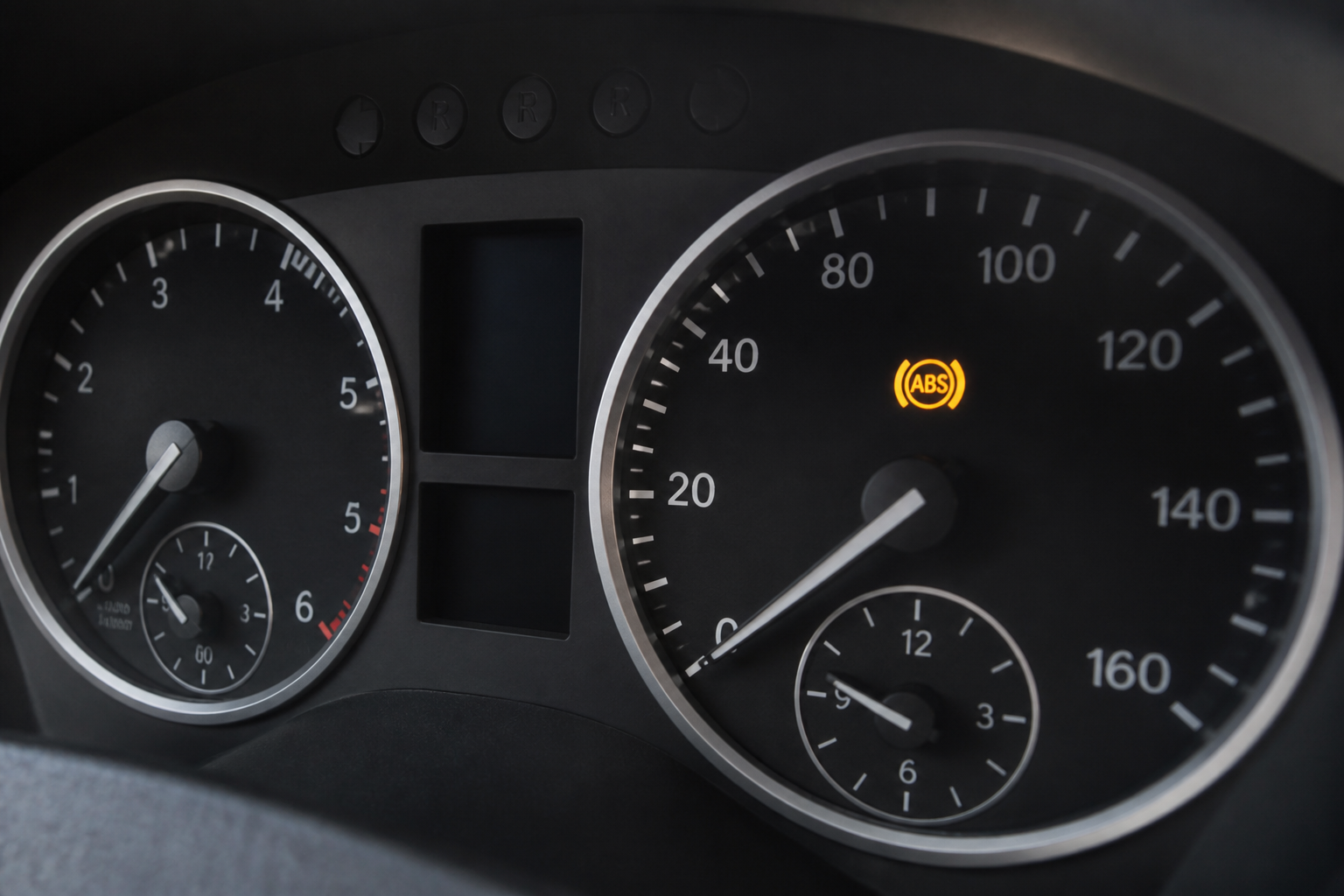
When the yellow ABS/ESP warning lamp comes on while the engine is running, treat it as a potential fault in the ABS/ESP or related stability systems and seek a professional inspection at an authorized Mercedes-Benz Center as soon as possible. Before diagnosis, confirm the lamp’s exact display text and any accompanying indicators, and note any brake-related inputs or safety concerns to discuss with the shop.
Mercedes ABS/ESP warning lamp: owner checks and diagnosis flow
- A yellow ABS/ESP lamp signals potential faults in anti-lock or stability systems and warrants prompt professional inspection.
- Owners should confirm how the lamp is displayed and observe any related indicators or brake inputs before visiting a shop.
- Sharing the observed lamp behavior and any related warnings helps technicians prioritize safety-critical checks and efficient diagnostics.
The Mercedes ABS/ESP warning lamp turning yellow while the engine is running signals a potential fault in the anti‑lock braking or stability‑control system. This article expands on the owner‑facing meaning, practical safety checks you can perform, and a diagnostic‑first plan to help you communicate efficiently with a shop. It follows the verified source material but adds a structured, owner‑oriented flow that reduces unnecessary repairs and improves diagnostic outcomes.
What the yellow ABS/ESP warning lamp means, in practical terms
Mercedes‑Benz describes the yellow ABS/ESP warning as an indication that the ABS/ESP or related stability systems may be impaired. In everyday terms, braking stability could be reduced and some safety features may become unavailable. The warning is not a simple routine fault; it is a safety‑critical signal that suggests the vehicle’s braking and chassis control may not operate as designed. When this lamp is on, you should treat the situation as requiring prompt professional diagnosis rather than continuing to drive with the assumption that the system is normal.
Why the emphasis on prompt inspection? ABS and ESP (Electronic Stability Program) depend on sensor data and actuator control to modulate brake pressure and throttle input for vehicle control. A fault in one part of the system can affect overall braking behavior, including steering stability in critical situations. Because ESP stability control can be unavailable or degraded, the driving dynamics may not respond as expected in wet, icy, or uneven road conditions.
Various source documents align on the core point: when the yellow ABS/ESP lamp appears with the engine running, schedule a check with a qualified technician at an authorized Mercedes‑Benz Center or an experienced workshop as soon as possible. This aligns with Mercedes‑Benz’s safety‑critical framing and helps prevent further risk from unresolved faults.
Owner checks you can perform before diagnosis
Before a diagnostic scan, you can perform a small, structured set of checks to help narrow down the context and aid the technician. These checks focus on confirming the lamp’s display behavior, ensuring basic safety considerations, and noting any related indicators or signals observed during driving or braking.
- Confirm the lamp behavior: Observe whether the lamp stays on steadily, blinks, or changes in any way when you perform light braking. Note if the lamp behavior matches prior warnings or appears after a specific event (damp road, vehicle start, etc.).
- Check for related indicators: Look for other warning lights in the cluster, particularly brake lights, ESC/TC indicators, or traction‑control signals. A cluster of warnings may indicate a common electrical fault or sensor issue.
- Brake‑light and pedal context: Confirm that the brake lights operate normally when you press the pedal. A failure or misadjustment in the brake‑light switch wiring or pedal sensor can mimic or influence ABS/ESP fault signals in some vehicles.
- Driving context: Consider whether the lamp appeared during heavy braking, after a long drive, or on a particular road surface. Note if the vehicle felt unstable or if braking response seemed altered prior to the warning.
- Recent changes: Recall any recent work, battery disconnections, or electrical system service that could have affected wiring or sensors. Electrical faults can sometimes trigger ABS/ESP warnings without a failed brake component being at fault.
These owner checks are designed to give the shop concrete context, which can help the technician decide whether the fault is sensor‑based, wiring/connector related, a hydraulics issue, or a broader control module fault. A focused description reduces the chance of chasing unrelated parts and speeds up a correct diagnosis.
What to tell the shop before diagnosis
When you arrive at a Mercedes‑Benz service facility, bring the observed lamp behavior and the context you noted from the owner checks. Clear, specific information helps technicians execute a diagnostic plan efficiently and safely. Consider sharing the following points with the shop:
- The exact wording or behavior of the yellow ABS/ESP lamp (steady on, blinking, or intermittent).
- Whether other warning lights were present and which ones, including brake lights or ESC/TC indicators.
- Any relevant driving context (stops, starts, braking on wet/difficult surfaces, etc.).
- Recent vehicle work or electrical service that could have affected wiring or sensors.
Communicating these details, alongside the general instruction from Mercedes‑Benz manuals to have the system checked promptly by a qualified workshop, helps technicians prioritize safety‑critical checks and plan an efficient diagnostic path. It also sets expectations about potential system unavailability and the need for careful sensor and module testing rather than immediate component replacement.
Diagnostic approach the workshop may take (high level)
Although only a technician can perform a full diagnosis, a typical diagnostic flow for a yellow ABS/ESP warning often follows these stages. This overview is for owner understanding and to help you discuss expectations with the shop, not a substitute for professional service:
- Verify warning details and system status: Technicians confirm the exact lamp behavior, read any stored fault codes, and determine if the warning is active or historical.
- Safety and basic vehicle condition check: A quick assessment of brakes, tire condition, wheel speeds, and any obvious hydraulic or mechanical issues, plus a scan for related body/comfort/control modules that might influence ABS/ESP signals.
- Sensor and wiring inspection: Visual and basic continuity checks on wheel speed sensors, connectors at the hubs, and the brake‑light switch circuit to rule out simple wiring faults or loose connections.
- Hydraulic and mechanical system checks: Inspect brake fluid level and condition, condition of calipers/pistons, and any signs of piston seizing or brake‑pad wear that might affect ABS activity.
- Control modules and software: If necessary, assess relevant ABS/ESP control modules for fault memory and consider whether software calibration or module replacement is warranted based on documented fault codes and vehicle history.
- Component‑level testing and repair plan: Based on collected data, the shop outlines targeted repairs (e.g., sensor replacement, wiring repair, or hydraulic system service) rather than blanket parts swapping.
This high‑level flow helps you set expectations: most owners are spared from unnecessary full‑system replacements by focusing diagnostic tests on the most probable root cause after confirming the fault code context with a hands‑on inspection.
Practical considerations and limits of owner diagnosis
Even well‑meaning owner checks have limits. A yellow ABS/ESP warning can be triggered by a spectrum of issues—from a simple sensor misalignment after tire rotation to a more subtle wiring fault or a failing hydraulic pump. Because ABS/ESP interacts with multiple subsystems (brakes, traction, steering, and powertrain controls), the same symptom can map to several possible faults. This means:
- Not every illuminated warning indicates a total failure of ABS or ESP. Some systems may be momentarily unavailable or entering a degraded mode.
- Electrical faults can masquerade as sensor or hydraulic faults. A wiring harness with a partially corroded connection may create intermittent errors that only appear under certain temperatures or loads.
- Drivability can be affected differently depending on road conditions, vehicle load, and tire condition. A safe driving strategy should be considered if the diagnosis will take time.
Because the diagnostics involve safety‑critical systems, relying on professional tools and the vehicle's fault memory is essential. Your goal as an owner is to provide precise context and avoid driving beyond what is reasonable if the system’s behavior is unpredictable or if the vehicle shows other Warning indicators simultaneously.
Sources