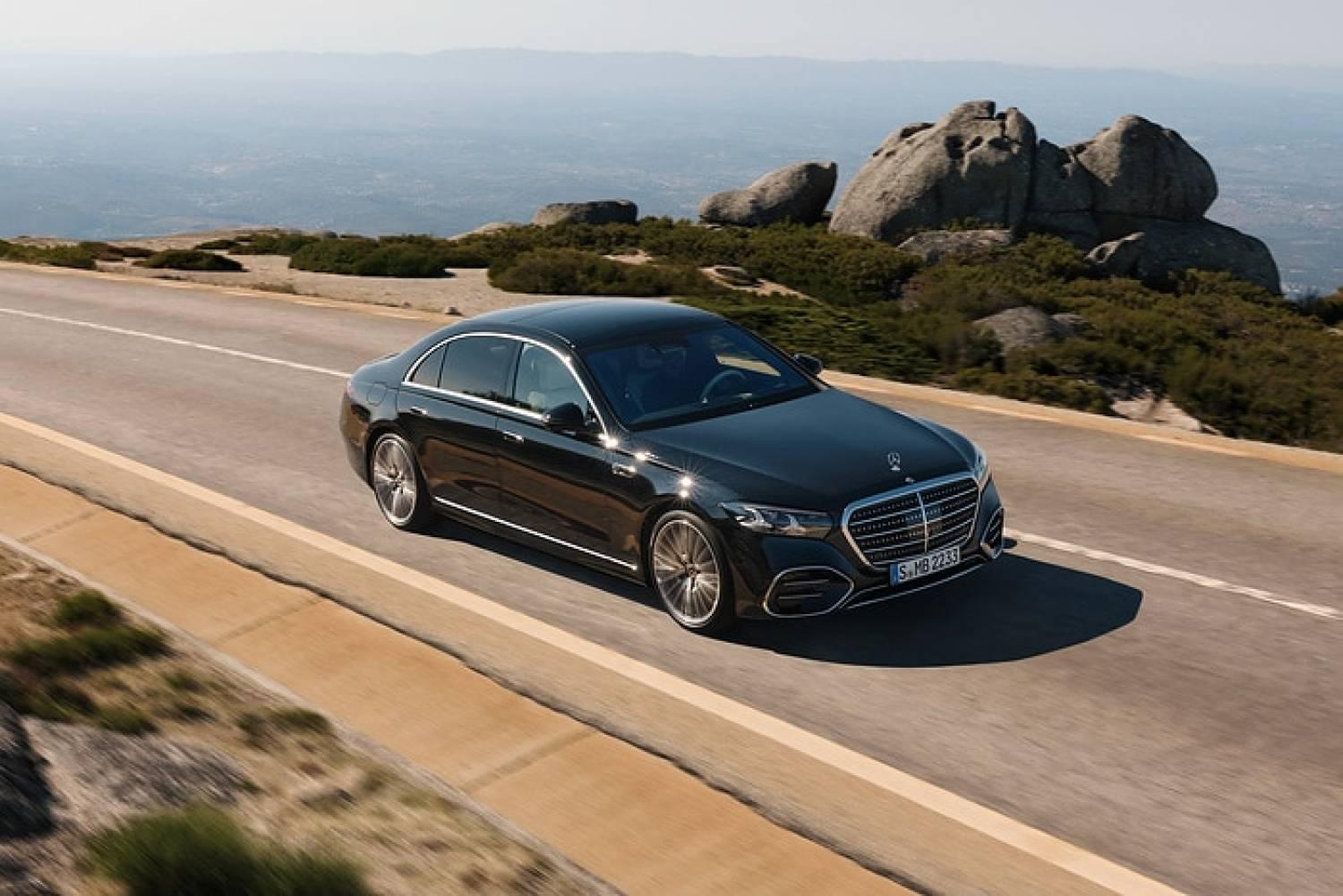
The 2026 Mercedes-Benz S-Class is not an all-new generation, but describing it as a minor facelift would miss the scale of the update. Mercedes-Benz has reworked the flagship around a revised engine portfolio, MB.OS-capable computing, fourth-generation MBUX, expanded assistance functions and detail changes intended to preserve the S-Class's traditional advantage: making long journeys feel easier for every occupant.
The car was presented in Stuttgart on 29 January 2026, 140 years after Carl Benz's patent for the motor car. That anniversary framing is ceremonial; the meaningful question is whether the updated W223 still provides a clearer luxury proposition than the BMW 7 Series, Audi A8 and high-end electric saloons. This review separates confirmed changes from marketing language and explains which buyers the S-Class still serves best.
2026 Mercedes-Benz S-Class overview
| Area | What is new or revised |
|---|---|
| Digital architecture | MB.OS-capable supercomputer and fourth-generation MBUX |
| Driver assistance | Expanded MB.DRIVE functions; MB.DRIVE ASSIST PRO rollout in selected markets |
| Powertrains | Revised six-cylinder petrol and diesel engines, plug-in hybrids and a new-generation V8 |
| Body styles | Standard and long-wheelbase saloons, depending on market |
| Officially listed derivatives | S 350 d, S 450, S 450 d, S 450 e, S 500, S 580 and S 580 e |
| Core positioning | Flagship comfort, rear-seat luxury and long-distance refinement |
What actually changed for 2026?
The update is broader than a new grille and software revision. Mercedes-Benz describes separate development programmes for design presence, intelligence, comfort and driving quality. The exterior changes are intended to make the car appear more formal and recognisable without abandoning the restrained proportions of the W223. Inside, the focus is on a more integrated digital environment for both front and rear occupants.
The most consequential technical change is the adoption of MB.OS-compatible computing. Rather than treating infotainment, navigation, assistance and connected functions as separate systems, Mercedes is moving them onto a common architecture. This allows more coordinated functions and over-the-air development, but it also makes software support and digital-service policy a larger part of long-term ownership.
Engine range: petrol, diesel, plug-in hybrid and V8
The S-Class remains deliberately multi-powertrain. Official technical documentation lists S 350 d and S 450 d diesels, S 450 and S 500 petrol models, S 450 e and S 580 e plug-in hybrids, and the S 580 4MATIC with V8 power. Exact outputs, equipment and availability differ by country, and some markets will receive only a subset of the full European range.
That variety is one of the S-Class's strongest commercial advantages. A high-mileage European buyer may still value diesel range and rapid refuelling. An urban executive with reliable charging may prefer a plug-in hybrid for short electric journeys. Buyers prioritising smoothness and traditional flagship character may choose the V8. Mercedes is not assuming that one drivetrain can satisfy every regulatory environment and ownership pattern.
Which S-Class version makes the most sense?
| Use case | Likely best fit | Why |
|---|---|---|
| High annual motorway mileage | S 350 d or S 450 d | Long range and strong low-speed torque |
| Balanced private ownership | S 450 or S 500 | Smooth petrol power without plug-in charging dependence |
| Regular city driving with home or office charging | S 450 e or S 580 e | Electric commuting potential with long-distance flexibility |
| Traditional flagship performance | S 580 4MATIC | V8 character and effortless acceleration |
| Chauffeur-driven use | Long-wheelbase version | Maximum rear legroom and executive-seat options |
A plug-in hybrid is only rational when it is charged frequently. Without regular charging, the owner carries the additional battery and hybrid hardware without receiving the intended efficiency benefit. Conversely, diesel remains difficult to justify for short urban trips even if its motorway consumption is attractive.
MB.OS and fourth-generation MBUX
The new computing platform is designed to support more capable navigation, voice interaction, entertainment and assistance functions. The objective is not merely a faster central screen. It is to allow the car to combine map data, vehicle sensors, cloud services and occupant preferences with fewer boundaries between systems.
For the driver, this should improve route guidance, situational visualisation and the consistency of assistance functions. For rear passengers, the S-Class remains one of the few cars designed around the assumption that the most important user may not be sitting behind the steering wheel. Rear displays, conferencing functions, seat controls and audio options are therefore central to the model rather than accessories added to a driver-focused saloon.
The risk is complexity. Buyers should examine which services are included for the life of the vehicle, which depend on a subscription and whether local mobile coverage supports the intended experience. A luxury car must remain easy to operate when cloud services are unavailable.
MB.DRIVE ASSIST PRO and assisted driving
Mercedes-Benz plans MB.DRIVE ASSIST PRO for point-to-point assisted driving in defined markets, beginning in China and expanding to the United States during 2026. Capabilities and legal limits vary by country. The system should therefore be judged by the exact local specification rather than global marketing language.
Even advanced Level 2 assistance requires continuous driver supervision. Road markings, weather, construction zones, sensor contamination and unusual traffic behaviour can reduce capability. The value in an S-Class is not that the driver can stop paying attention; it is that well-calibrated assistance can reduce workload during long, repetitive journeys.
Ride comfort and chassis priorities
The S-Class has traditionally separated itself from ordinary executive saloons through body control rather than softness alone. A good flagship should isolate sharp impacts, suppress secondary movement and remain stable at high speed without making occupants feel disconnected from the road.
The 2026 update continues to prioritise air suspension, adaptive damping and rear-axle steering, with equipment dependent on version. Rear steering is particularly useful because it can reduce the effective turning circle at low speed while improving stability at higher speeds. That matters in a car whose long-wheelbase form is designed around rear-cabin space rather than parking convenience.
Interior comfort: where the S-Class still has a clear identity
The cabin is strongest when configured around comfort rather than visual theatre. Seat geometry, low noise, controlled body movement, climate consistency and easy access to frequently used functions determine whether the car feels genuinely luxurious after several hours.
Long-wheelbase versions can be specified with rear executive seating, extended adjustment and comfort functions. Buyers using the car with a driver should evaluate the rear-right seating position, entry space, foot support, privacy options and the ability to operate climate and media without assistance from the front.
S-Class versus BMW 7 Series and Audi A8
| Model | Primary strength | Potential drawback |
|---|---|---|
| Mercedes-Benz S-Class | Balanced ride comfort, rear-seat focus and broad engine choice | Digital complexity and expensive options |
| BMW 7 Series | Bold technology presentation and strong driver engagement | Design and interface may be polarising |
| Audi A8 | Understated appearance and intuitive traditional luxury | Older overall platform and less visual impact |
| High-end electric saloon | Silent operation and rapid acceleration | Charging dependence and different long-distance workflow |
The BMW 7 Series makes a stronger visual statement and often feels more overtly technological. The Audi A8 is more discreet but lacks the freshness of the newer German flagships. The S-Class remains the middle path: formal without being anonymous, technology-heavy without abandoning traditional powertrains, and comfortable from both seating rows.
Is the S-Class still worth buying in an electric era?
Yes, for the right use case. The S-Class is not trying to imitate an EV with a combustion engine. It offers rapid long-distance refuelling, a wide regional engine choice and mature luxury-car packaging. Buyers who can charge reliably and prefer fully electric operation may find an EQS or competing electric saloon more coherent, but the S-Class remains more flexible where charging infrastructure or journey patterns are inconsistent.
The plug-in hybrids provide a transitional solution, but they are more mechanically complex than either a pure combustion car or a battery EV. Long-term buyers should consider battery warranty, high-voltage service access and the cost of model-specific suspension and electronic components.
Parts, servicing and long-term ownership
An S-Class contains a dense combination of luxury trim, air-suspension hardware, cameras, radar sensors, lighting modules and software-coded control units. Many parts can look identical while carrying different hardware revisions or option-code compatibility. The VIN, data card and complete OEM number should be checked before purchase. For owners comparing international supply beyond the franchised network, AutoScandi can be used as an additional parts-marketplace reference, with final fitment confirmed against the vehicle's build data.
Tyres, brakes and suspension wear also depend heavily on wheel size and vehicle weight. The largest factory wheels may improve appearance, but smaller approved sizes often deliver better ride quality, lower tyre cost and greater resistance to pothole damage.
Strengths and weaknesses
Strengths
- Exceptionally broad powertrain choice for a modern flagship.
- Strong rear-seat and chauffeur-driven credentials.
- Integrated MB.OS and fourth-generation MBUX platform.
- Air suspension and rear steering support both comfort and manoeuvrability.
- More discreet and traditional than many electric luxury alternatives.
Weaknesses and risks
- High purchase price rises quickly with options.
- Complex electronics and chassis systems can be expensive outside warranty.
- Some digital services may depend on subscriptions and mobile connectivity.
- Plug-in hybrids only make sense with frequent charging.
- Market specifications differ enough to make global comparisons misleading.
Verdict
The 2026 S-Class update is significant because it improves the areas that matter to actual flagship owners instead of replacing the car with a design experiment. The engine range remains unusually broad, MB.OS gives the digital platform a longer development path and the chassis continues to prioritise controlled comfort.
The S-Class is not automatically the best choice for every luxury buyer. The BMW 7 Series is more theatrical, an electric saloon can be quieter around town and an Audi A8 may appeal to drivers who want less attention. But for buyers who need one car to function as a private luxury saloon, chauffeur vehicle and high-speed long-distance machine, the Mercedes remains the segment's most complete traditional proposition.
See the complete 2026 Mercedes-Benz model guide for the wider product strategy, or read our new AMG GT 4-Door Coupé first look to see how AMG is taking a completely different electric route.
Frequently asked questions
Is the 2026 Mercedes-Benz S-Class a new generation?
No. It is a substantial update of the W223 generation, with revised design details, powertrains, computing and assistance technology.
Does the new S-Class use MB.OS?
Mercedes-Benz says the updated car uses MB.OS-capable supercomputing hardware and fourth-generation MBUX.
Will the S-Class still be available with diesel engines?
Yes in selected markets. Official technical documentation lists S 350 d and S 450 d derivatives, although availability differs by country.
Is there a plug-in hybrid S-Class?
Yes. S 450 e and S 580 e derivatives are included in the official technical-data range, with market-specific availability.
When was the 2026 S-Class revealed?
Mercedes-Benz presented the updated S-Class in Stuttgart on 29 January 2026.
Research sources: Official 2026 S-Class press kit; Mercedes-Benz S-Class 2026 media special.