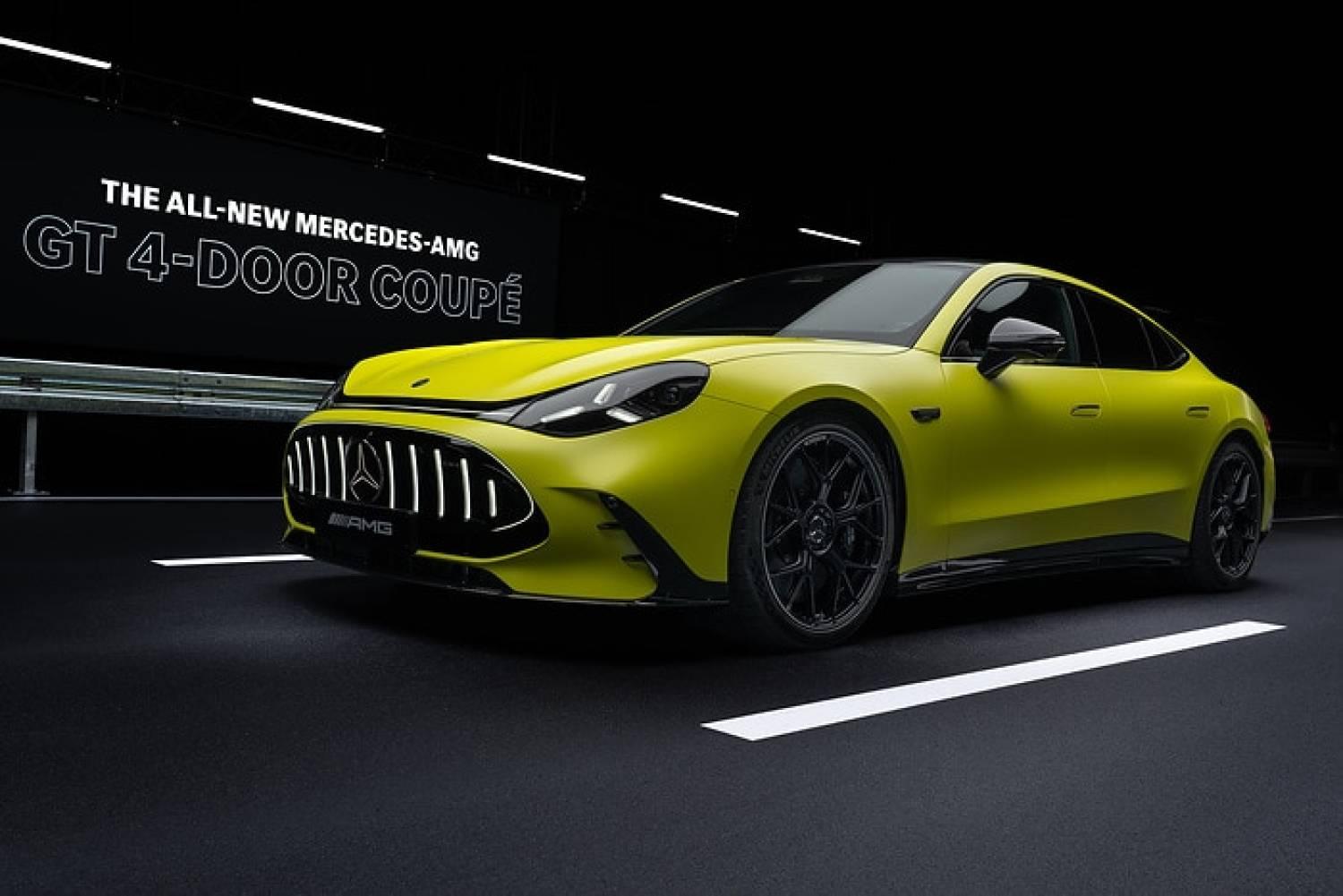
The new Mercedes-AMG GT 4-Door Coupé is not an electric conversion of the previous petrol and plug-in-hybrid fastback. It is the first production model built around AMG.EA, a dedicated high-performance electric architecture using three axial-flux motors, a directly cooled cylindrical-cell battery and an 800-volt system designed for both repeated power delivery and extremely rapid charging.
Mercedes-AMG revealed the GT 55 and GT 63 on 20 May 2026, then announced the GT 53 as the entry model on 6 August 2026. That expanding range matters because the car's story is no longer limited to the 1,169 hp headline. The GT must also work as a four-door grand tourer, remain consistent under repeated hard use and justify its position against the Porsche Taycan, Lucid Air and other high-performance electric saloons.
New AMG GT 4-Door Coupé: key facts
| Specification | Confirmed information |
|---|---|
| Architecture | Dedicated AMG.EA high-performance electric platform |
| Motor layout | Three axial-flux motors: two rear, one front |
| GT 55 peak output | 600 kW / 816 hp |
| GT 63 peak output | 860 kW / 1,169 hp with AMG Launch Control and required battery state |
| Electrical system | 800 volts |
| Maximum announced charging | Up to 600 kW |
| Ten-minute charging claim | More than 460 km WLTP range added under suitable conditions |
| Suspension | AMG ACTIVE RIDE CONTROL with semi-active roll stabilisation |
| Aerodynamics | Active AEROKINETICS system |
| Range structure | GT 53, GT 55 and GT 63 positioning |
Why axial-flux motors matter
Most electric cars use radial-flux motors. In an axial-flux design, the magnetic flux runs parallel to the motor's axis, allowing the active components to be arranged as compact discs. Mercedes-owned YASA developed the core principle used by AMG. The front motor installation is less than nine centimetres wide, while each rear motor is around eight centimetres wide.
The advantage is not simply a dramatic peak number. Axial-flux motors can provide high torque and power density in a compact package, freeing space for cooling, suspension and crash structures. AMG's rear drive unit combines two motors with a compact planetary input gearbox and oil cooling. A third motor drives the front axle.
Three motors also give the control system more freedom to distribute torque. The car can prioritise efficiency, traction, rotation or stability depending on the selected mode and available grip. The quality of that calibration will determine whether the GT feels agile or merely powerful.
GT 53, GT 55 and GT 63: how the range is structured
The GT 63 4MATIC+ is the maximum-output flagship. Its 860 kW or 1,169 hp figure is a peak value available with AMG Launch Control and an 80-percent battery state of charge. The GT 55 4MATIC+ produces 600 kW or 816 hp, still far beyond the output of most four-door performance cars.
The GT 53 was announced on 6 August 2026 as the more accessible entry to the new generation. Mercedes-AMG had not yet made every market detail equally visible when this article was prepared, but the model's role is clear: offer the design, architecture and electric AMG experience without requiring the price or peak performance of the GT 55 and GT 63.
| Version | Position in range | Best for |
|---|---|---|
| AMG GT 53 4-Door Coupé | Entry model | Drivers who want the new platform with lower cost and less extreme output |
| AMG GT 55 4-Door Coupé 4MATIC+ | High-performance core model | Buyers seeking 816 hp without choosing the flagship |
| AMG GT 63 4-Door Coupé 4MATIC+ | Maximum-performance model | Track-capable repeatability and the full 1,169 hp peak |
Battery cooling: the real performance technology
An electric performance car can produce a spectacular first acceleration run while reducing power as the battery and motors heat up. AMG is therefore placing unusual emphasis on direct cell cooling. The battery uses cylindrical cells with a dedicated chemistry and a thermal system intended to maintain a more even temperature under sustained load.
A large cooling circuit, intelligent valves, a chiller and multiple radiators support the battery and motors. The purpose is to make full power and high charging rates available repeatedly rather than only under ideal laboratory conditions. This is where the production car will need to prove itself: consecutive acceleration runs, fast laps, hot-weather charging and motorway travel reveal more than one launch-control figure.
600 kW charging: impressive, but infrastructure is the limitation
Mercedes-AMG states that the GT can charge at up to 600 kW and add more than 460 km of WLTP range in ten minutes. This is one of the highest announced charging figures for a production car. It is enabled by the 800-volt architecture and the battery's thermal capability.
The practical limitation is the charger. Public units capable of sustaining 600 kW for a passenger vehicle remain uncommon. A car can only accept what the charger, cable, grid connection, battery temperature and charging curve allow. Even at lower power, however, an architecture designed around 600 kW may maintain a strong average rate on more common high-power chargers.
AMG ACTIVE RIDE CONTROL and active aerodynamics
AMG ACTIVE RIDE CONTROL uses interconnected hydraulic elements to control roll without relying solely on very stiff anti-roll bars. The target is a wider operating range: low body movement during aggressive cornering, but enough compliance for long-distance travel.
The AEROKINETICS system actively manages airflow and downforce. Active aerodynamic elements can reduce drag when efficiency matters and increase stability when speed or cornering load rises. This is especially relevant for a heavy, extremely powerful EV because tyre load, brake temperature and body movement can change rapidly.
Will an electric AMG feel emotional?
AMG has created an optional V8-style experience called AMGFORCE S+. Engineers recorded a genuine AMG GT R V8 using multiple microphones and more than 100 measurements. The resulting sound environment includes acceleration, simulated shift events, approach and locking sounds, and charging feedback.
This approach will divide buyers. Some will value a recognisable AMG character; others will prefer the mechanical honesty of electric silence and motor sound. The important point is that the experience is selectable. It should enhance the car without hiding what the powertrain actually is.
Four-door practicality and grand-touring role
The GT 4-Door Coupé must provide usable rear access and luggage capacity to justify its name. Its fastback shape is intended to combine a low performance-car profile with everyday seating. Final market specifications and option packages will determine how much rear headroom and cargo flexibility remain after the battery, suspension and aerodynamic hardware are packaged.
For buyers who only want maximum acceleration, lighter two-seat or two-door cars may offer a purer solution. The GT's value is the ability to carry passengers and luggage while delivering repeated high performance and rapid long-distance charging.
AMG GT versus Porsche Taycan and Lucid Air
| Model | Strongest argument | Question to consider |
|---|---|---|
| Mercedes-AMG GT 4-Door Coupé | Three-motor AMG.EA platform and extremely high charging target | Price, mass and real-world charger availability |
| Porsche Taycan | Proven chassis calibration and mature fast-charging ecosystem | Less dramatic peak output in many versions |
| Lucid Air performance models | High efficiency, range and straight-line speed | Service network and regional availability |
| Petrol or hybrid performance fastback | Refuelling convenience and traditional engine character | Higher fuel use and less immediate electric response |
The AMG's advantage will not be that competitors are slow. Its case depends on repeatability, steering, brake consistency and the ability to combine track-level control with grand-touring comfort. A heavy EV that only wins a specification table will not be enough.
Tyres, brakes and parts support
Extreme power places exceptional demand on tyres, wheels, brakes, cooling components and suspension joints. Correct load rating and homologated tyre specification are essential. Even visually identical sensors or body modules may require version-specific coding. For international component research, an OEM-number-based parts marketplace can help compare supply, but AMG fitment should always be confirmed by VIN, option code and the exact supersession chain.
Owners should also budget for performance tyres and potential wheel damage. Large-diameter wheels with low-profile tyres improve response, but they increase replacement cost and vulnerability on poor roads.
Strengths and open questions
What looks exceptional
- Three compact axial-flux motors with highly flexible torque distribution.
- Up to 860 kW or 1,169 hp in the GT 63.
- Battery cooling engineered for repeatable performance.
- Charging architecture targeting up to 600 kW.
- Active suspension and aerodynamics designed for a wide dynamic range.
What still needs independent testing
- Vehicle mass and tyre behaviour during repeated track use.
- Real charging curve on existing public infrastructure.
- Brake feel as regeneration and friction braking interact.
- Rear-seat comfort and luggage practicality.
- Pricing of GT 53, GT 55 and GT 63 in each market.
Verdict
The new AMG GT 4-Door Coupé is technically ambitious in the areas that matter, not only in peak power. Axial-flux motors, direct battery-cell cooling, active chassis control and a 600 kW charging target show a coherent attempt to solve the weaknesses of early high-performance EVs.
The GT 55 may become the most balanced version because 816 hp is already extreme, while the GT 63 exists for buyers who want the complete engineering statement. The newly announced GT 53 could be more important commercially if it retains the platform's character at a less intimidating price.
This remains a first look until independent road and track testing establishes range, thermal consistency, braking and comfort. For the broader Mercedes context, read our 2026 new-model guide. Buyers more concerned with electric family practicality should see the GLC with EQ Technology review.
Frequently asked questions
How powerful is the new AMG GT 63 4-Door Coupé?
Mercedes-AMG quotes a peak of 860 kW or 1,169 hp with AMG Launch Control and an 80-percent battery state of charge.
How many motors does the new AMG GT use?
The GT 55 and GT 63 use three axial-flux motors: two at the rear axle and one at the front.
Can it really charge at 600 kW?
The vehicle is engineered for a maximum of up to 600 kW, but actual charging depends on charger capability, battery temperature, state of charge and the charging curve.
What is the AMG GT 53?
The GT 53, announced on 6 August 2026, is positioned as the entry version of the new electric GT 4-Door Coupé range.
Is this the same platform as the previous AMG GT 4-Door?
No. The new car is based on the dedicated electric AMG.EA architecture.
Research sources: Official Mercedes-AMG GT 4-Door Coupé launch information; Mercedes-Benz Media latest release index, including GT 53 announcement.