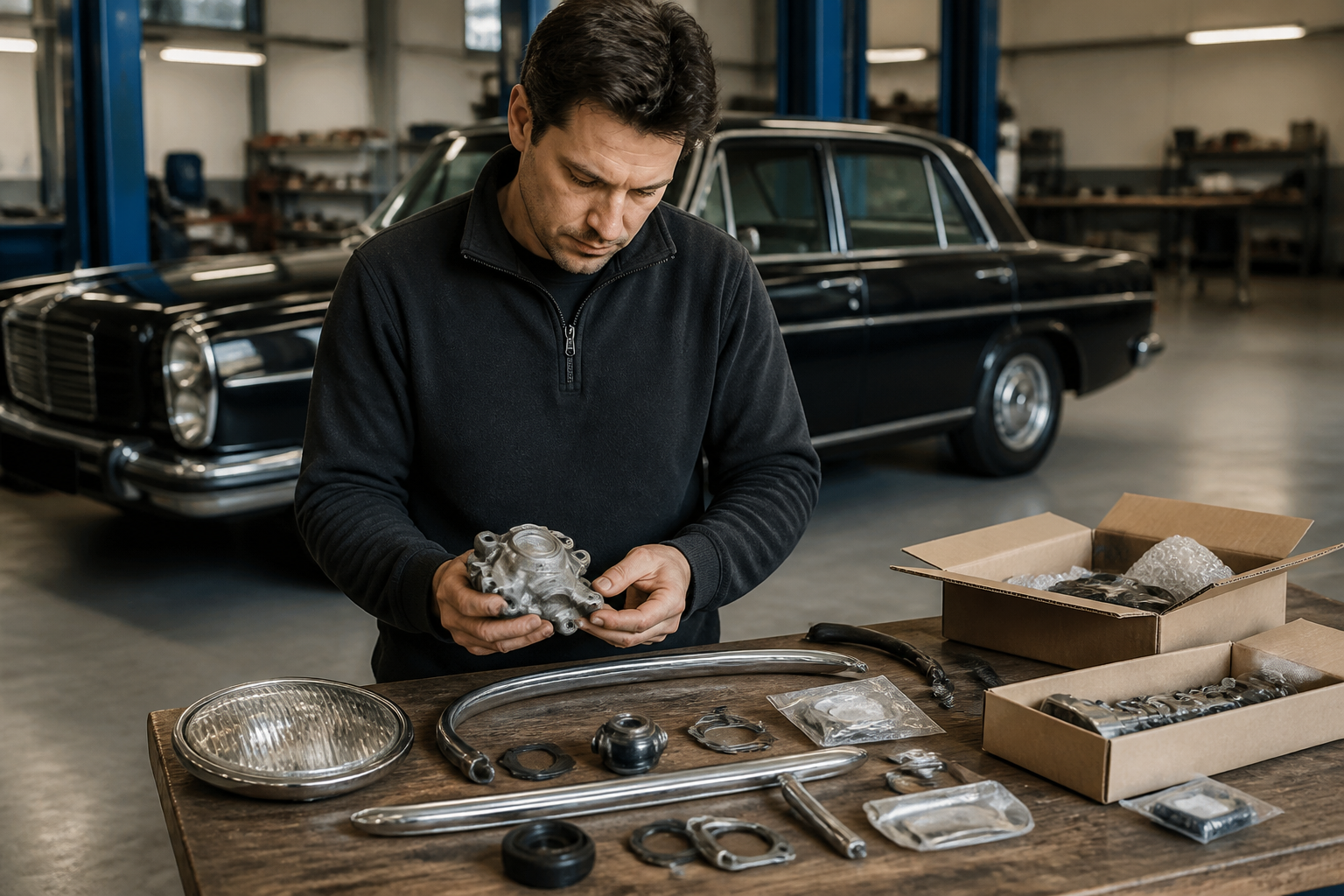
Use the Mercedes-Benz Classic parts search to locate the exact part with VIN/context; if the part is not available, submit a Request through the site to have product management assess remanufacture feasibility, and contact the Classic Center via MBUSA for further guidance on alternatives or sourcing routes.
Key takeaways
- Start with exact part identification in the Mercedes-Benz Classic parts search (by part name/number and VIN context).
- If the result is not available, use the site’s Request workflow to have Mercedes Product Management evaluate remanufacture feasibility.
- When a part is clearly no longer produced, consult the Classic Center and MBUSA contact channels for alternatives, repairs, or other sourcing options.
Mercedes-Benz owners and independent shops frequently grapple with a common dilemma: a part that seems essential is hard to source, or the official parts catalog marks it as not available (NLA). This guide combines a practical, step‑by‑step workflow using Mercedes‑Benz Classic’s parts tools with the official channels at Mercedes‑Benz Classic Center, so you can reliably determine availability and chart a path forward when a part isn’t readily found.
Step 1 — Identify the exact part and the VIN/vehicle context
Begin with precision in identifying the part you need. The Mercedes‑Benz Classic online parts search is designed to help you locate correct genuine components for classic or heritage models. You can search by part name or part number, and you can filter by model series, engine, and transmission. If you do not have a part number, you must establish the vehicle context—variant, equipment level, and VIN if possible—to increase the likelihood of a correct match. The system makes clear that accurate identification is foundational; a mismatch in context can lead to misleading availability results. Access the tool here: https://partssearch.mercedes-benz-classic.com/ and consult the help guide for nuances on matches: https://partssearch.mercedes-benz-classic.com/help.
Step 2 — Read the availability signals: what does NLA actually mean?
The Classic parts search presents the current availability status for a part. When it marks a part as not available or as no longer produced, this indicates that the official catalog/public listing can’t guarantee supply through standard channels. It is important to note that availability in the system is dynamic—Mercedes‑Benz updates the catalog periodically (monthly), so a part listed as NLA today could appear differently in future updates if supply decisions change or if remanufacturing considerations evolve. This context helps you set realistic expectations about timing and alternative pathways.
Step 3 — If the part isn’t found, use the “Request” pathway
When the search cannot locate a part or shows a non‑available status, Mercedes‑Benz Classic provides a formal escalation route via the “Request” workflow. Submitting a request routes the inquiry to Mercedes’ product management team to assess feasibility for remanufacture or reissue based on demonstrated demand. This pathway is designed for cases where a part is scarce or out of production but potentially serviceable if enough interest exists. Remember that the response depends on internal assessments, and timing may vary as the database is refreshed monthly.
Practical tip: prepare a concise context document including the exact vehicle model, year, VIN (if available), and what you are repairing (e.g., a specific subsystem or assembly). Attach any photos or part numbers you have to improve the chances of a meaningful evaluation. Access the help page for the submission process: https://partssearch.mercedes-benz-classic.com/help.
Step 4 — When a part is confirmed as no longer produced
If the official line is that a part is no longer produced, you have to pivot to alternatives. Mercedes‑Benz’s ecosystem emphasizes two broad avenues: repair/alternative strategies and other sourcing routes through official channels. The Classic Center and MBUSA offer guidance and human assistance to discuss feasibility, including the potential for remanufacture or viable equivalents. It’s important to differentiate between “not in the catalog” and “not producible ever,” since the latter invites different strategic paths such as vendor remanufacture programs or compatible modern substitutes where approved by the manufacturer.
In practice, tasks to consider include assessing repair feasibility (can the part be rebuilt or refurbished to OEM specifications?) and identifying permissible substitutes or compatible assemblies that satisfy safety and performance requirements. The Classic Center team can help navigate these decisions and point you toward authorized service partners or recommended refurbishers.
Step 5 — How to contact Mercedes‑Benz Classic Center for persistence or clarification
Mercedes‑Benz maintains formal channels for parts inquiries through its Classic Center. The official MBUSA Classic Center page provides direct contact details to reach parts specialists who handle difficult sourcing cases. Notably:
- Dedicated email for parts inquiries: classicparts@mbusa.com
- Classics support line for questions related to classic parts
Using these channels can help you obtain bespoke guidance, such as confirmation of remanufacture feasibility, compatibility checks, or alternative sourcing paths that aren’t visible in the online catalog. The Classic Center page also outlines the scope of support and how to engage in a structured discussion about scarce items.
Practical workflow recap
Here is a compact sequence you can follow on a typical sourcing quest:
- Identify the exact part with a precise description, part number (if available), model context, and VIN.
- Check the Mercedes‑Benz Classic parts search results for availability and interpret any NLA indicators with the understanding that updates occur monthly.
- If not found or marked NLA, submit a “Request” through the parts search portal to involve product management in a remanufacture or reissue assessment.
- If a part is confirmed as no longer produced, consult the Classic Center/MBUSA for repair alternatives or approved substitutes and next steps.
- Document all communications and decisions, and recheck the catalog periodically since availability can change with time and demand signals.
Limitations and caveats to keep in mind
- The online parts search for classics is geared toward genuine OEM components; it may not always reflect aftermarket or third‑party compatibility options. Always verify any non‑OEM pathways with a qualified technician or the manufacturer’s guidance before purchasing.
- “Not produced” or “NLA” in the catalog does not guarantee that no supply exists at all; it may indicate that current production is halted or that the part is not allocated in the standard supply chain. Special orders or limited remanufacture programs may still be possible.
- The escalation timelines depend on internal reviews and parts‑planning cycles. If you’re in a time‑critical situation (e.g., a restoration deadline), factor in potential lead times and consider parallel options such as refurbished cores or compatible subassemblies where approved.
- VIN context and equipment variants can dramatically affect matching accuracy. If you’re unsure, reach out to a Classic Center specialist early in the process rather than relying solely on the automated result.
Conclusion
Dealing with scarce or discontinued Mercedes‑Benz parts requires a disciplined sourcing workflow: start with exact part identification in the Classic parts search, interpret availability with an eye to monthly updates, escalate through the official Request channel when necessary, and engage the Classic Center for deeper guidance on remanufacture or alternatives. This approach helps you maximize the chance of a correct part finding or an approved workaround while keeping your project aligned with manufacturer guidance and warranties where applicable.
Key sources used for this guidance include the Mercedes‑Benz Classic parts search portal, the help guide, and the MBUSA Classic Center contact page. For reference and direct access: