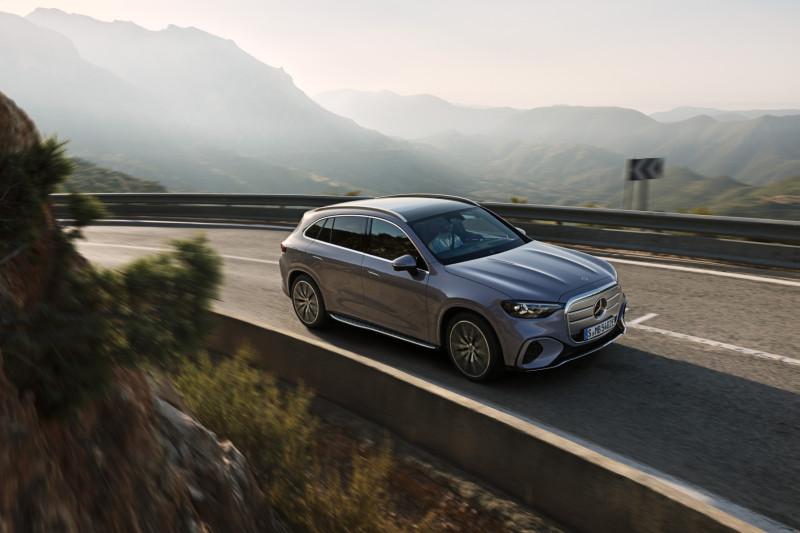
The Mercedes GLC EQ range question has three answers: the headline, the certified configuration and the distance your own driving allows. This guide explains all three and complements our complete 2026 GLC EQ 400 review.
Official GLC EQ range figures
| Measure | Official figure |
|---|---|
| Early reveal headline | Up to 713 km WLTP |
| Latest production communication | Up to 715 km WLTP |
| Current GLC 400 4MATIC range band | 568–714 km WLTP |
| Combined consumption | 18.9–14.9 kWh/100 km |
| Usable battery | 94 kWh |
The range band matters more than the best-case headline. Larger wheels, wider tyres and equipment can increase consumption, while homologation updates can move the maximum by a few kilometres. When comparing dealer cars, ask for the WLTP figure attached to that exact configuration rather than assuming every GLC EQ 400 reaches the maximum.
GLC EQ range and real-world efficiency
No responsible road-test estimate can guarantee a single real-world number. Temperature, speed and wind can change consumption on the same route. The most transparent planning method is based on energy use: 94 ÷ consumption × 100 gives a theoretical full-to-empty distance in kilometres.
| Observed consumption | Theoretical full-to-empty distance | Practical meaning |
|---|---|---|
| 17 kWh/100 km | About 553 km | Favourable mixed driving |
| 20 kWh/100 km | About 470 km | A useful neutral planning example |
| 23 kWh/100 km | About 409 km | Cold, fast or heavily loaded travel |
| 27 kWh/100 km | About 348 km | Severe winter, high speed or towing can approach this territory |
These are calculations, not test results. Do not plan to arrive at zero. A 10–15% reserve protects against a closed charger, weather change or detour. For a 20 kWh/100 km journey, using only 80% of the 94 kWh battery gives roughly 376 km between a full start and a 20% arrival.
Why motorway speed changes the answer
Aerodynamic drag rises rapidly with speed. A small increase above normal motorway pace can cost more range than extra passengers. Roof boxes, bicycles and trailers add drag as well. If the navigation predicts a low arrival charge, reducing speed early is usually more effective than waiting until the last few kilometres.
Winter GLC EQ range
Cold cells accept and release energy less efficiently, cabin heating consumes power and winter tyres can add resistance. The standard heat pump helps, but it cannot remove the effect of temperature. Precondition the cabin while connected to AC power, navigate to the rapid charger so the battery can prepare, clear unnecessary roof accessories and use seat heating intelligently.
A practical long-trip plan
- Start with the battery and cabin conditioned while plugged in.
- Enter the destination and charging stops in the car's navigation.
- Prefer arriving at a rapid charger with a low but comfortable state of charge.
- Use the first five minutes of the stop to check the actual charging curve, not only the advertised peak.
- Read the 330 kW GLC EQ charging guide before relying on an unfamiliar charging network.
- If towing, use the more conservative method in our GLC EQ towing guide.
What to record on your test drive
Reset a trip meter, drive a route that includes your normal motorway speed and note ambient temperature, average speed and kWh/100 km. Ask the retailer for the wheel size and certified WLTP range of the test car. One repeatable route is more useful than a short demonstration drive with unknown battery temperature.
Mercedes GLC EQ FAQ
Does every GLC EQ 400 have 715 km of range?
No. The current manufacturer range band is 568–714 km for the model, while up to 715 km appears in production communication.
What consumption should I use for planning?
Use the car's own recent motorway consumption in similar weather. If you have no data, model several scenarios rather than relying on the best WLTP number.
Does fast charging change the official range?
No, but faster charging can reduce journey time. It does not make the battery store more energy.
Will 22-inch wheels reduce range?
Larger or less aerodynamic wheel-and-tyre combinations commonly reduce efficiency; check the certified figure for the exact specification.
How much reserve should I keep?
A 10–15% arrival reserve is a sensible starting point, increased for winter, remote routes or towing.
Continue your GLC EQ research
Sources and methodology
Specifications and dates were checked against manufacturer material. Range and charging results in daily use vary with temperature, speed, wheels, traffic, payload and charger conditions.
- Mercedes-Benz current specification table (official manufacturer source)
- Mercedes-Benz production announcement (official manufacturer source)