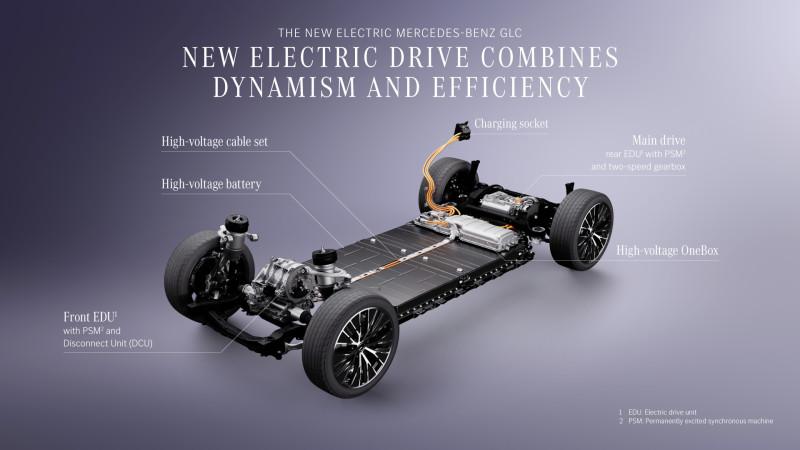
Peak charging power is easy to advertise and easy to misunderstand. The 2026 Mercedes GLC EQ 400 can accept up to 330 kW DC, but a good journey depends on the charging curve, battery temperature and where in the battery you start. This article expands the charging section of our GLC EQ 400 review.
How fast does the GLC EQ charge?
| Charging measure | GLC 400 4MATIC |
|---|---|
| Electrical architecture | 800 volt |
| Maximum DC input | 330 kW |
| 10–80% DC time | 22 minutes |
| Range added in 10 minutes | Up to 305 km WLTP |
| Standard AC charger | 11 kW |
| Optional AC charger | 22 kW |
Mercedes' 22-minute figure is the most useful official benchmark because it covers a meaningful part of the battery. The 330 kW peak may appear only during an ideal part of the session. A charger can also be labelled 350 kW yet deliver less because of site sharing, cable temperature, voltage limits or the car's state of charge.
What 10–80% means in energy
Seventy percent of a 94 kWh usable battery is 65.8 kWh. Replacing that energy in 22 minutes requires a very high average charging rate after losses, which is why battery preparation matters. It also explains why charging beyond 80% is usually slower on a road trip: the car reduces power to protect the cells as they fill.
How to get the best rapid-charging result
- Select the rapid charger in the vehicle navigation early enough for battery preconditioning.
- Arrive at a low state of charge when the next charger is reliable and you still have a safe reserve.
- Use an 800-volt high-power charger capable of supplying the required voltage and current.
- Avoid beginning the session at 60–70% if the goal is to test the peak.
- Move on when the charging rate falls below what the next leg needs; 100% is rarely the fastest road-trip strategy.
Home charging at 11 kW and 22 kW
A simple capacity calculation suggests roughly 8.5 hours from empty to full at 11 kW and about 4.3 hours at 22 kW before charging losses. Real sessions take longer, and a 22 kW wallbox only helps if the car has the optional 22 kW onboard charger, the property can supply it and the installation is approved. Most owners charge a partial amount overnight, not 0–100%.
Can the GLC EQ use a 400-volt charger?
Public-network compatibility and any voltage-conversion limits should be confirmed for the market specification and charger. An 800-volt label does not mean the car only works at 800-volt sites, but the maximum rate may not be available everywhere. Before a long trip, check connector type, charger voltage, payment method, opening status and recent reliability reports.
Charging time versus BMW iX3
BMW quotes 400 kW, 21 minutes from 10–80% and up to 371 km added in ten minutes for the iX3 50 xDrive. Mercedes quotes 330 kW, 22 minutes and up to 305 km. The BMW leads on the official charging numbers, although a one-minute laboratory difference is less important than charger availability and the actual curve. See the full GLC EQ vs BMW iX3 comparison.
Road-trip checklist
- Leave with the battery and cabin prepared on AC power.
- Plan a backup charger for every critical stop.
- Check whether the station charges by energy, time or both.
- Stop early enough that a failed charger does not become an emergency.
- Use the consumption method in our GLC EQ real-world range guide to calculate each leg.
Mercedes GLC EQ FAQ
Is 330 kW available during the whole session?
No. It is a maximum. Charging power changes with state of charge, temperature, battery protection and charger capability.
How long does 10–80% take?
Mercedes lists 22 minutes under the stated conditions.
How much range can ten minutes add?
Up to 305 km WLTP, which is a laboratory-based comparison figure rather than guaranteed motorway distance.
Is 22 kW AC standard?
No. Current manufacturer data lists 11 kW as standard and 22 kW as optional.
Should I charge to 100% on every trip?
Not usually. On a rapid-charging journey, shorter sessions within the faster part of the curve are often quicker; follow the battery guidance in the owner's manual.
Continue your GLC EQ research
Sources and methodology
Specifications and dates were checked against manufacturer material. Range and charging results in daily use vary with temperature, speed, wheels, traffic, payload and charger conditions.
- Mercedes-Benz current charging specifications (official manufacturer source)
- BMW Group iX3 charging specifications (official manufacturer source)