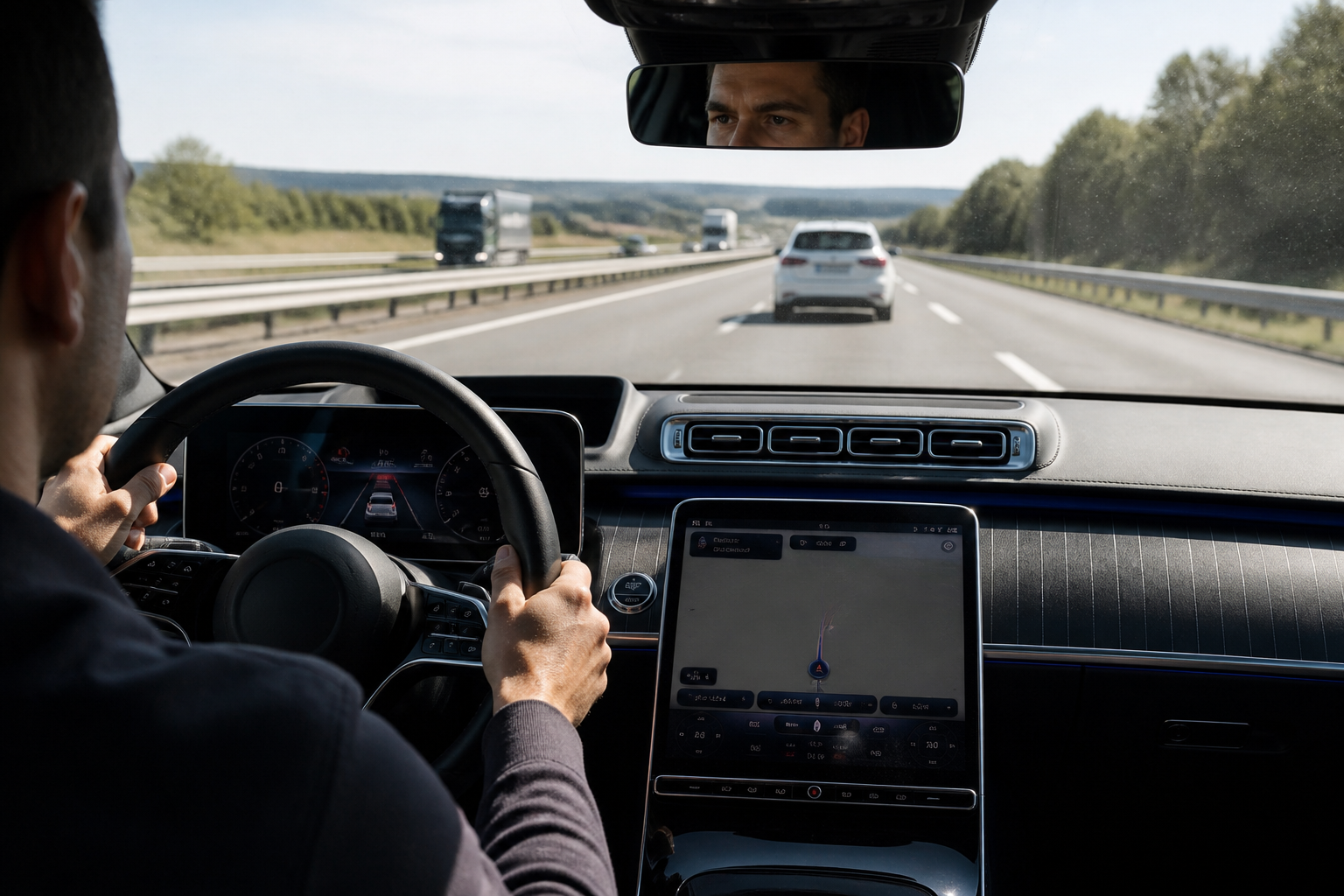
To adjust the DISTRONIC following distance on a Mercedes-Benz with Active Distance Assist DISTRONIC, use the steering-wheel controls to vary the time-gap between 1 and 2 seconds. Increase the time-gap to widen the following distance and decrease it to shorten it. Regardless of settings, you must maintain a safe distance and stay attentive; ACC handles speed, not the full responsibility of driving.
Key takeaways
- DISTRONIC uses a time-gap setting (1–2 seconds) to control following distance.
- Adjust the gap via steering-wheel controls; longer time-gap means more space ahead.
- Driver attention and readiness to intervene are essential at all times, especially in adverse conditions.
Overview: how DISTRONIC following distance functions and why it matters
Mercedes-Benz’s Adaptive Cruise Control system, Active Distance Assist DISTRONIC, is designed to automatically adjust vehicle speed to maintain a pre-set distance to the vehicle ahead. This involves a driver-selected time gap (commonly described as a number of seconds) that translates into a following distance across typical speeds. While DISTRONIC can reduce the need for constant throttle input and braking, it does not remove the responsibility from the driver to monitor the road, traffic, and weather, and to be ready to intervene when conditions demand it.
Understanding the limits of the system helps you use it safely. The vehicle’s sensors and software determine the available following distance, but the driver’s attention and judgment remain essential. Manufacturer guidance and safety authorities consistently emphasize driver monitoring, situational awareness, and readiness to intervene even with adaptive cruise engaged.
What you can adjust: the time-gap / minimum following distance
In Mercedes-Benz operator’s manuals for many models, the specified minimum distance is adjustable by varying the time span between roughly one and two seconds. This corresponds to a following distance that expands with speed: at higher speeds, the same time-gap yields a larger physical gap. The adjustment is performed via steering-wheel controls within the DISTRONIC/Adaptive Cruise Control menu or via the instrument cluster in some models. Increasing the time gap moves you farther behind the vehicle ahead; decreasing it brings you closer, within the system’s safety envelope.
Practical note: the exact available time-gap range can vary by model year and market. If in doubt, consult your vehicle’s manual for the precise time-span steps and any model-specific caveats. The driver should select a time-gap that matches typical traffic flow, road conditions, and personal comfort with following distance.
Step-by-step: how to adjust DISTRONIC’s following distance
- Activate DISTRONIC/Adaptive Cruise Control and verify you’re in a suitable driving environment (straight road with clear traffic and no imminent hazards).
- Open the DISTRONIC settings using the steering-wheel controls or the instrument-display menu, depending on model and year.
- Choose the current time-gap/minimum distance setting. The display will typically show a numeric or icon-based representation of the following distance.
- Increase the time-gap to enlarge the following distance, or decrease it to reduce the gap. Confirm the selection if prompted by the system interface.
- Return to normal driving and monitor the gap visually, using the system’s indicators to ensure the preset distance remains safe for current traffic and road conditions.
Tip: when traffic density changes, or weather introduces slick surfaces or reduced visibility, consider increasing the time gap beyond your usual setting to allow greater margin for stop-and-go or emergency braking scenarios.
Limits and safety considerations: what the system can and cannot do
DISTRONIC is a driver-assist feature that modulates speed to keep a pre-set following distance, but it does not guarantee collision avoidance. Sensor inputs have finite range and resolution, and certain conditions can challenge performance:
- Adverse weather (heavy rain, snow, fog) can reduce sensor effectiveness and may require larger following distances.
- Lane geometry, roadworks, or abrupt maneuvers by the vehicle ahead can exceed the system’s reaction capability.
- Slippery or uneven surfaces may lengthen stopping distances even if the system reduces speed smoothly.
- System limitations may apply at very high speeds or in complex traffic patterns where multiple obstacles require human judgment.
In all cases, the driver must maintain attentive control, comply with local laws, keep hands on the wheel as appropriate, and be prepared to override or disengage DISTRONIC to execute immediate braking, acceleration, or steering input if safety warrants it.
Best practices for safe use
- Always choose a time-gap that provides a comfortable margin for your typical speed and following environment. Higher speeds generally require more distance, especially on wet or slippery roads.
- Regularly scan the road, traffic, pedestrians, and potential hazards. Do not rely solely on the system to handle braking or evasive maneuvers.
- Test the system in a controlled setting when possible to understand how it responds to slower vehicles, merging lanes, or sudden braking ahead.
- If road conditions change abruptly, manually increase the distance and be prepared to disengage the system to resume full manual control if needed.
- Remember that legal or safety guidelines may vary by jurisdiction; always prioritize safe following distances in compliance with local laws.
How model and year can affect DISTRONIC behavior
Different Mercedes-Benz models and model years implement DISTRONIC with variations in display terminology, interface flow, and the exact time-gap steps available. While the core concept remains the same, some vehicles may expose additional driver aids (such as stop-and-go capability or speed adaptation in dense traffic), and others may present a simplified setpoint for basic following distance. Always refer to your specific vehicle’s Owner’s Manual for precise instructions, time-gap values, and any model-specific warnings.
Practical test: what to observe on the road
A practical approach is to observe how the system maintains distance when the lead vehicle changes speed. The following distance is a dynamic margin that the system continuously adjusts as the lead vehicle accelerates or decelerates. If you notice the gap becoming too small in normal driving, intervene and restore manual control or increase the time-gap setting. Conversely, if you frequently encounter the need for manual intervention on long highway stretches, consider lengthening the time gap or reassessing your driving environment for repeated braking events.
Driver responsibility and system limits in traffic
Adaptive cruise control systems operate within a domain of driver-assist safety. They are designed to support, not replace, human judgment. In heavy traffic, on winding roads, or in situations requiring precise lane-level decisions, the system’s confidence may wane. The driver should maintain situational awareness, prepare for unexpected stops, and be ready to resume full manual control at any moment. In jurisdictions with stringent hands-on-wheel laws, operators should comply with regulations while using DISTRONIC as a supplemental aid.
Model-year and market notes: planning around variations
Since DISTRONIC configurations differ by model year and market, the exact steps, naming conventions, and available time-gap options may vary. When in doubt, consult your vehicle’s Owner’s Manual for the precise sequence and allowable time-gap values. If your dealership or regional Mercedes-Benz resource provides an updated guide, consider cross-checking with those materials to ensure you’re applying the system as designed for your exact vehicle.
References and safety framing
Official guidance from Mercedes-Benz manuals describes adjusting the minimum distance by changing the time gap between about one and two seconds, with driver vigilance emphasized as essential. Government and independent safety organizations describe adaptive cruise control as a driver-support feature that requires ongoing attention and readiness to intervene when conditions exceed the system’s capabilities.
Key sources consulted for this guidance include:
- Driving systems (2019 GLE Coupe Operator’s Manual) — Setting a specified minimum distance for Active Distance Assist DISTRONIC
- Driver Assistance Technologies — Adaptive Cruise Control (NHTSA)
- Advanced driver assistance — (includes adaptive cruise control distance/time-headway explanation and driver-in-the-loop discussion) (IIHS)
For readers seeking exact, model-specific steps and current recommendations, refer to the official Mercedes-Benz owner’s manual for your vehicle and year, along with updated safety guidance from NHTSA and IIHS.
Sources
- Driving systems (2019 GLE Coupe Operator’s Manual) — Setting a specified minimum distance for Active Distance Assist DISTRONIC
- Driver Assistance Technologies — Adaptive Cruise Control (ACC)
- Advanced driver assistance — (includes adaptive cruise control distance/time-headway explanation and driver-in-the-loop discussion)