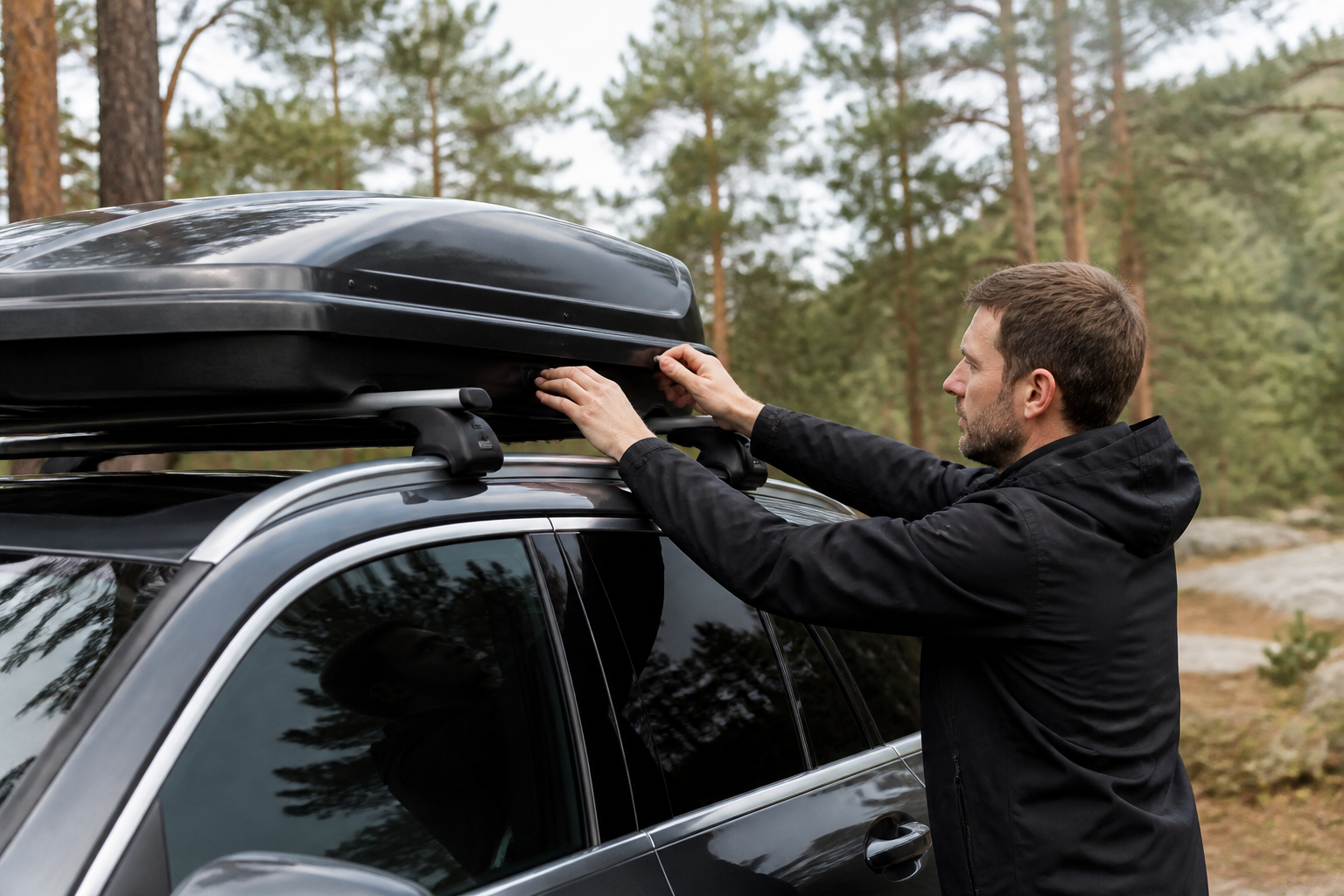
Follow Mercedes-Benz’s practical installation and safety guidance: (1) verify that your roof box is compatible with Mercedes-approved carrier bars, (2) measure and record the vehicle’s overall height after installation and respect load limits, (3) keep the box locked and remove the key when driving while performing regular anchor checks, and (4) avoid common do-not-do items like opening the sunroof with the box installed or driving through an automatic car wash. Use Mercedes Original Parts and seek confirmation of fitment via VIN when in doubt.
Key takeaways
- Use only Mercedes-approved carrier systems and roof boxes.
- Record vehicle height and roof-box load to avoid clearance issues.
- Lock the box and perform regular anchor checks during trips.
- Follow do-not-do rules (no sunroof clearance, no car wash with box, no transporting people/dangerous goods).
Mercedes Roof Box Practical Installation Checklist
This article expands a practical, safety-focused checklist for owners using a Mercedes-Benz roof box with Mercedes-approved carrier systems. It merges official installation instructions with real-world steps to help you verify compatibility, track height and load, secure cargo, and avoid common mistakes before and during trips.
1) Confirm carrier compatibility and fit
Begin with a documented confirmation that your roof box is approved for use with your vehicle’s specific roof carrier system. Mercedes-Benz guidance emphasizes that roof box installation is approved for vehicles equipped with basic carrier bars or basic carrier bars for rails, and that using only accessories approved for the vehicle helps ensure safe performance. If you cannot confirm fitment from labels or your vendor, consult a Mercedes-Benz Center or authorized dealer for guidance. The broader Mercedes parts ecosystem reinforces that vehicle-specific roof carrier bases form a scalable, safe foundation for transport solutions, including roof boxes.
Practical steps you can take now:
- Locate the VIN and match it to the carrier system’s compatibility list provided in the owner’s manual or official Mercedes materials.
- Inspect the carrier bases for wear, corrosion, or looseness before installation.
- Record the approved model and maximum load rating of both the roof box and the carrier in your vehicle notes.
References and practical authority: official installation instructions acknowledging Mercedes-approved compatibility, and Mercedes Original Parts guidance that highlights VIN-based fitment checks.
2) Measure and record overall height and load
After the roof box is mounted, measure the complete vehicle height with the box in place. Record this height on a visible sticker inside the vehicle or in your trip log. Why this matters: clearances in garages, car washes, toll booths, and drive-throughs depend on accurate height data.
Key load considerations:
- Do not exceed the roof box’s rated maximum load or the vehicle’s permissible gross mass (the vehicle’s published gross vehicle weight rating minus existing occupants and cargo).
- Distribute cargo evenly inside the box so nothing shifts during transit, and secure items to prevent movement that could compromise stability or damage the box or roof rails.
- Re-check weight distribution after reconfiguring cargo or adding/removing items during a trip.
These practices reflect Mercedes-Benz emphasis on stability and safety for roof transport systems and align with official guidance to monitor height and load limits.
3) Locking, keys, and securement checks
Always keep the roof box locked and remove the key when driving. Before each trip and at regular intervals during longer journeys, verify that anchorages and locking mechanisms remain secure. The general instruction set calls for repeated checks to ensure nothing has loosened in transit and to deter theft by keeping the system locked when not in use.
- Before departure, perform a quick tactile check of all anchors and locking latches to confirm they are fully engaged.
- During long drives, stop at intervals to re-check that cargo remains secure and that fasteners have not loosened from vibration or wind forces.
- Keep the key in a secure location separate from the vehicle when driving; never leave a key in the box or in an exposed lock during stops.
These steps correspond with Mercedes-Benz installation materials that stress securement, theft protection, and ongoing checks throughout a trip.
4) Do-not-do rules to avoid damage or unsafe use
- Do not open tilting or sliding sunroofs when the roof box is installed. The intrusion path can be blocked or damaged by the box or mounting hardware.
- Do not drive through automatic car washes with the roof box installed unless the wash is designed to accommodate height, width, and the box’s presence.
- Avoid transporting people, animals, or hazardous materials in the roof box. The box is meant for luggage and cargo; it is not designed to carry occupants or sensitive goods without appropriate ventilation considerations and securement.
These cautions mirror the documented do-not-do rules from Mercedes-Benz installation materials, which accompany proper fitment with practical safety guidance.
5) Practical takeaway: use Mercedes-approved components
Mercedes-Benz Original Parts pages describe roof carrier bases as a modular, quick-mount foundation designed for compatibility with roof boxes and other carriers, including theft protection and conformity to Mercedes-norm safety testing. The practical takeaway is to verify VIN-based fitment and select components that are explicitly approved to work together within the Mercedes ecosystem. When purchasing or replacing parts, use the official parts catalog workflow to confirm fitment before installation.
- Verify the part numbers for your carrier rails, crossbars, and roof box against the vehicle’s VIN and the manufacturer’s compatibility matrix.
- Prefer Mercedes-approved carriers and boxes to ensure the intended dynamic performance, weather sealing, and load distribution characteristics.
- Keep documentation of compatibility checks and the installation steps in your vehicle records for quick reference on future service or inspections.
Related sources emphasize that using Mercedes-approved carrier systems is part of a safety-conscious setup when adding roof boxes and related transport accessories.
What to have handy before driving with a Mercedes roof box
- Documentation of approved compatibility for your carrier rails and roof box model (part numbers, VIN checks, and supplier confirmation).
- Recorded overall height and load limits.
- Roof box securely locked with the key removed when driving; keep the key in a separate location during travel.
- A concise, up-to-date checklist of do-not-do rules and reminders for safe operation.
For reference, Mercedes-Benz official materials consistently emphasize using only approved accessories and checking compatibility before installation. These practices support safe performance, ease of use, and long-term reliability of roof transport systems.
Sources and further reading for verification and practical alignment: official Mercedes-Benz roof box installation instructions; Mercedes-Benz Original Parts carrier and roof box overview; VIN-based fitment guidance within Original Parts product pages.
Sources
- Roof box — Installation instructions (A0008400500 / A0008400600)
- Dachträger und Dachboxen (Roof racks and roof boxes) — Mercedes-Benz Original Parts overview
- DACHGEPAECKTRAEGER (Roof luggage carrier) — product page (example carrier system listing)
Related Mercedes-Benz guides