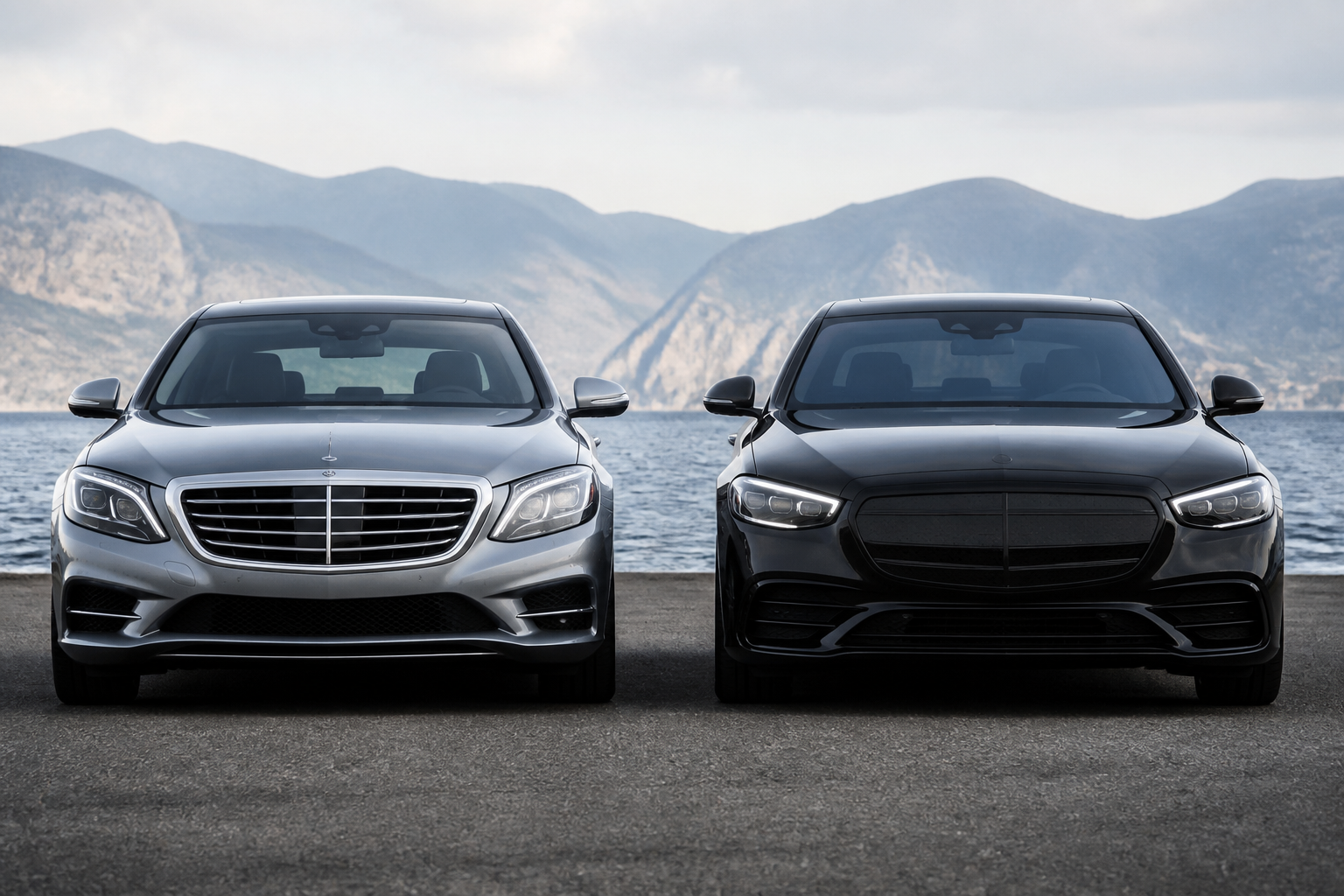
Mercedes-Benz front-end design evolved from practical, chrome-framed radiators with a prominent central star to sculpted 1990s fronts, and finally to the EQ era’s Black Panel front that preserves a central star within a grille-less or minimal-grille presentation. The star’s placement has served as a consistent brand signal across eras, with the grille forming and function adapting to each design phase.
Key takeaways
- Early Mercedes fronts used the radiator grille as a practical feature that became a styling element with chrome framing and a prominent central star.
- The 1990s introduced more sculpted, distinctive front-ends where grille shapes and star placement varied across models.
- In the modern EQ era, the design often shifts to a Black Panel front, retaining a central star while integrating lighting and sensors for a cleaner silhouette.
From Chrome to Black Panel: The Design Evolution of Mercedes-Benz’s Radiator Grille and Star
Mercedes-Benz frames its front-end language as a living storyboard, where the radiator grille, the central star, and the surrounding frontage reflect shifts in engineering, safety, aerodynamics, and brand signaling. Official history archives trace a path from practical cooling openings to highly stylized front ends, culminating in the present-day EQ era’s signature Black Panel presentation. This article expands on those milestones with emphasis on design intent, decision criteria, and how these choices affect ownership and visual identity across generations.
Foundations: the grille as a functional element that becomes a brand feature
Early Mercedes designs treated the radiator bay primarily as a cooling necessity. Over time, designers leveraged the opening to craft a recognizable silhouette. The Mercedes star—an emblem of brand identity—was positioned prominently in front of the radiator opening or within a surrounding chrome frame. This placement served dual purposes: immediate brand recognition at a distance and a cohesive front-face rhythm that could be tuned across model lines. The chrome detailing that often accompanied the early grilles reinforced the notion that function and form were inseparably linked in the brand’s design language.
Three design phases that shaped the lineage
- Early chrome-enhanced radiators and prominent star
In the foundational era, the grille began as a straightforward cooling aperture. Mercedes’ designers layered chrome framing and a large central star as the visual signature, establishing a front that was instantly identifiable. The star’s placement and the grille’s framing cues became a visual shorthand for Mercedes-Benz—an approach that anchored the brand across disparate models and eras. This period also favored bold chrome detailing that signaled luxury and technical prowess.
- 1990s toward sculptural integration
The 1990s ushered a shift toward more sculpted, integrated front ends. Grilles grew into elements that harmonized with the car’s overall face, while the star remained a steadfast focal point. This era emphasized three-dimensionality, with sculpted corners, refined chrome accents, and grille treatments that conveyed modernity without sacrificing brand legibility. The result was a front that could vary from executive to sporty, while preserving the signature Mercedes identity anchored by the star.
- EQ era and the Black Panel concept
As electric propulsion became central to Mercedes’ strategy, the front-end philosophy evolved again. The traditional grille often receded in favor of a Black Panel front that communicates width and precision. A central star persists, but the surrounding surface integrates lighting signatures, sensors, and aerodynamic considerations into a grille-less or grille-minimized face. This direction preserves iconic branding while prioritizing electric-age needs, such as airflow management and sensor placement, in a cleaner, more streamlined silhouette.
Star placement as a design signal, not just a badge
Across generations, the star’s location relative to the grille has been a barometer of styling intent. A larger, centrally placed star often signaled sportier, more commanding presence on performance-oriented models, while variations in grille geometry could soften or sharpen the face for luxury or entry-level lines. Even as the front facet evolved—from open, chrome-trimmed grilles to sculpted fascias and then to Black Panel configurations—the star’s centrality remained a consistent beacon of brand identity. This continuity helps owners instantly recognize a Mercedes-Benz vehicle, regardless of body style or powertrain.
Evidence and framing from official Mercedes-Benz history resources
Two core official references anchor this narrative. The first traces the evolution of the radiator grille itself, highlighting how the opening began as a cooling feature and transformed into a defining exterior motif, with the star and chrome framing playing key roles. The second, a brand tradition overview, explains how the star has been presented on vehicles over time and how its placement aligns with different front-end expressions—from traditional radiators to the modern, digitized front faces. Together, these sources establish a timeline that moves from practicality to expressive design language.
Readers seeking deeper archival context are guided to the primary Mercedes-Benz history pages on the evolution of the radiator grille and on the Good Star emblem, which provide formal context for the narrative arc described here. The Mercedes-Benz Magazine also notes the introduction of the diamond grille as part of the design identity’s evolution, linking historical milestones to contemporary styling cues.
Practical implications for owners and buyers
- Visual identity across generations: The grille and star together tell a design story that mirrors Mercedes’ product strategy, from classic, premium sedans to electric-era SUVs. Understanding this lineage helps buyers spot the generation and trim cues that influence perceived value and resonance with the brand.
- Maintenance and care implications: While styling changes are largely cosmetic, certain front-end treatments—especially in the Black Panel era—integrate sensors and lighting that affect bumper serviceability and repair approaches after impacts. When planning bodywork or insurance quotes, consider how grille treatment and sensor placement may influence replacement parts or alignment procedures.
- Resale and recognition: Familiar design cues, such as the central star and the surrounding fascia, can influence perceived value and recognition across model generations, aiding identification for collectors and enthusiasts and supporting brand equity in marketplaces where visual language matters.
Scope, limitations, and caveats
The narrative here draws on official Mercedes-Benz history resources and brand heritage pages to outline broad design trajectories. It does not attempt exhaustive year-by-year cataloging or model-by-model mapping. For granular detail, the linked official sources and Mercedes-Benz Magazine archives offer era anchors, such as the diamond grille reference, and provide context for specific design cues implemented on particular models or markets.
Practical guidance for interpretation
When evaluating a Mercedes-Benz front end, buyers and enthusiasts can read the grille as a design logbook. The persistent central star acts as a throughline, while changes in grille geometry, chrome detailing, and integration with lighting signatures reveal the model’s generation and intended market emphasis. This approach helps in quick visual dating, which can be useful for maintenance planning, insurance categorization, and valuing vintage or limited-run variants.
Concluding perspective
The Mercedes front end has evolved from a practical cooling aperture into a calibrated design system where the grille, star, and lighting/signature elements communicate brand values across eras. The transition from chrome-framed radiators to a modern Black Panel front in EQ-line models encapsulates a broader shift: a brand identity that remains instantly recognizable while adapting to electric propulsion, sensor integration, and advanced aerodynamics. For owners, buyers, and enthusiasts, this evolution offers a visual shorthand for a model’s generation, technology emphasis, and the brand’s ongoing balance between heritage and innovation.
Sources
- The evolution of the radiator grille
- Motoring under a lucky star
- Mercedes-Benz magazine (PDF) — No. 377 (includes ‘diamond grille’ historical note)
Related Mercedes-Benz guides
- Mercedes-Benz Vent Tube (Vent Line) From Activated Charcoal Filter To Boot.
- Mercedes-Benz Vacuum Line From Vacuum Pump To Brake Unit A4474351225 Review
- Mercedes-Benz Radiator Cap A0005016415 Review
- Mercedes-Benz Protective Grille A9018800385 Review
- Mercedes-Benz Parts Kit, Filter Element From 1001 Km;Range Of Delivery.