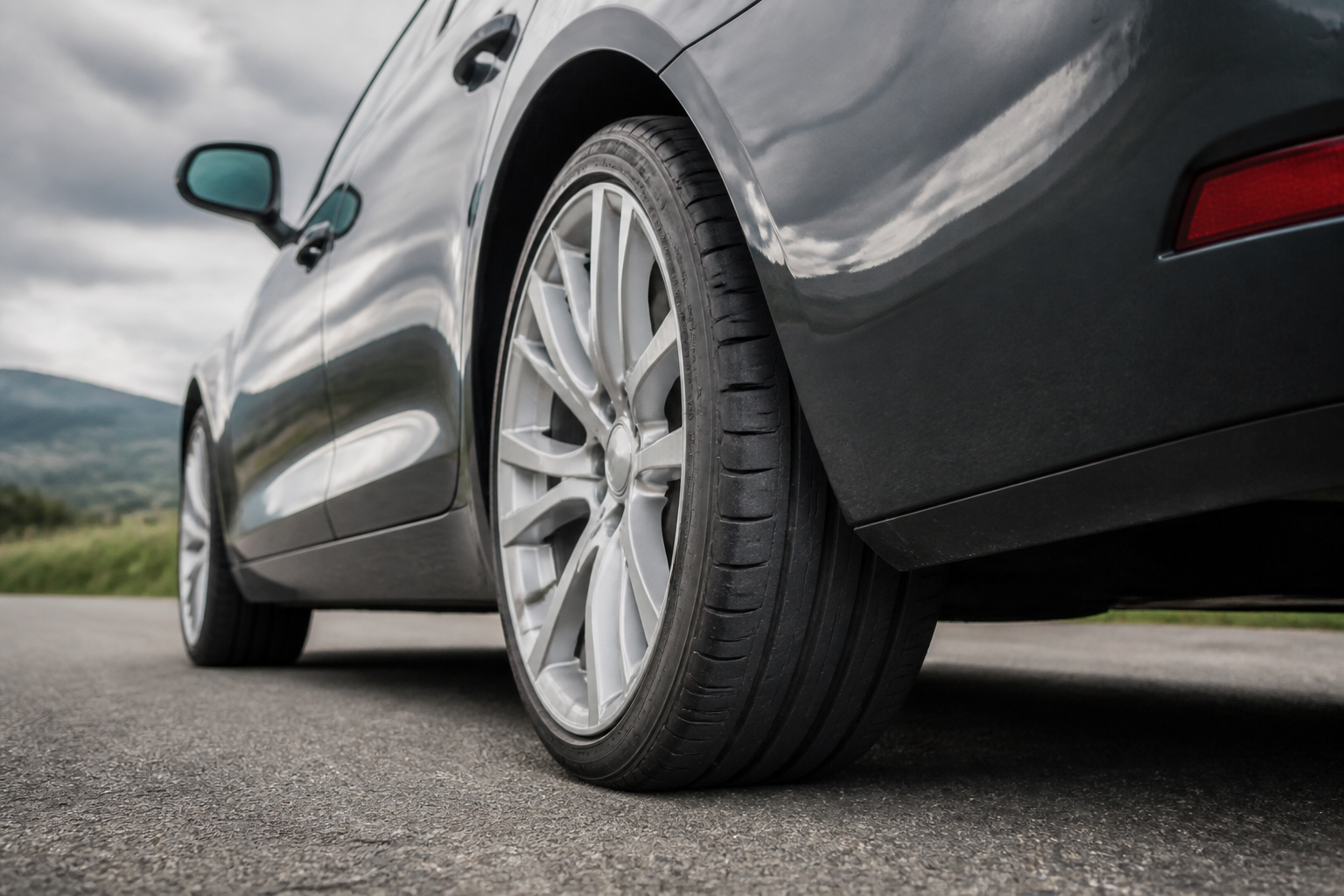
MOExtended tires provide temporary mobility after tire pressure loss, allowing a vehicle to reach a safe location for repair or replacement. They are Mercedes-Benz designed and fitted to Mercedes-Benz wheels, but are not meant to replicate ISO run-flat capabilities in all loads or for extended driving. Use MOExtended to get to a service point rather than for long-distance or high-load driving after a TPMS warning.
3 key takeaways
- MOExtended is a Mercedes-developed temporary-mobility solution meant to help reach a safe place for service after a puncture or pressure loss.
- MOExtended does not guarantee ISO run-flat performance under all loading conditions; it is designed for short-range, controlled mobility.
- Treat MOExtended as a stop-gap to get to repair or replacement, and follow manufacturer guidance for fitment and use on Mercedes wheels.
Mercedes-Benz MOExtended (MOE) Tires: Real-World Temporary Mobility Limits After TPMS Alerts
Mercedes-Benz MOExtended tires, marketed as Mercedes Original Extended (MOE/MOExtended), are a purpose-built response to a common dilemma: what should a driver do after a puncture or rapid pressure loss to move safely to a place where the tire can be serviced? Mercedes-Benz presents MOE as a temporary-mobility solution that preserves vehicle controllability and provides a defined window of driveability after a low-pressure event. This article translates that intent into practical, model-specific guidance, detailing the expected limits on speed, distance, and load, and contrasting MOExtended with genuine ISO run-flat behavior. The aim is to help owners decide when MOExtended is appropriate and how to operate the vehicle safely if a TPMS warning occurs.
MOExtended is not a universal substitute for a true run-flat system. OEM and independent sources describe MOExtended as a temporary-mobility concept rather than a blanket ISO-compliant run-flat across all loads and speeds. Recognizing this distinction is essential: MOExtended extends the mobility window after a pressure loss but does not guarantee the same performance as a dedicated ISO run-flat under every loading condition. Consequently, the practical limits after a puncture depend on vehicle load, tire size, and the specific MOExtended variant fitted by Mercedes-Benz for that model.
What does that mean for on-road behavior after a TPMS alert? MOExtended tires are designed with reinforced sidewalls intended to preserve handling and steering response when air pressure is reduced. They are intended to be fitted on Mercedes-Benz wheels to maintain intended durability and to avoid accelerated wear on incompatible wheel assemblies. The overarching aim is to enable safe, controlled motion to a service location for proper tire repair or replacement, rather than permitting unlimited driving with a compromised tire.
Realistic operating limits after TPMS alerts
Because MOExtended is marketed as a temporary-mobility feature, the guidance you receive is typically expressed in practical, vehicle-specific terms rather than a single universal mile-count. In general terms, MOExtended enables limited movement under reduced pressure, not long-distance travel at highway speeds. The exact figures—distance, speed, and permissible loads—vary by model, tire size, and vehicle configuration, so owners should consult their exact model’s MOExtended guidance in the owner’s manual or Mercedes-Benz technician notes for precise limits.
Owners should expect a conservative envelope: moderate speeds, smooth acceleration and braking, careful steering inputs, and avoidance of strenuous maneuvers. The objective is steady progress to a service location, not sustained highway cruising with a damaged tire. In practice, this translates to reduced speed limits and shorter travel distances after a pressure loss, with a clear emphasis on getting off the road and into professional tire service as soon as feasible.
MOExtended vs ISO run-flat: a practical distinguishment
ISO run-flat tires are designed to maintain operation under specific loads and speeds even when punctured, allowing a longer driving range under defined conditions. MOExtended, by contrast, is a Mercedes-Benz-developed strategy focused on controllable mobility and safe reach to service, but it does not universally replicate ISO-run-flat guarantees across all loads and scenarios. For heavily loaded vehicles or high-speed operation after a puncture, MOExtended may not match the performance of a true ISO run-flat. This distinction matters when planning a trip with a partially inflated tire—MOExtended should not be treated as a permit for extended high-speed travel or long-distance driving after a puncture.
Practical guidance by scenario
- Lightly loaded or single-occupant vehicle: MOExtended can enable a short, careful trip to a nearby service location. Do not interpret this as permission for a long journey on a damaged tire.
- Moderate to heavy load: Reduced pressure effects grow with load. Excess vehicle weight can accelerate tire deformation and alter handling, so plan for the nearest repair facility rather than extended travel.
- High-speed highway driving: If you must operate after a TPMS warning, reduce speed and avoid sustained high-speed travel. MOExtended is not intended to support prolonged highway operation under compromised tire conditions.
Fitment, wheels, and vehicle-specific considerations
MOExtended tires carry an MOE/MOExtended designation on the sidewall, signaling their intended use as Mercedes-original extended-mobility tires. They are described as requiring fitting to Mercedes-Benz wheels to preserve designed component wear and compatibility with the chassis. This vehicle-specific approach highlights the importance of using MOExtended as intended and avoiding substitutions with non-Mercedes wheels or non-standard tires in pursuit of extended reach after a puncture.
Technicians and owners should recognize MOExtended as a Mercedes-developed strategy rather than a cross-brand universal solution. The design aims to balance safe, controllable mobility with the practical need to reach a service point for proper tire repair or replacement, rather than to enable indefinite travel with a damaged tire.
What to do when TPMS warns you
When a TPMS warning activates, safety and getting to service remain the top priorities. Practical steps include: safely reducing speed, performing smooth steering and braking, planning a controlled, well-considered stop if conditions permit, and contacting Mercedes-Benz service or a tire shop for specific MOExtended guidance for your model. Do not treat MOExtended as a guarantee of continued normal driving or as a substitute for prompt tire repair.
Model-dependent caveats and limitations
Because MOExtended is calibrated differently for various platforms, owners should not extrapolate a single distance or speed figure across all models. The MOExtended limits can depend on wheel size, tire dimension, vehicle load, tire pressure at the time of loss, road surface, and ambient temperature. Always verify the exact operating envelope for your vehicle from the owner’s manual or the MOExtended guidance for your exact model year and trim. In some cases, vehicle software or service documentation may include a dedicated MOExtended tooltip or display to indicate allowed travel distance and speed after a low-pressure event.
Fitment notes and sources
Key sources describing MOExtended/mOE behavior emphasize its role as a temporary-mobility concept rather than a universal run-flat substitute. They describe MOExtended as a Mercedes-developed, reinforced-sidewall tire concept intended to help the vehicle remain controllable after pressure loss and to provide a defined window to reach a service location. For readers seeking exact, model-specific limits, consult the owner’s manual and MOExtended guidance for their exact model year, trim, and wheel fitment, since parameters are calibrated per platform.
Primary references include: Mercedes-Original Tires | Mercedes-Benz USA, What Are Mercedes-Benz Original Extended (MOExtended Or MOE) Tires?, and GF40.10-P-1020-01A Tire Designation.
For readers, the practical takeaway remains clear: MOExtended provides a defined, limited path to safety after a TPMS warning, but it is not a universal guarantee of ISO-run-flat performance. Always consult your vehicle’s MOExtended documentation and local Mercedes-Benz service guidance to establish the exact limits for your model, wheel, and load conditions.